MRU's Level II background check and the 24-hour rule
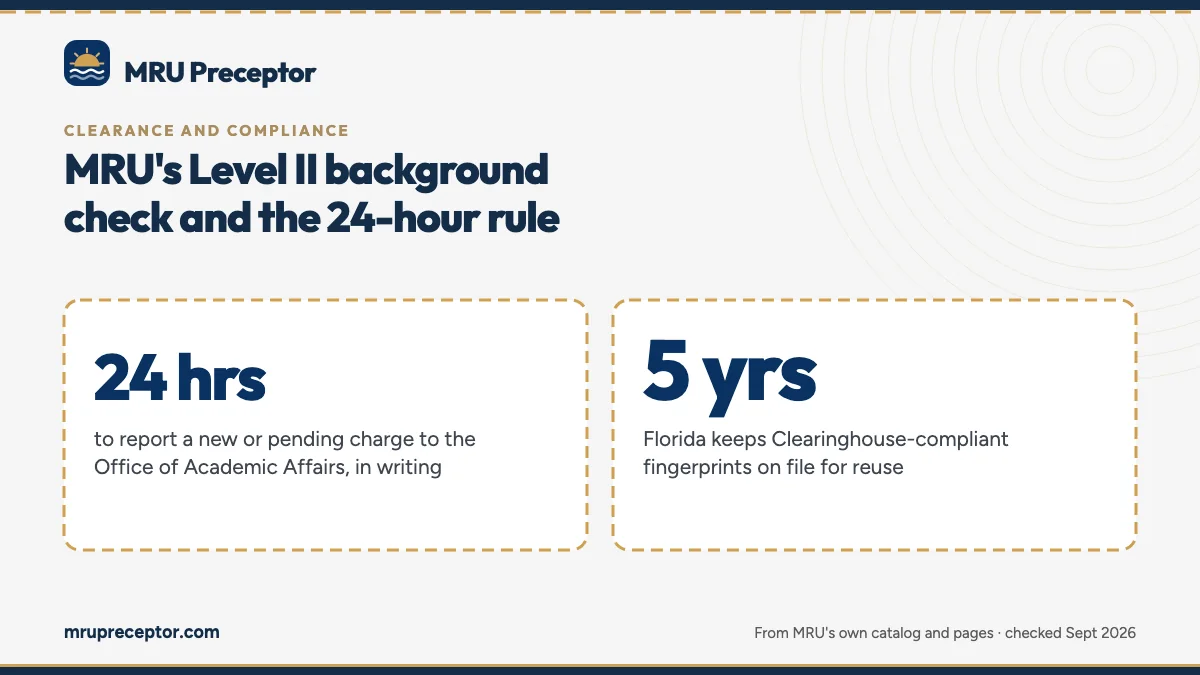
MRU requires a Level II background check with fingerprints for its MSN-FNP, AGACNP, PMHNP and DNP students, separate from the standard clearance bundle. It searches every county you have lived in, national sex-offender and healthcare-fraud records, and your residency history. After that, any change in your record, even a pending charge, must reach the Office of Academic Affairs in writing within 24 hours.
Get your placement plan
Tell us your MRU program and where you live. A placement advisor replies with what an MRU-ready preceptor and site look like for you.
What MRU's Level II check covers
MRU's July 2025 fee tables describe the Level II check in six parts. It sits on its own line, apart from the American Data Bank clearance bundle, and the programs it names are the MSN-FNP, the DNP, and the AGACNP and PMHNP certificates.
- A search of all counties where you have lived
- The national sex offender registry
- A national healthcare fraud and abuse scan
- An identity verification alert
- Your residency history
- Fingerprints
MRU calls the check Level II but does not cite the Florida statute behind the name. If you are in the FNP post-master's certificate, RN-to-BSN or the MSN in Healthcare Systems Leadership, check your own program's fee table and onboarding instructions to confirm which background check applies to you before you order anything.
How Florida law defines Level 2 screening
In Florida, Level 2 screening is set out in chapter 435 of the Florida Statutes. Section 435.04 describes fingerprints submitted electronically to the Florida Department of Law Enforcement for state and national (FBI) criminal history checks, along with local law-enforcement checks and sex-offender registry searches covering the states where you lived in the past five years.
The same section lists disqualifying offenses. They include violent and sexual offenses, abuse or neglect, felony theft and fraud, and drug trafficking. The list is long and specific, so read the statute on the Florida Senate site rather than relying on anyone's summary, this one included.
Florida's screening law for providers licensed by the Agency for Health Care Administration, section 408.809, spells out who must be screened: owners, administrators, financial officers, and employees or contractors who give direct personal care or can reach client funds or living areas. Students are not named in that list. Whether a hospital screens nursing students through the state system is therefore a facility policy rather than something the statute settles.
The Clearinghouse and fingerprint reuse
Since July 1, 2025, most health professions licensed by the Florida Department of Health must have Level 2 screening, according to the department's background screening FAQ. The Agency for Health Care Administration runs the Care Provider Background Screening Clearinghouse, which lets participating agencies share results.
Fingerprints taken by a Clearinghouse-compliant Livescan provider are kept for five years and can be reused within that window. The FAQ does not address students, and MRU does not say whether its Level II prints are taken that way, so do not count on reuse. Ask whoever takes your MRU fingerprints whether the prints are Clearinghouse-compliant.
Fingerprints come up again after graduation. The Florida Board of Nursing requires electronic fingerprinting for APRN applicants, a rule tied to HB 975 from the 2024 session, and it will not approve an application until that step is done. Plan for another set when you apply, using the ORI number the Board specifies.
The 24-hour disclosure rule
MRU's catalog says a background check can happen at the start of your program and again during enrollment. Between checks, the duty to report sits with you. If anything changes in your criminal record, a charge that is still pending included, the Office of Academic Affairs must receive a written disclosure from you within 24 hours.
A day is not long. Write the disclosure the same day, send it from your MRU email so it carries a timestamp, and keep a copy. Mentioning it to a faculty member in passing does not meet a rule that asks for writing.
The catalog also allows MRU to pass background information to externship agencies, and to drop a student if the record rules out or limits an externship placement. Reporting promptly gives the Office of Academic Affairs the chance to weigh your situation before a site hears about it some other way.
The 24-hour clock applies to pending charges too, not only convictions.
When your record could affect placement
MRU does not publish which offenses would stop an externship, and it does not publish an appeal route specific to background results. What it does say is that a record which prevents or restricts placement can lead to being dropped. Much depends on the site, since agencies set their own screening standards and MRU may share results with them.
If something is on your record, deal with it before you line up a preceptor, not after. Ask the Office of Academic Affairs in writing how your situation is handled, and ask early enough that the answer shapes where you look. A preceptor and site you arrange still need MRU approval, and a site can decline you after its own check. Our guide to the secure-your-own-preceptor rule shows where approval fits in the sequence.
Keep copies of any court paperwork showing how a matter was resolved. If a question comes up months later, having the documents ready is faster than requesting them again.
What South Florida sites ask for
Hospitals and health systems run their own checks on top of MRU's. Baptist Health South Florida lists a Level-1 background check for student rotations. Memorial Healthcare System's page for visiting medical students, which is not a nursing page, asks for a Level 2 check with fingerprinting and tri-county checks. Nicklaus Children's Hospital's student portal lists a clinical background check.
Each site decides for itself, and its requirement can be stricter or lighter than MRU's. When a site sends its onboarding list, compare it with what you already completed for MRU and ask whether any piece can be shared rather than repeated. Our guide to South Florida NP preceptors collects what each system publishes, and American Data Bank at MRU covers the rest of school clearance.
Questions MRU students ask
Is MRU's Level II check the same as Florida's Level 2 screening?
MRU uses the term Level II and includes fingerprints, which is the core of Florida's Level 2 screening under section 435.04. MRU does not cite the statute, though, and its package adds items such as a healthcare fraud and abuse scan and an identity verification alert. Treat the two as similar in method rather than officially identical.
Do I have to report a minor offense to MRU?
MRU's wording covers any change in your criminal background, including pending charges, and it does not publish a list of exceptions. Rather than decide for yourself whether something counts, send the Office of Academic Affairs a written note within the 24-hour window and let the office tell you. That keeps you on the right side of the rule either way.
Can a clinical site see my MRU background check?
It can. MRU's catalog says it may release background information to externship agencies, and sites also run their own checks; Baptist Health South Florida, for instance, lists a Level-1 check for student rotations. Assume that a site considering you may learn what MRU's check found, and be ready to explain anything on it.
Will I be fingerprinted again for my Florida APRN license?
Plan on it. The Florida Board of Nursing requires electronic fingerprinting for APRN applicants and will not approve an application until it is done. Prints taken by a Clearinghouse-compliant Livescan provider can be reused for five years, but MRU does not publish whether the prints taken for its Level II check qualify.
Does the Level II check apply to RN-to-BSN students?
MRU's fee tables clearly tie the Level II check to the MSN-FNP, AGACNP, PMHNP and DNP. For RN-to-BSN, read your own program's fee table and onboarding instructions, since MRU lists fees program by program and the catalog's background policy covers nursing students generally. Confirm what you need before your first clinical course.
Related pages
Last checked 2026-09-24
We check these pages against MRU's own catalog, addenda and program pages. The nursing student handbook on the MRU student portal and MRU's Office of Academic Affairs have the final word.
MRU says secure your own preceptor. We start the search now.
Tell us your MRU program, where you live and when your next clinical course starts. We look for preceptors who fit the course and help you gather what MRU checks before approving them.
- Preceptors matched to the course: adult primary care for
MSN5700, women's health, pediatrics, psychiatric or acute care - Credentials, license and site details collected before MRU's credential check
- Miami-Dade, Broward and Palm Beach, or wherever in a SARA state you live
Start your placement plan
Program, city and start date is all we need to begin.