Who can precept an MRU nurse practitioner student
MRU does not publish preceptor qualifications for its NP tracks; the catalog leaves them to the nursing student handbook on the student portal. For a clinical setting in Florida, Florida Administrative Code rule 64B9-4.001(13) sets the baseline: an APRN who is certified and practicing, a physician (MD or DO) or a dentist, licensed in Florida. It sets no minimum years in practice.
Looking for a qualified preceptor?
Tell us your MRU program, course and where you live. We look for preceptors who fit the course; MRU approves.
MSN6400, in one setting under a clinical preceptor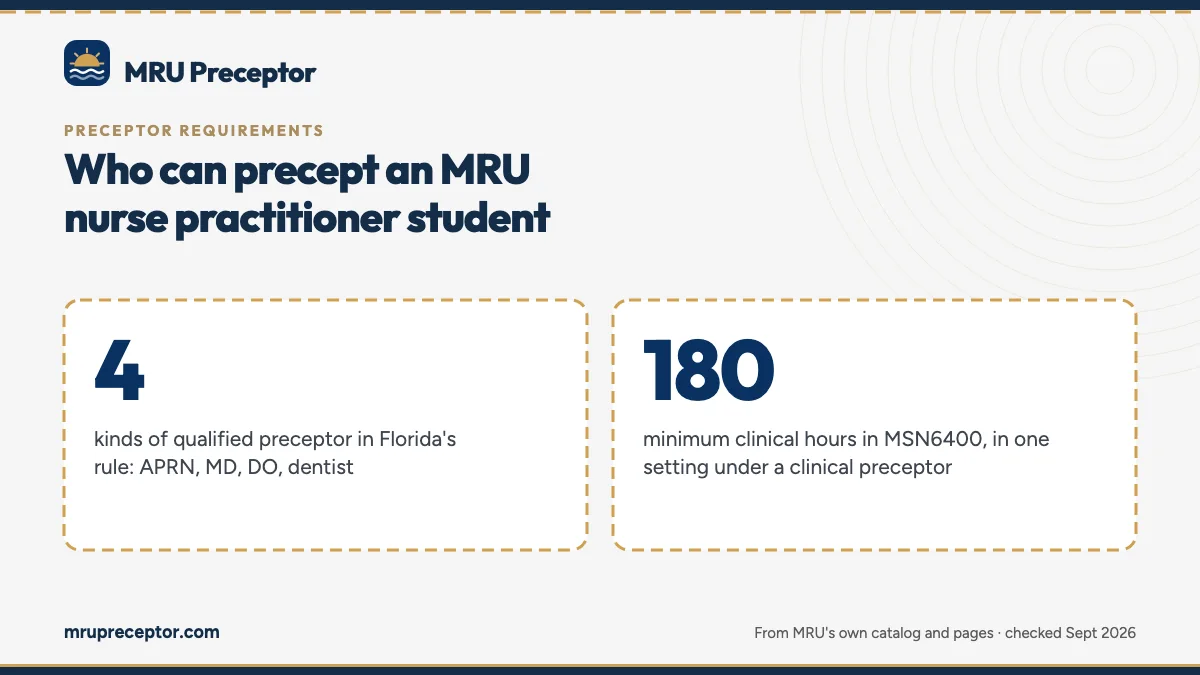
What MRU publishes
For the MSN-FNP and the three post-master's certificates, MRU publishes no preceptor qualifications. No public source states the credential required, a minimum number of years in practice, whether a Florida license or board certification is needed, or any specialty-match rule. The catalog sends students to the handbook each time.
A few course descriptions still help. MSN6400 is done in one clinical setting under a clinical preceptor, with at least 180 clinical hours. PMHNP clinical courses are specialty rotations in psychiatric-mental health, each with a preceptor guiding the student. The leadership MSN names a preceptor type outright, as covered below.
Read the handbook's rule alongside the state rule that applies where your clinical site is. Where both apply, you have to satisfy both.
Florida's rule for clinical settings in Florida
Rule 64B9-4.001(13) of the Florida Administrative Code, in the Board of Nursing's chapter, defines a "Qualified Preceptor" for nurse practitioner students. The official text is published on flrules.org.
What the rule says
- Three groups qualify: certified practicing APRNs, licensed physicians (MD or DO) and licensed doctors of dental medicine.
- The preceptor supervises, teaches and evaluates the NP student in the clinical setting.
- Where the clinical setting is in Florida, the preceptor's license has to be a Florida one, issued under chapter 458 (MD), 459 (DO), 464 (nursing) or 466 (dentistry).
- The student must be an RN licensed under chapter 464.
- No minimum years of experience are set.
A related definition, 64B9-4.001(6), treats clinical experience as practice under a qualified preceptor in actual patient care. Physician assistants are not on the rule's list.
One point is left open. The rule does not spell out whether a multistate Compact RN license issued under s. 464.0095 meets the chapter 464 requirement for the student. If you hold a Compact license from another state and plan clinicals in Florida, ask MRU and check with the Florida Board of Nursing.
Preceptors in other states
Florida's rule covers clinical settings in Florida. If you live in another SARA member state and do your hours there, the preceptor's licensing is governed by that state's rules, not Florida's. That is a reading of the rule's scope, so confirm it with MRU and with the board in the state where you train.
In its catalog, MRU confines its licensure assurance to Florida and asks students elsewhere to consult their own state board first. Its August 2025 NC-SARA licensure disclosure rates the FNP, AGACNP and PMHNP programs "Meets" in every state on its list, and California is absent from that list.
A practical starting point: your preceptor should hold an active license in the state where the clinical site sits, and you should hold an RN license valid there. The out-of-state guide covers the rest.
Matching an FNP preceptor to each course
For FNP students the question is usually fit, not eligibility. Each of the four clinical courses asks for a different patient population.
| Course | Population and setting | Look for |
|---|---|---|
MSN5700 (8 credits) | Adults and older adults in community, clinic or primary-care practice | Adult, geriatric or family primary care |
MSN6050 (5 credits) | Women from menarche to the end of pregnancy | Women's health or obstetric practice |
MSN6150 (5 credits) | Infants to adolescents, with sports physicals depending on the site | Pediatric or family practice seeing many children |
MSN6400 (8 credits) | Across the lifespan in one clinical setting, at least 180 clinical hours | Family practice seeing all ages |
Florida APRNs work either under a physician protocol or, for registered primary-care APRNs, autonomously. The rule does not distinguish between them, and the Florida protocol page explains how each arrangement affects who says yes.
PMHNP, AGACNP and Healthcare Systems Leadership
PMHNP. The 765 clinical hours run through MSN5056C and MSN6057C (180 each) and MSN6065C (405). Of those, 115 must involve children and adolescents and 150 must be psychotherapy, with 500 across the lifespan, so between them your preceptors must see young patients and deliver therapy.
AGACNP. The 810 hours sit in MSN5040C and MSN5041C (225 each) and MSN5042C (360), all acute care with adults from young adulthood to the frail elderly, covering cardiovascular, pulmonary, neurological, endocrine, GI and multisystem problems. Look for preceptors who manage acutely ill adults; the AGACNP courses page has the detail.
Healthcare Systems Leadership. For MSN5855, MRU wants a preceptor who is a nurse, educated to master's level or beyond, in an administration and management role; the course carries 180 practicum hours. This is a leadership track, not an NP one, so MRU's own description is the requirement to work from. The leadership MSN page covers the course.
Questions to settle before you ask anyone
Run through these before the first conversation, not after the preceptor has already said yes.
- Is the clinical site in Florida? If so, does the preceptor hold a Florida license?
- Is the preceptor an APRN with current national certification, or a licensed MD or DO?
- Does the practice see the population your course requires, in enough volume for the hours?
- Can they supervise within your course dates, including the last day for the signed evaluation?
- Does the site require an agreement with MRU before it takes students?
- What does the MRU handbook add for your program?
When the answers line up, the approval stage starts on firm ground. If you would rather have someone else run these checks, how it works explains what a placement advisor does, and MRU still decides.
Questions MRU students ask
Can a physician assistant precept an MRU NP student?
Not for a clinical setting in Florida under the state rule, which lists certified practicing APRNs, MDs, DOs and dentists but not physician assistants. MRU has not published its own list. For a site in another state, check that state's rules and the MRU handbook before approaching a physician assistant.
Does my preceptor need a minimum number of years in practice?
Florida's rule sets no minimum, and MRU publishes none for its NP tracks. The handbook on the student portal may set one, so check it before you ask. A newer clinician who meets the license and certification rules may still be a valid choice.
Does my FNP preceptor have to be a family nurse practitioner?
Neither MRU's public documents nor Florida's rule say so. The rule accepts a certified practicing APRN, MD or DO with a Florida license for Florida sites. What matters most for MRU's courses is that the practice sees the right population, such as children for MSN6150.
Does a preceptor outside Florida need a Florida license?
Only if the clinical setting is in Florida. The rule ties the license requirement to where the clinical setting is, so a preceptor supervising you in another state works under that state's rules. Confirm with MRU, since its catalog tells out-of-state students to check with their own board.
Where can I read the Florida preceptor rule myself?
Rule 64B9-4.001 is published on flrules.org, Florida's official administrative code site, and the Board of Nursing's APRN page on floridasnursing.gov covers licensure. Subsection (13) defines the qualified preceptor and subsection (6) defines clinical experience. Read the current text at those official sources rather than a copy elsewhere.
Related pages
Last checked 2026-09-24
We check these pages against MRU's own catalog, addenda and program pages. The nursing student handbook on the MRU student portal and MRU's Office of Academic Affairs have the final word.
MRU says secure your own preceptor. We start the search now.
Tell us your MRU program, where you live and when your next clinical course starts. We look for preceptors who fit the course and help you gather what MRU checks before approving them.
- Preceptors matched to the course: adult primary care for
MSN5700, women's health, pediatrics, psychiatric or acute care - Credentials, license and site details collected before MRU's credential check
- Miami-Dade, Broward and Palm Beach, or wherever in a SARA state you live
Start your placement plan
Program, city and start date is all we need to begin.