MRU clinicals outside Florida
You can do MRU clinicals in the state where you live, but three sets of rules meet there: MRU's own, your state board's rules on out-of-state programs, and the license rules for you and your preceptor. MRU's licensure table marks its NP programs as meeting requirements in every state it lists, yet its catalog tells you to check with your own board first. Do that before you look for a preceptor.
Get your placement plan
Tell us your MRU program and where you live. A placement advisor replies with what an MRU-ready preceptor and site look like for you.
Two MRU documents, two messages
MRU's NC-SARA Professional Licensure disclosure, reviewed August 21, 2025, marks the FNP, AG-ACNP and PMHNP programs as "Meets" for every jurisdiction it lists: 49 states, the District of Columbia, Puerto Rico and the US Virgin Islands. California is not in the table, and neither are Guam, the Northern Mariana Islands or American Samoa. The PDF points to an online summary page that returned a not-found error when we checked in September 2026.
The catalog is more cautious. It says MRU makes no promise that licensure requirements are met in any state other than Florida, and it sends out-of-state applicants to their own board for an answer first. When the two documents point different ways, act on the cautious one and get your board's view in writing.
The disclosure names MRUCompliance@mru.edu as the contact for questions about it. That is the address to use if you want MRU's position on your state set down on paper.
Your state may regulate MRU's clinicals
Some boards require out-of-state programs to get approval, file notice or register students before any clinical hours happen in their state. Others do not regulate graduate programs at all. A few examples from the boards' own rules:
- New York: the State Education Department says all out-of-state and online nursing programs must be registered or approved before they place students in clinical rotations there, and it treats a placement as physical presence even for SARA schools.
- Arizona: out-of-state APRN programs whose students do clinicals in Arizona must be approved by the Arizona Board of Nursing.
- Alabama: out-of-state prelicensure and advanced practice programs must send the Board a letter of intent at least 15 days before clinical experiences begin.
- Alaska: APRN students in a program based outside the state register individually with the Board for clinical practice.
- Georgia and Kentucky: the boards say they do not approve out-of-state graduate or post-licensure programs for clinical placements.
MRU does not publish which of these steps it has completed in which states. Before you commit to a site, ask MRU whether it can place a student in your state and whether a board filing is needed first.
Where your preceptor must be licensed
Florida's rule is the clearest. Under Board of Nursing rule 64B9-4.001(13), three kinds of clinician can precept an NP student: certified practicing APRNs, physicians (MD or DO) and dentists. For a Florida site, that person needs a Florida license, and the rule does not ask for any minimum number of years in practice.
That rule covers Florida settings, so outside Florida your preceptor's licensing follows the state where you train. States word it differently. Iowa's rule says an ARNP preceptor must be licensed under the laws of the state where they practice. Kansas says an APRN preceptor should hold a Kansas APRN license in the student's role. Vermont accepts an APRN or physician with a Vermont license and says PAs may not precept APRN students. Washington bars preceptors who are relatives or personal friends of the student.
MRU adds its own layer: whoever precepts you must be approved by MRU before the preceptorship starts, and MRU does not publish its preceptor qualifications. Our page on MRU preceptor requirements sets out what is known.
The RN license you need where you train
As an NP student you work on your RN license, so the question is whether that license is valid where the site sits. MRU's NP programs ask for an active RN license without naming a state; the state where you do clinicals decides what it accepts.
Many states accept either their own license or a multistate Compact license. Alabama asks post-licensure students doing clinicals there for an Alabama or multistate license, and Arizona asks the same of APRN students from out-of-state programs. Oklahoma requires an unencumbered license to practice as an RN in Oklahoma. West Virginia wants a West Virginia license if that is your primary state of residence, or a multistate license if you live elsewhere.
A few states exempt RNs licensed elsewhere who are enrolled in advanced programs. Pennsylvania allows unpaid clinical practice by an RN licensed in another jurisdiction who is enrolled in an accredited graduate program, and Virginia exempts RNs licensed in another state for the clinical practice their advanced program requires. If you hold a single-state license and plan to train across a state line, check the rule where the site is.
Health records and clearance from a distance
Two MRU requirements are written around Florida. Immunization proof must come from a Florida-licensed healthcare provider, and MRU Health, the clinic that helps with clinical-site compliance, is on campus in Miami Springs. MRU does not explain how students elsewhere meet the first rule, so ask the Office of Academic Affairs before you repeat shots at home.
The rest of clearance travels better. Background screening, drug testing and document review run through American Data Bank, and MRU's Level II check already searches every county you have lived in. The 15-day deadline for insurance proof applies no matter which state your externship is in.
AGACNP students have one trip to Miami Springs they cannot skip, wherever they live: the on-campus skills and simulation weekend, three days long, in semester I. The catalog ties missing or failing it to course failure, so book travel as soon as the dates are out.
An order of operations for out-of-state students
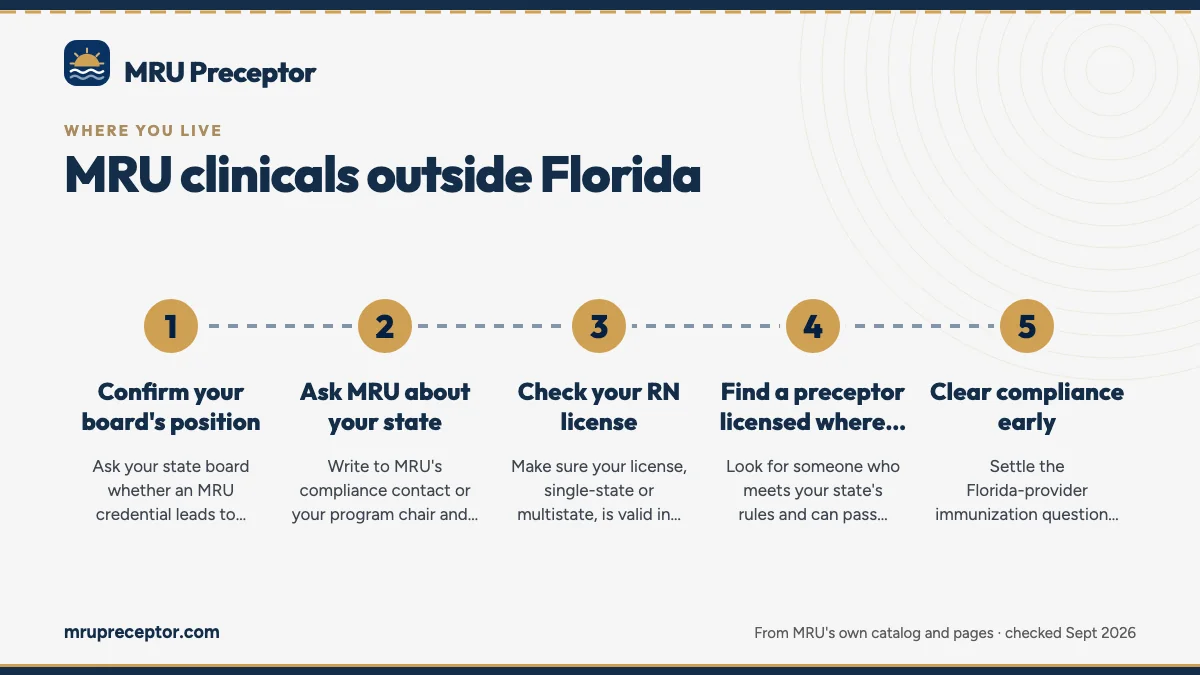
- Confirm your board's positionAsk your state board whether an MRU credential leads to licensure there and whether out-of-state programs must file anything before clinicals. Keep the reply.
- Ask MRU about your stateWrite to MRU's compliance contact or your program chair and ask whether MRU can place students in your state and what it needs from you.
- Check your RN licenseMake sure your license, single-state or multistate, is valid in the state where the site is located.
- Find a preceptor licensed where you trainLook for someone who meets your state's rules and can pass MRU's approval, and collect their details for MRU's credential check.
- Clear compliance earlySettle the Florida-provider immunization question and your liability insurance before the term starts, not during it.
Our guide to the SARA residency rule covers who can enroll from where. If you want help finding a preceptor in your state, contact us with your course and city.
Questions MRU students ask
Can I do my MRU FNP clinicals in my home state?
In principle, yes. You need to live in a SARA member state, and MRU has to approve both your preceptor and your site. MRU's disclosure marks the FNP as meeting requirements in every state it lists, but its catalog tells you to confirm with your home-state board. Check whether your state requires a filing from out-of-state programs before you commit to a site.
Does my preceptor need a Florida license if I live in Georgia?
No. The Florida-license requirement in rule 64B9-4.001(13) applies only to clinical settings inside Florida. If you train in Georgia, Georgia's rules govern your preceptor's license, and MRU must still approve the preceptor. MRU does not publish its own preceptor qualifications, so confirm them before you sign anyone up.
Do I need a Florida RN license to study at MRU from another state?
Not for the MSN-FNP or the certificates as MRU publishes them; they ask for an active RN license without naming a state. What matters for clinicals is whether your license is valid where the site is. The DNP is different: it asks for a Florida license or one from a Nurse Licensure Compact state.
Can I split my clinical hours between Florida and another state?
MRU does not publish a rule against it, but each preceptor needs MRU approval and every hour must be done by the course's last day. A Florida site needs a Florida-licensed preceptor under state rule, while a site elsewhere follows that state's rules. Your RN license must be valid in both places.
Where do I find my state's rules for out-of-state nursing programs?
Your state board of nursing is the authority, and many boards publish a page for out-of-state or distance programs. Our state guides, such as the one for Texas, summarize what each board says, but confirm with the board itself before you rely on any summary.
Related pages
Last checked 2026-09-24
We check these pages against MRU's own catalog, addenda and program pages. The nursing student handbook on the MRU student portal and MRU's Office of Academic Affairs have the final word.
- MRU NC-SARA Professional Licensure disclosure (Aug 2025)
- MRU Catalog Volume X, 2025 (out-of-state licensure statement)
- Florida Administrative Code rule 64B9-4.001 (definitions, qualified preceptor)
- New York State Education Department, RN FAQ (out-of-state programs)
- Arizona State Board of Nursing, APRN clinicals for out-of-state programs
MRU says secure your own preceptor. We start the search now.
Tell us your MRU program, where you live and when your next clinical course starts. We look for preceptors who fit the course and help you gather what MRU checks before approving them.
- Preceptors matched to the course: adult primary care for
MSN5700, women's health, pediatrics, psychiatric or acute care - Credentials, license and site details collected before MRU's credential check
- Miami-Dade, Broward and Palm Beach, or wherever in a SARA state you live
Start your placement plan
Program, city and start date is all we need to begin.