Immunizations and health records for MRU clinicals
MRU wants proof of immunization from a healthcare provider licensed in Florida, a flu shot every year, and the items clinical sites ask for, from TB and hepatitis B to titers, CPR and a physical. You pay the costs. MRU Health, the on-campus clinic, exists to help you meet them, but the Florida-provider rule is a real hurdle for students who live elsewhere.
Get your placement plan
Tell us your MRU program and where you live. A placement advisor replies with what an MRU-ready preceptor and site look like for you.
The rule in MRU's catalog
Three points in the catalog do most of the work. Your immunization proof has to be issued by a healthcare provider who holds a Florida license. The student pays all costs. And every nursing student needs an influenza vaccination each year.
The flu shot rule has an exemption route. MRU allows religious and medical exemptions, but it also warns that declining the vaccine may keep you from clinical participation at affiliate sites. If no accommodation is possible, the catalog says the student is withdrawn, so settle an exemption well before a clinical term rather than the week it starts.
AGACNP certificate students carry one more item from admission onward: current ACLS and BLS certification. Keep copies of both cards with your health records, and note their expiration dates alongside everything else.
What MRU Health checks, and where sites overlap
MRU Health runs out of the third floor of MRU's Miami Springs building. It describes its purpose as helping students meet school and clinical requirements, and it serves students heading into clinicals and preceptorships. Services include immunizations, labs, imaging and physicals, and payment is by card or cash only.
| Item | Where MRU names it | Also on a published site list |
|---|---|---|
| Tuberculosis (TB) | MRU Health list | Baptist (TB screening); Nicklaus (PPD or chest X-ray) |
| Influenza | Catalog: every year, for every nursing student | Baptist; Nicklaus (vaccine or masking in flu season) |
| Hepatitis B | MRU Health list | Not on either list |
| MMR | MRU Health list | Baptist |
| Varicella | MRU Health list | Baptist |
| Tdap | MRU Health list | Not on either list |
| Titers | MRU Health list | Not on either list |
| CPR or BLS | MRU Health list (CPR); AGACNP admission (ACLS and BLS) | Baptist (BLS); Nicklaus (CPR) |
| Physical | MRU Health list | Not on either list |
| Drug screen | MRU Health list; catalog screening policy | Baptist (10-panel); Nicklaus (cleared drug test) |
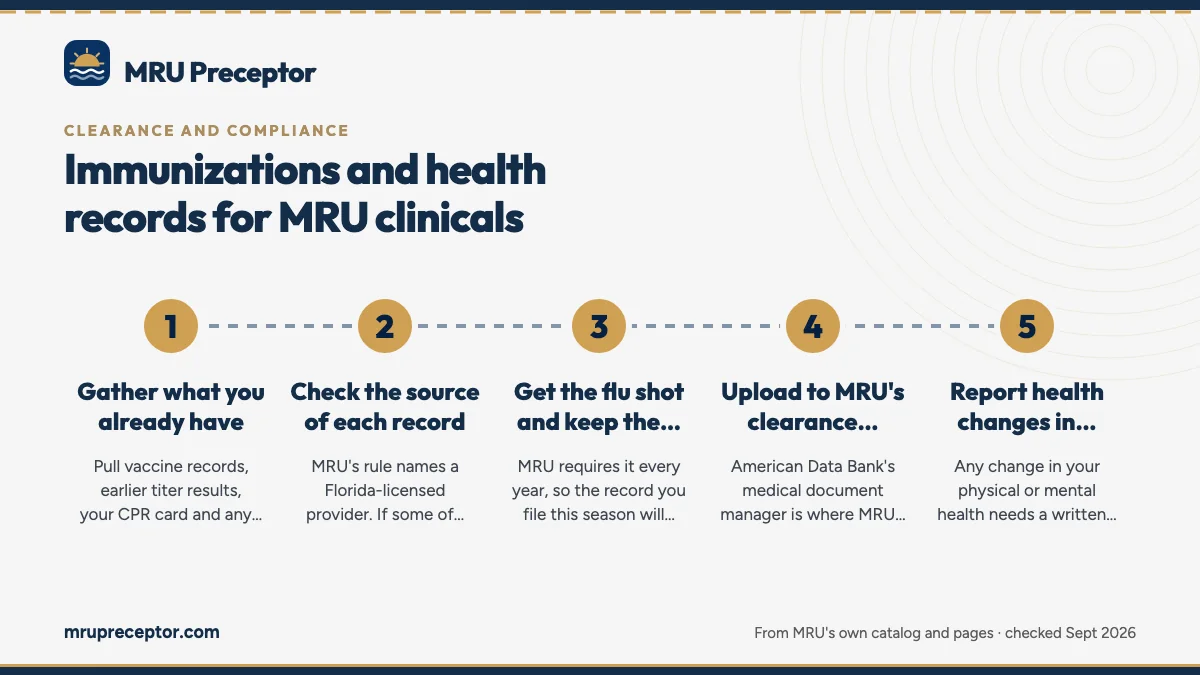
Building your record, step by step
- Gather what you already havePull vaccine records, earlier titer results, your CPR card and any recent physical before you book anything. Records you already hold may cover several items at once.
- Check the source of each recordMRU's rule names a Florida-licensed provider. If some of your records come from another state, ask MRU how they will be treated before you repeat a shot or a titer.
- Get the flu shot and keep the dated proofMRU requires it every year, so the record you file this season will need replacing next season.
- Upload to MRU's clearance platformAmerican Data Bank's medical document manager is where MRU collects health documents. Confirm each item shows as accepted after you upload it. See American Data Bank at MRU for the rest of the clearance file.
- Report health changes in writingAny change in your physical or mental health needs a written disclosure to the Office of Academic Affairs within 24 hours, or before you next enter an affiliate agency.
The Florida-provider hurdle for out-of-state students
Online students may live in any SARA member state, yet the catalog asks for immunization proof from a Florida-licensed provider. MRU does not explain how a student in Georgia or Ohio is expected to meet that. It is a practical gap MRU has not addressed in public.
Before you pay for new shots or titers at home, put three questions to the Office of Academic Affairs in writing. Is a record from a provider licensed in your state acceptable? Can a Florida-licensed provider review and confirm records you already have? Or do you need to be seen in Florida? Keep the answer with your clearance file.
If a trip to Miami Springs turns out to be the only route, MRU Health can handle immunizations, labs and a physical on campus, so plan the visit to cover as much as possible at once. AGACNP students already travel for the required on-campus skills weekend in the first semester, which may be a sensible time to do it. The same where-you-live question comes up again for your preceptor and your RN license; see clinicals outside Florida.
When a site's list differs from MRU's
Hospitals keep their own health requirements, and they do not always match MRU's. The table above shows the overlap for two published lists, but every site you approach may ask for something slightly different, and some want documents in their own system as well as MRU's.
Watch for places where a site looks more relaxed than MRU. Nicklaus Children's Hospital's page allows masking during flu season instead of the flu vaccine. MRU's own rule still requires the annual shot unless you have an approved exemption, so a site's alternative does not release you from the school's requirement.
Timing is the other difference. Baptist Health South Florida wants each student's profile in no later than 10 business days before the rotation begins, so your health documents need to be finished well ahead of your first shift. For how the larger systems handle students more generally, see our guide to South Florida NP preceptors.
Keeping records current across the program
Your health record needs upkeep for as long as you are in clinical courses. The flu shot renews every year, CPR and BLS cards expire, and MRU can order repeat and random drug screens during enrollment.
A simple habit helps. At the start of each term, open your clearance account, note every expiration date that falls before the course's last day, and renew anything that would lapse mid-course. A lapse in the middle of a term could interrupt your time at the site while you fix it, and every clinical hour still has to be done by the course's final day.
If a lapse has already cost you shifts, read behind on clinical hours for how to recover time before the course ends.
Questions MRU students ask
Can I use vaccine records from my doctor in another state?
MRU's catalog says immunization proof must come from a healthcare provider licensed in Florida, and MRU does not publish an out-of-state alternative. Ask the Office of Academic Affairs in writing whether your records are acceptable before paying for repeats, and keep the written answer in your clearance file in case the question comes up again.
Can I refuse the flu vaccine as an MRU nursing student?
MRU allows religious and medical exemptions to the annual flu shot. It also says declining may block clinical participation at affiliate sites, and a student who cannot be accommodated is withdrawn. Start an exemption request early, and ask how a site you are considering handles unvaccinated students before you commit to it.
How do I pay at MRU Health?
MRU Health lists card or cash as its payment methods, and the catalog says students pay all costs of immunizations. Ask about the charge for each item when you book. If you already see a provider licensed in Florida, compare the two before deciding where to go, and make sure either one gives you records you can upload.
Which titers does MRU require?
MRU Health lists titers among the clinical-site items it checks, but MRU does not publish which titers it requires or what result counts. Hepatitis B, MMR and varicella all appear on MRU Health's list, so those are the ones to ask about first. Confirm the exact list in your clearance instructions or the student handbook.
Do I have to report a health change during a clinical course?
Yes. MRU wants the change reported to the Office of Academic Affairs in writing, within a day of it happening or before you go back into an affiliate agency. Report it in writing even if you expect to keep attending your site, and keep a copy of what you sent.
Related pages
Last checked 2026-09-24
We check these pages against MRU's own catalog, addenda and program pages. The nursing student handbook on the MRU student portal and MRU's Office of Academic Affairs have the final word.
MRU says secure your own preceptor. We start the search now.
Tell us your MRU program, where you live and when your next clinical course starts. We look for preceptors who fit the course and help you gather what MRU checks before approving them.
- Preceptors matched to the course: adult primary care for
MSN5700, women's health, pediatrics, psychiatric or acute care - Credentials, license and site details collected before MRU's credential check
- Miami-Dade, Broward and Palm Beach, or wherever in a SARA state you live
Start your placement plan
Program, city and start date is all we need to begin.