Can't find a preceptor for your MRU clinical course
With no preceptor yet, you still have three moves: widen your own search, get help with it, or ask MRU to appoint one for the Practicum Affiliation Fee. What you cannot do is start hours before MRU approves someone, so your real deadline lands well before the first day of class.
Get your placement plan
Tell us your MRU program and where you live. A placement advisor replies with what an MRU-ready preceptor and site look like for you.
Your real deadline is earlier than day one
MRU wants the preceptor approved before the preceptorship begins, and it counts a practicum hour only when it is done with a University-approved preceptor. Add the other gates and the calendar tightens: MRU must hold your insurance proof no later than 15 days before the externship, clearance through American Data Bank has to be complete, and MRU does not publish how long preceptor approval takes.
Work backward from your start date. Spring 2027 begins on January 4, so if your externship starts that week, the 15-day insurance rule puts your proof of coverage due around December 20, 2026 by our count. A preceptor who agrees in late December leaves almost no room for MRU's review.
If your course comes later, the same arithmetic applies; the academic calendar page has every semester's dates.
Why searches stall
Most dead ends have ordinary causes, and most of them can be fixed.
- Asking only hospitals, where rotations depend on a school affiliation agreement rather than one willing NP
- Asking preceptors whose patients do not match the course, such as an adult-only clinic for
MSN6150pediatrics - Finding a preceptor who can give some weeks but not the full hours before the course's last day
- A willing clinician whose practice owner or supervising physician has not agreed
- A search radius smaller than the drive you could actually manage
- Asking one practice at a time and waiting a week for each answer
If three or more of these describe your search, the fix is usually a wider list rather than more calls to the same places. A fresh list built around the course, not around the places you already know, often turns up options you had not considered.
Ways to widen the search
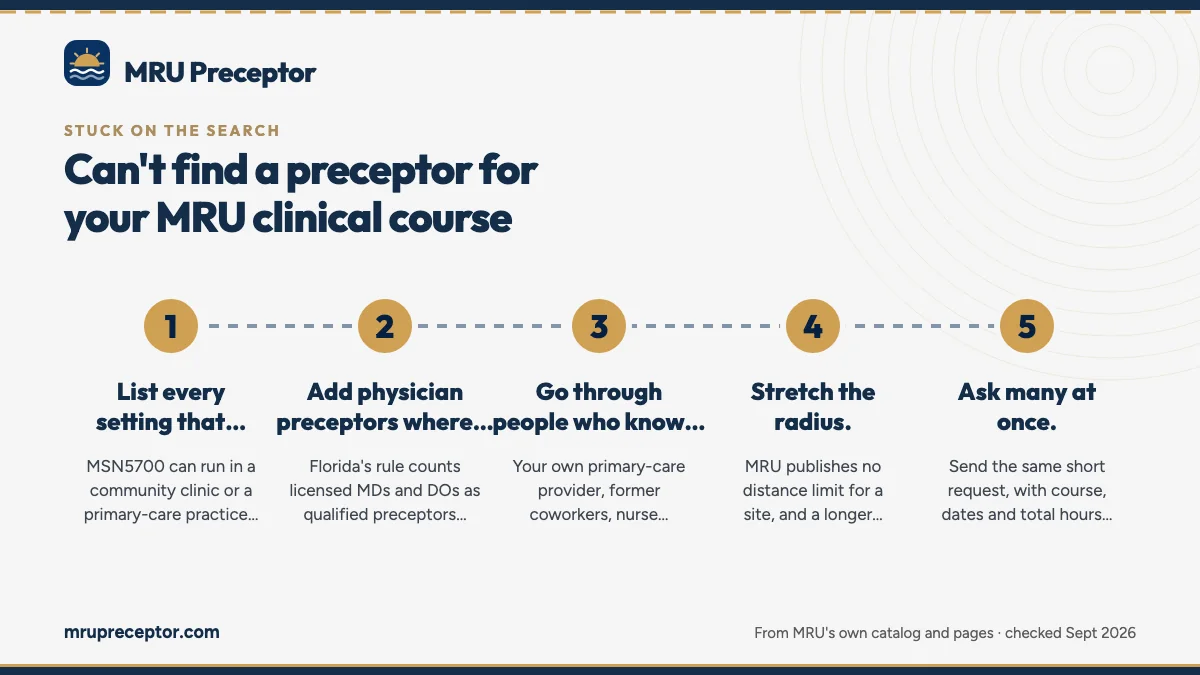
- List every setting that fits the course.
MSN5700can run in a community clinic or a primary-care practice;MSN6050needs women's health; the PMHNP courses need psychiatric settings that include children, adolescents and psychotherapy. Write down every kind of site that fits before you pick up the phone. - Add physician preceptors where MRU allows them. Florida's rule counts licensed MDs and DOs as qualified preceptors. Check your handbook to see whether MRU accepts them for your course.
- Go through people who know you. Your own primary-care provider, former coworkers, nurse managers and NPs you have worked beside are warmer leads than cold calls.
- Stretch the radius. MRU publishes no distance limit for a site, and a longer drive for one semester may cost you less than a delayed course.
- Ask many at once. Send the same short request, with course, dates and total hours, to a batch of practices in the same week.
- Have the packet ready. When someone says yes, their credentials, license and site details should reach MRU within days, not weeks.
One caution: MRU does not publish whether a course's hours can be split between preceptors, and MSN6400 is described as one clinical setting, so do not plan on splitting without asking.
The route MRU offers
MRU's catalog gives students who do not provide a preceptor a way through: MRU appoints one, charging the one-time Practicum Affiliation Fee for it. For a student who has run out of contacts, that is a legitimate option, not a failure.
Before relying on it, ask the Office of Academic Affairs (or your program's approver) how late you can request an appointment, how MRU chooses the preceptor and site, and what the fee is for your program. None of that is public. The route comparison sets MRU's appointment next to finding your own, with the trade-offs of each. If you take MRU's route, make the request through your MRU email and keep the reply with your records.
If the semester starts without a preceptor
MRU does not offer a leave of absence, so you cannot pause the program while you search. What you can do depends on the date.
- During add/drop week: dropping in week one removes the course charges; once add/drop closes, the semester's tuition is fully earned.
- Before the course's 50% point: a withdrawal is a W, which counts toward completion rate and maximum timeframe but not GPA.
- After the 50% point: a withdrawal becomes a WF, which counts in GPA and as a failure.
- Leaving all courses: the Office of Academic Affairs processes your withdrawal, and coming back means a re-entry application through Admissions; 14 consecutive days of unexcused absence from every course also triggers withdrawal.
MRU treats a pair of Ws in one course as a failure, so a W still carries weight. An Incomplete does not help here either, because MRU grants one only when at least 80% of the course is done. Talk to your program advisor or associate dean before you act; the no-leave-of-absence page has the details.
Never log hours with a preceptor MRU has not approved. They do not count, and misrepresented hours can mean course failure and possible dismissal.
How we help a stalled search
We pick up where your list ran out. A placement advisor searches in person near where you live for a preceptor and site that fit the specific course, checks license and specialty before introducing anyone, and helps you assemble what MRU reviews. MRU gives the final approval and sets what follows from it; from us you get a thorough search and a plain account of where it stands at every step.
If the timeline is too short to be realistic, we say so, so you can weigh MRU's appointment or a W while those options are still open. If the course starts within weeks, read the fast-track guide next. Otherwise, send your program, course and city through the contact page and a placement advisor will reply with what a search for that course would involve.
Questions MRU students ask
Can I start clinical hours while MRU reviews my preceptor?
No. Under MRU's catalog, approval has to come before the preceptorship does, and only hours done with a University-approved preceptor count. Hours logged during the review would not meet that rule, and recording them anyway risks the integrity penalties MRU attaches to misrepresented hours.
Does MRU keep a list of preceptors I can contact?
No public list exists. MRU publishes no list of clinical sites, partner practices or affiliation agreements, and the only matching it describes is the paid appointment route. If you want MRU to find the preceptor, ask the Office of Academic Affairs about an appointment rather than waiting for a list to appear.
Can MRU move my clinical course to next semester?
MRU does not publish a deferral option for a clinical course, and it has no leave of absence. The tools it describes are dropping during add/drop, withdrawing with a W before the course's midpoint, and re-entry through Admissions if you leave entirely. Ask your program chair or advisor how each would affect your course sequence.
Should I accept a preceptor outside my course's specialty just to get started?
Only if MRU would approve that preceptor for that course, which makes it a risky shortcut. Each MRU clinical course names its population, and failing any component, including the preceptorship, means an F for the whole course. A mismatched preceptor can also leave you short of the hours the course actually needs.
Is it too late to look for a preceptor for next semester?
Usually not, if you start now. MRU publishes no deadline for naming a preceptor, only the rules around it: approval before any hours, insurance proof 15 days out and the registration window. The earlier you begin, the more of the search happens before those dates, and the more room MRU has for its review.
Related pages
Last checked 2026-09-24
We check these pages against MRU's own catalog, addenda and program pages. The nursing student handbook on the MRU student portal and MRU's Office of Academic Affairs have the final word.
MRU says secure your own preceptor. We start the search now.
Tell us your MRU program, where you live and when your next clinical course starts. We look for preceptors who fit the course and help you gather what MRU checks before approving them.
- Preceptors matched to the course: adult primary care for
MSN5700, women's health, pediatrics, psychiatric or acute care - Credentials, license and site details collected before MRU's credential check
- Miami-Dade, Broward and Palm Beach, or wherever in a SARA state you live
Start your placement plan
Program, city and start date is all we need to begin.