MRU's FNP post-master's certificate: clinical courses and preceptors
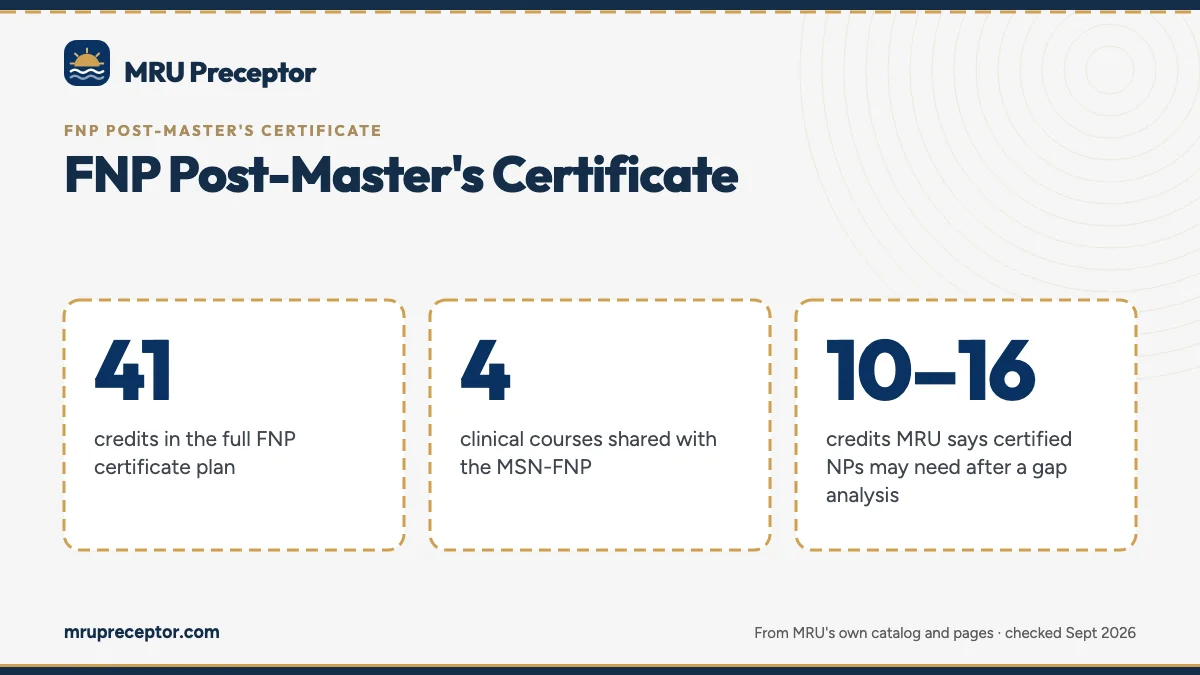
The FNP Post-Master's Certificate is MRU's route into family practice for nurses who already hold an MSN. The full plan is 41 credits and uses the same four clinical courses as the MSN-FNP, under the same rule: you secure your own preceptor, and the Office of Academic Affairs approves that person before the preceptorship begins. Nurse practitioners who are already certified may take a shorter plan after a gap analysis.
Get your placement plan
Tell us your MRU program and where you live. A placement advisor replies with what an MRU-ready preceptor and site look like for you.
What the certificate is
It is a Post-Master's Certificate, not a second degree. The catalog prints 41 credits and 1,140 total clock hours, spread over four semesters, with a stated length of 4 to 18 months. Delivery is onsite in Miami Springs and online, the same two options the MSN-FNP offers.
The 1,140 figure mixes lecture, lab and clinical time, so do not quote it to a site as your clinical total. If you want the MSN version of this track instead, the MSN-FNP page covers it.
What MRU asks for at admission
- A Master of Science in Nursing
- Graduation from a programmatically accredited nursing program
- An active RN license
- Residence in Florida or a SARA member state for the whole program
- A gap analysis of your previous graduate coursework
The clinical courses
The certificate's clinical work runs through the four FNP courses below. MRU's catalog lists their prerequisites alongside the course descriptions, and the order holds: primary care first, then women's health and pediatrics, then the integration course.
| Course | Who you see | Credits | Total clock hours |
|---|---|---|---|
MSN5700 Advanced Practice in Primary Care | Adult and geriatric patients in community, clinic or primary-care settings | 8 | 270 |
MSN6050 Women's Health | Menarche through the end of pregnancy | 5 | 165 |
MSN6150 Pediatrics | Infant to adolescent; sports physicals at some sites | 5 | 165 |
MSN6400 Role Development in Family Practice: Clinical Integration | The whole lifespan, in a single clinical setting | 8 | 300 |
MRU publishes no clinical-hour total for this certificate. Applying its conversion of 45 clinical hours per credit to the credits and clock hours above gives roughly 765 clinical hours if you take all four courses; that is our calculation, explained on the FNP clinical hours page. MSN6400's own description sets a floor of 180 clinical hours.
The gap analysis for certified nurse practitioners
If you already hold NP certification, MRU reviews your transcript against the FNP curriculum. The catalog lists the certifications it considers: AG-ACNP, AG-PCNP, PNP-PC, ACNP and adult NP. After the review, MRU says you "may only need" 10 to 16 credits.
The catalog then prints a plan for currently certified NPs that still lists all four clinical courses, at 26 credits and 900 hours. Those two statements do not line up, and MRU does not explain the difference publicly. Ask your program chair which courses your own analysis leaves you, and keep that answer in writing.
The result decides your preceptor search. An adult-gerontology NP adding the family role, for example, may find the pediatric and women's health courses are where the work lies, which means looking for a preceptor who sees children for MSN6150 and one who sees women through pregnancy for MSN6050. Your analysis, not this example, is what counts.
Who finds the preceptor, who approves it, and what MRU charges
The FNP-PMC section of the catalog carries the same sentence as the MSN: "Students are required to secure their own preceptor." The Office of Academic Affairs must approve your preceptor before the preceptorship begins. A student who does not bring one is appointed a preceptor by the University for an additional fee.
Here the fee documents do not match each other. The FNP-PMC fee table on MRU's web page and in the July 2025 Bursar addendum shows no Practicum Affiliation Fee, no Practicum Credentialing Fee, no clinical clearance line and no Typhon line, even though the catalog still says an appointed preceptor comes with a fee. Before you choose, ask the Office of Academic Affairs how that fee applies to certificate students. Our Practicum Affiliation Fee page explains the fee as it appears for the MSN.
The own-preceptor paragraph is not on the public FNP-PMC web page either. It appears in the catalog and in MRU's October 2025 international FNP-PMC program sheet. The details of approval (forms, timing, what MRU verifies) are in the nursing student handbook on the student portal, not on the public site; our credentialing page covers what to collect from your preceptor so the check moves quickly.
Preceptor fit, supervision and records
MRU has not published its own preceptor qualifications for FNP students. If your site is in Florida, the Board of Nursing's qualified-preceptor rule, 64B9-4.001(13), lets a certified practicing APRN or a licensed MD, DO or dentist precept you, and it requires a Florida license for a Florida clinical setting. In another state, that state's rules govern who may precept.
Indirect clinical supervision in MRU's post-master's certificates is capped at one supervisor to eight students. The catalog's documentation rules apply to certificate students too: hours finished with a University-approved preceptor, logs, case lists and an evaluation signed by the preceptor, the clinical instructor and you, all by the course's last day.
Which tracking system the certificate uses is not stated; the MSN-FNP names Typhon, but the FNP-PMC fee table names none. Your first clinical syllabus should tell you. The same goes for clearance: the catalog's background, drug-screen, immunization and insurance rules apply to nursing students generally, so ask which clearance account to open. The American Data Bank page covers MRU's usual vendor.
Liability insurance proof is due at least 15 days before the externship starts. Late proof can see the course dropped from your schedule.
Where you live, and accreditation
The residence rule is the same as for the MSN: Florida or a SARA member state for the duration of the certificate. California is not a SARA member and does not appear in MRU's licensure table. MRU's catalog also says it does not promise licensure requirements are met outside Florida, so check with your own board before enrolling; the out-of-state clinicals page explains the practical side.
ACEN accredits MRU's master's and post-master's certificate programs, and ACEN's record lists the FNP post-master's certificate among the approved options. MRU holds institutional accreditation from SACSCOC.
Why certificate students choose us
A certificate student's need can be narrow: one or two courses left after the gap analysis, and a specialty they have not practiced in. We look for a preceptor who sees the patients those courses require, near you, and help you assemble the preceptor and site details MRU will check. MRU makes the approval call, and we make sure the preceptor details it sees are complete and matched to your remaining courses. Send us your remaining courses through the form below.
Questions MRU students ask
How long does MRU's FNP post-master's certificate take?
The catalog gives 4 to 18 months across four semesters for the full 41-credit plan. Where you land in that range depends on your gap analysis: a certified NP who needs only a few courses finishes faster than a non-certified MSN nurse taking everything. Clinical courses still run in their fixed order, so a late preceptor approval can push the end date.
Does MRU charge the Practicum Affiliation Fee on the FNP certificate?
The public documents disagree. The catalog says certificate students without a preceptor are appointed one for an additional fee, but the FNP-PMC fee table does not list the Practicum Affiliation Fee. Ask the Office of Academic Affairs or your program chair directly before deciding whether to bring your own preceptor or let MRU assign one.
I'm already certified as an adult-gerontology NP. Will I repeat MSN5700?
Possibly not. MRU says certified NPs, including AG-ACNP, AG-PCNP and adult NPs, may only need 10 to 16 credits after a gap analysis. The plan printed for certified NPs still shows all four clinical courses, though, so only your individual analysis settles whether adult primary care is on your list.
Can I do the FNP certificate outside Florida?
Yes, if you live in a SARA member state for the whole certificate; California residents are excluded. Your preceptor must meet the rules of the state where your clinical site sits, and MRU still has to approve them. Check early with your home board of nursing, since MRU confirms licensure requirements only for Florida.
Which system do FNP certificate students log hours in?
MRU does not say publicly. Typhon is named in the MSN-FNP fee table, but the FNP-PMC fee table names no tracking system. Your clinical course syllabus or instructor will tell you, and whichever system it is, logs, case lists and the three-signature evaluation are due by the course's last day.
Related pages
Last checked 2026-09-24
We check these pages against MRU's own catalog, addenda and program pages. The nursing student handbook on the MRU student portal and MRU's Office of Academic Affairs have the final word.
MRU says secure your own preceptor. We start the search now.
Tell us your MRU program, where you live and when your next clinical course starts. We look for preceptors who fit the course and help you gather what MRU checks before approving them.
- Preceptors matched to the course: adult primary care for
MSN5700, women's health, pediatrics, psychiatric or acute care - Credentials, license and site details collected before MRU's credential check
- Miami-Dade, Broward and Palm Beach, or wherever in a SARA state you live
Start your placement plan
Program, city and start date is all we need to begin.