MSN6150 Pediatrics at MRU: patients, hours and preceptors
MSN6150 Advanced Practice in Primary Care – Pediatrics covers patients from infancy through adolescence, with sports physicals depending on the site. The catalog gives it 5 credits and 165 total clock hours. MRU prints no clinical-hour figure for it; our calculation from MRU's credit rule is 135.
Get your placement plan
Tell us your MRU program and where you live. A placement advisor replies with what an MRU-ready preceptor and site look like for you.
MSN6150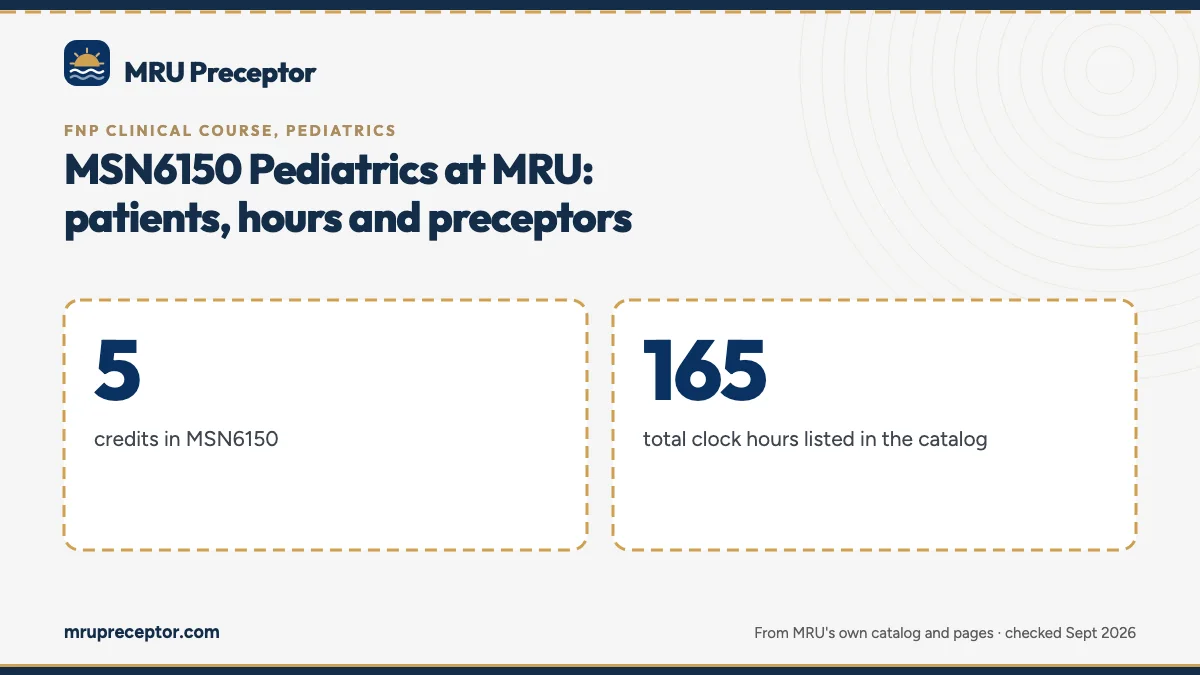
MSN6150 in MRU's catalog
Pediatrics is the second 5-credit primary-care course in MRU's MSN-FNP, and it shares its prerequisites with women's health: everything needed for MSN5700, then MSN5600 and MSN5700 themselves. The catalog's 165 clock hours count lecture and clinical time as one total.
Full-time students take it in semester IV with MSN6050. Part-time students take it in semester VI or VII, since that plan spreads the four clinical courses one per semester from V to VIII. FNP Post-Master's Certificate students take it too, unless a gap analysis says otherwise.
| Item | Detail |
|---|---|
| Title | Advanced Practice in Primary Care – Pediatrics |
| Credits | 5 |
| Total clock hours | 165 |
| Patients | Infant to adolescent |
| Named activity | Sports physicals, depending on the site |
| Clinical hours | Not published; 135 by our calculation |
| Preceptor approval | Office of Academic Affairs, before the preceptorship starts |
The clinical-hour question
MRU converts credits at 45 clinical hours or 15 lecture hours apiece. Five credits and 165 total hours resolve into 2 lecture credits plus 3 clinical credits, which is 135 clinical hours. That number is our calculation, labeled as such, until your syllabus confirms or corrects it.
Why it matters: preceptors plan their clinic weeks around a target, and a pediatric office that agrees to 165 hours has agreed to 30 more than the arithmetic suggests you need. Quote the syllabus figure when you ask, and keep your own running total in Typhon so there is no surprise near the course's last day.
If your preceptor works only certain days, count backwards from the course's last day. Every hour, log and case list, plus an end-of-course evaluation signed by the preceptor, the clinical instructor and you, has to be in by then or the course fails. The four FNP courses are compared side by side on the FNP clinical hours page.
The patients: infant to adolescent
The catalog's age range runs from infancy to adolescence, and it names sports physicals as something you may do depending on where you are placed. It does not specify an age mix or a list of visit types. Any required spread across babies, school-age children and teenagers would be set in the syllabus.
A practice that sees mostly teenagers, or mostly newborns, can leave gaps in that spread. Before you commit, ask the preceptor which ages fill a typical clinic day.
Places that can fit the course
- A general pediatrics office
- A family practice with a large pediatric panel, if your faculty agree it fits
- A community health center that sees children and adolescents
- A pediatric urgent care, only after you have asked, since the course is framed as primary care
Who can precept pediatrics
For a Florida site, rule 64B9-4.001(13) accepts a certified practicing APRN or a licensed MD or DO, and requires a Florida license. A pediatric NP, a family NP with a busy pediatric schedule or a pediatrician can all meet that. The rule does not sort preceptors by specialty and sets no minimum years in practice.
Florida's autonomous-practice statute lists general pediatrics among the primary-care fields where a registered APRN can practice without a physician protocol. Autonomy is not a condition for precepting, though: a protocol APRN qualifies under the same rule. Florida protocol and autonomous practice has the details.
MRU's own qualification rules, if it sets any beyond the state's, are in the nursing student handbook on the portal rather than on mru.edu.
Children's hospitals and health systems in South Florida
The health systems that publish student policies add a school-level step before any preceptor question. Nicklaus Children's Hospital's nursing-student page covers NP students and says they must be enrolled at an affiliated institution, have their school's approval, and secure a preceptor before submitting requirements. Confirm whether MRU is one of its affiliated institutions before you plan around Nicklaus.
Jackson and Baptist also require a school agreement before any rotation, and Baptist takes requests only through Complio. If a hospital-based pediatric clinic is your plan, ask the Office of Academic Affairs about agreements before you ask the clinician. South Florida NP preceptors goes through each system's published rules.
Securing a willing pediatrician does not clear a hospital's affiliation step. Check the system's school requirement first, then the preceptor.
Clearance before you see children
MRU's clearance rules apply to every clinical course, pediatrics included. Proof of immunization has to come from a healthcare provider licensed in Florida, and every nursing student needs a flu shot each year; declining it can keep you out of affiliate sites.
MRU Health, the on-campus clinic on the third floor, checks the items sites ask for: TB, influenza, hepatitis B, MMR, varicella, Tdap, titers, CPR, a physical and a drug screen. American Data Bank handles the background check, drug screening and document clearance for the MSN-FNP, and there is a separate Level II background check with fingerprints. Proof of individual liability insurance is due at least 15 days before the externship starts. The immunization and health records page covers the out-of-state hurdle.
Questions MRU students ask
Does MSN6150 require sports physicals?
The catalog says the course includes sports physicals depending on the site, which ties them to where you are placed rather than making them a fixed quota. It sets no number. If your syllabus does ask for them, choose a practice that performs pre-participation exams, and check with your faculty before the term if your site does not.
Can a family nurse practitioner precept MSN6150?
Florida's rule does not restrict preceptors by specialty: a certified practicing APRN with a Florida license qualifies, as does a Florida-licensed MD or DO. An FNP who sees plenty of children meets the rule. MRU publishes no specialty-match requirement, so confirm with the Office of Academic Affairs that a family practice suits this course.
Could one family practice host both pediatrics and women's health?
Possibly, if its schedule really covers both populations. MRU does not publish a rule on one preceptor or one site covering two courses in the same term, so ask before you build your semester around it. If it is allowed, log each encounter to the right course in Typhon and collect a separate evaluation for each.
What immunizations does a pediatric clinical need?
MRU's list is the same for every clinical: immunization proof from a Florida-licensed provider, a yearly flu shot, and the items MRU Health checks, including TB, hepatitis B, MMR, varicella, Tdap and titers. A children's hospital may add its own. Nicklaus, for example, asks for a flu vaccine or masking during flu season.
Is MSN6150 the same as the BSN pediatrics course?
No. MSN6150 is a graduate nurse practitioner course in primary care that you arrange a preceptor for. The pre-licensure pediatric courses carry their own 2026 codes (NUR1310 in the ASN, NUR4310 in the BSN, NGR6300 in MSN Direct Entry), and MRU schedules those at contracted externship agencies.
Related pages
Last checked 2026-09-24
We check these pages against MRU's own catalog, addenda and program pages. The nursing student handbook on the MRU student portal and MRU's Office of Academic Affairs have the final word.
MRU says secure your own preceptor. We start the search now.
Tell us your MRU program, where you live and when your next clinical course starts. We look for preceptors who fit the course and help you gather what MRU checks before approving them.
- Preceptors matched to the course: adult primary care for
MSN5700, women's health, pediatrics, psychiatric or acute care - Credentials, license and site details collected before MRU's credential check
- Miami-Dade, Broward and Palm Beach, or wherever in a SARA state you live
Start your placement plan
Program, city and start date is all we need to begin.