The end-of-course evaluation: three signatures by the last day
Each MRU NP clinical course closes with an end-of-course evaluation signed by three people: your preceptor, your clinical instructor and you. It is due by the course's last day along with your logs, and if a signature is missing the course is failed. Most missing signatures come down to timing, and timing is something you can plan.
Get your placement plan
Tell us your MRU program and where you live. A placement advisor replies with what an MRU-ready preceptor and site look like for you.
What MRU requires
The rule is printed in the 2025 catalog for the MSN-FNP and for the FNP, PMHNP and AGACNP certificates, and again on the MSN-FNP program page. Each version requires an end-of-course evaluation signed by the preceptor, the clinical instructor and the student, completed by the last day of the course. If it is not, the course is failed.
The evaluation sits alongside the other end-of-course items: hours completed with a University-approved preceptor, logs, case lists and other documentation. The logs and case lists page covers those, and any one of them missing on the last day has the same result.
MRU does not publish the evaluation form, its name, the criteria it scores or whether it is completed on paper or online. Those details sit in your syllabus and in the nursing student handbook on the student portal. Find the form before your first shift, so you and your preceptor both know what will be judged.
Who signs, and what each signature stands for
- Your preceptor: the clinician who supervised you at the site. Florida's Board of Nursing rule describes a qualified preceptor as someone who supervises, teaches and evaluates an NP student in the clinical setting, so evaluating you is part of the role, not a favor.
- Your clinical instructor: MRU's side of the course. MRU does not publish how clinical instructors oversee sites or whether they visit, but their signature is required for the course to pass.
- You: your signature is one of the three the rule requires. Leave time for it in the final week rather than treating it as an afterthought.
The preceptor's part is usually the hardest to schedule, because it depends on someone outside MRU with their own patients and calendar. That is where planning pays off.
If you want to brief your preceptor before the course starts, the preceptor guide explains what precepting an MRU student involves from their side.
Why signatures go missing
The rule is simple, but the last week of a clinical course is crowded. These are the situations that put a signature at risk.
- Your final shift falls on the course's last day, leaving no time to sign.
- Your preceptor is on leave or away during the final week.
- Your preceptor changed mid-course, and the new one saw only part of your work.
- The form went to an old or mistyped email address.
- Your clinical instructor needs the preceptor's section before signing theirs.
- You are waiting for the form to arrive instead of asking for it.
Each of these is avoidable with a date agreed early. MRU says externship shifts can fall on nights, weekends and holidays, so do not assume your preceptor will be available on a weekday afternoon at the end of the term.
A timeline that leaves room
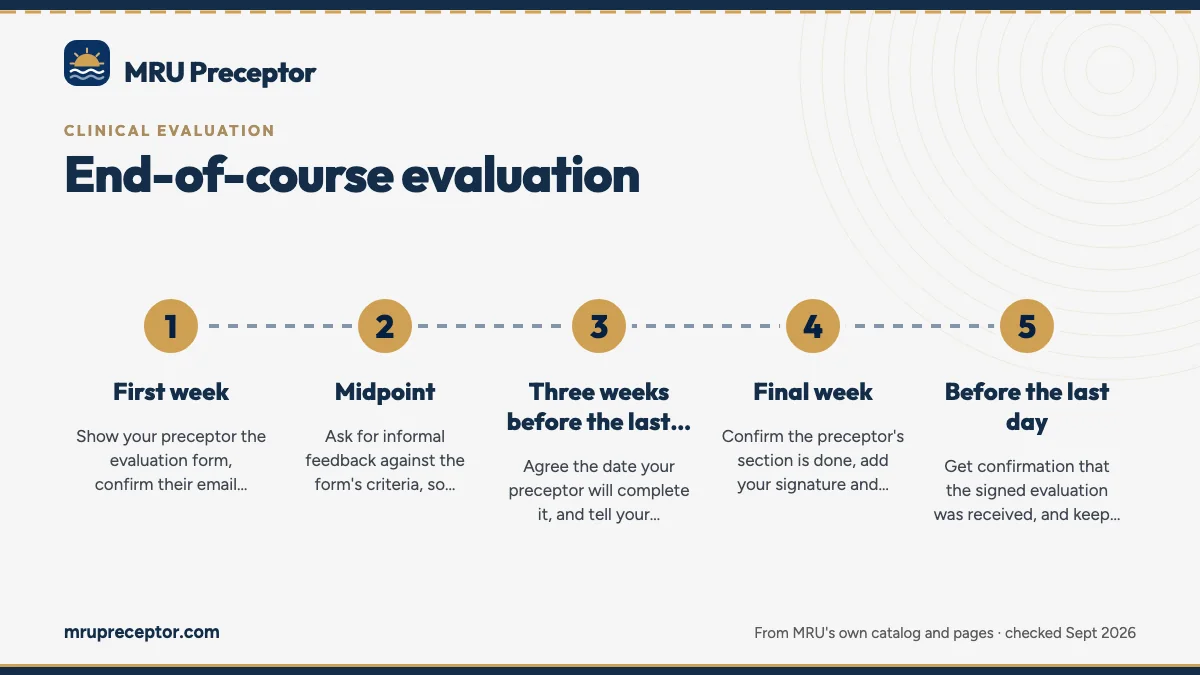
This timeline is our suggestion, not an MRU rule. Stretch or compress it to fit the course length in your syllabus.
- First weekShow your preceptor the evaluation form, confirm their email address and ask how they prefer to complete it.
- MidpointAsk for informal feedback against the form's criteria, so nothing on the final evaluation comes as a surprise.
- Three weeks before the last dayAgree the date your preceptor will complete it, and tell your clinical instructor when to expect it.
- Final weekConfirm the preceptor's section is done, add your signature and check that your clinical instructor has what they need.
- Before the last dayGet confirmation that the signed evaluation was received, and keep a copy if the process allows it.
If your preceptor leaves before signing
Tell your clinical instructor the same day. MRU publishes no procedure for a replacement signature, so the course team decides how to handle it, and the earlier they know, the more options they have.
If you need a new preceptor to finish the hours, MRU has to approve that person before their hours count. For most NP programs, MRU's documents name the Office of Academic Affairs as the approver; the approval page lists the exceptions. A new preceptor may only be able to evaluate the part of the course they saw, which is another question for your clinical instructor.
If time runs out, MRU publishes two routes. An Incomplete needs at least 80% of the course done plus faculty and Dean approval. A withdrawal is recorded as W only before the course's 50% point. The preceptor dropped out page walks through the first days after a preceptor leaves.
Why students choose us for the whole course
We are an independent placement service. We look for a preceptor and site that fit your MRU course, help you gather what MRU checks before a preceptorship starts, and stay on call if a preceptor drops out mid-course. When we introduce a preceptor, we explain the end-of-course evaluation up front, so the final signature is planned from the first week.
MRU approves every preceptor and site, and the evaluation belongs to you, your preceptor and your clinical instructor. Our contribution is preparation: every preceptor we introduce knows MRU's end-of-course requirements before agreeing to take you, so the three signatures are expected from day one. If you want help lining up a preceptor who can see your course through to its last day, use the form below.
Questions MRU students ask
Can my preceptor sign the MRU evaluation electronically?
MRU does not say publicly whether the end-of-course evaluation is completed on paper, inside a tracking system or by electronic signature. Your syllabus or clinical instructor will know. Ask in the first week, so your preceptor is not caught out by an unfamiliar process in the last few days of the course.
Does the end-of-course evaluation affect my grade?
It can decide it. MRU requires the signed evaluation for the course to be passed, and failing any component of an MSN concentration course, the preceptorship included, means an F for the whole course. How the evaluation is scored and weighted is not public, so the syllabus is where to look. The failing a clinical course page covers what follows an F.
What if I disagree with my preceptor's evaluation?
Talk to your clinical instructor first, since they co-sign the evaluation and know the course standard. If it leads to a grade you believe is wrong, MRU's academic appeals process starts with an appeal form on the student portal, then goes to the Academic Appeals Committee and finally to the President. The catalog sets out each step.
Do DNP or leadership MSN students need a three-signature evaluation?
The catalog prints the three-signature rule in the MSN-FNP section and the three NP certificate sections. The DNP addendum and the leadership MSN addendum do not repeat it in their public text. Those programs may still require an evaluation at the end of a practicum course, so check your syllabus and ask your mentor or course faculty.
Who is the clinical instructor on an MRU clinical course?
The catalog names a clinical instructor as one of the three signers but does not describe the role further in public documents. Check your syllabus first. If it does not name one, ask your course faculty on day one who signs as clinical instructor and how they want to hear from you and your preceptor.
Related pages
Last checked 2026-09-24
We check these pages against MRU's own catalog, addenda and program pages. The nursing student handbook on the MRU student portal and MRU's Office of Academic Affairs have the final word.
MRU says secure your own preceptor. We start the search now.
Tell us your MRU program, where you live and when your next clinical course starts. We look for preceptors who fit the course and help you gather what MRU checks before approving them.
- Preceptors matched to the course: adult primary care for
MSN5700, women's health, pediatrics, psychiatric or acute care - Credentials, license and site details collected before MRU's credential check
- Miami-Dade, Broward and Palm Beach, or wherever in a SARA state you live
Start your placement plan
Program, city and start date is all we need to begin.