The MRU clinical placement process, from preceptor search to final signature
Miami Regional University does not publish one placement process, but its catalog and addenda hold every piece. For NP students the order is: find a preceptor, get MRU's approval, have the preceptor's credentials verified, clear your own compliance, show liability insurance at least 15 days ahead, register, log every hour and collect three signatures by the course's last day.
Get help with the preceptor stages
Tell us your MRU program and where you live. MRU approves every preceptor and site; we help you find and prepare one.
What the catalog settles and what it leaves open
The catalog gives you the rules and their order, not the paperwork. It says who finds the preceptor, who approves, what clearance you need and what must be finished by the last day of the course. It does not name the forms, set a date for submitting your preceptor, or say how long approval takes.
Those mechanics live in the nursing student handbook, which MRU posts only on the student portal. Use the stages on this page as the frame, then fill in dates and form names from the handbook and your course syllabus.
The path below applies if you are in the MSN-FNP, one of the FNP, PMHNP or AGACNP certificates, or the leadership MSN. The DNP, the RN-to-BSN and the on-campus programs run differently, as a later section explains.
The ten stages at a glance
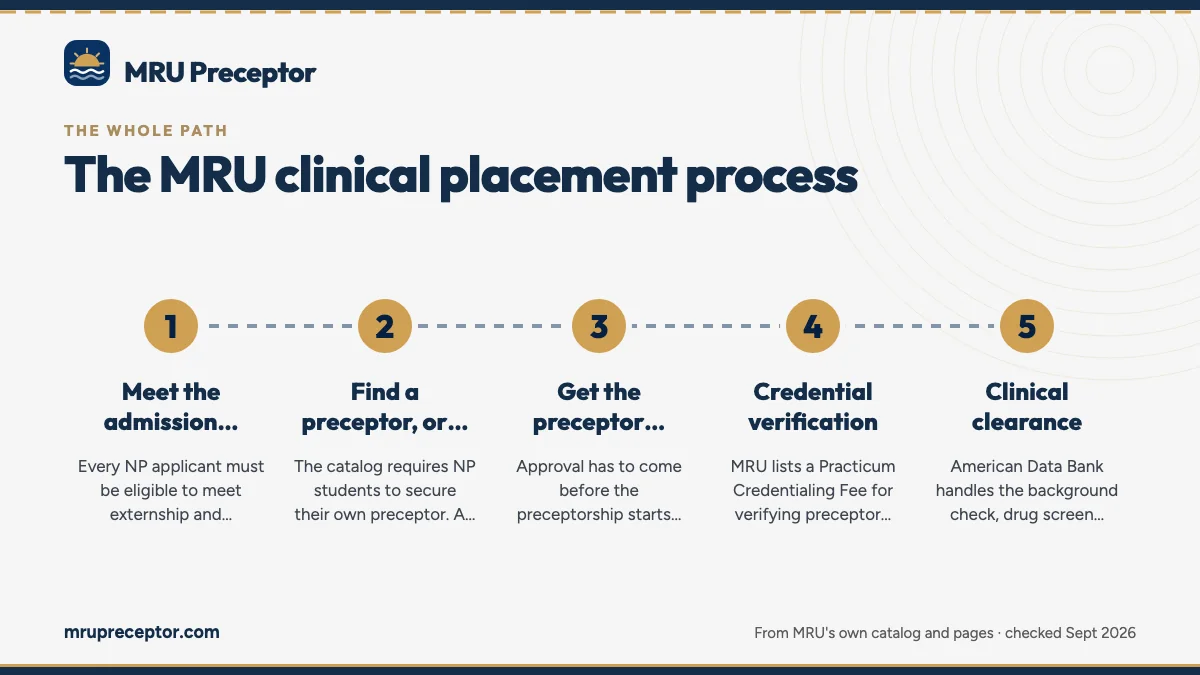
- Meet the admission conditionEvery NP applicant must be eligible to meet externship and preceptorship requirements. PMHNP and AGACNP applicants also attend a programmatic orientation, interview, and show liability insurance before the first clinical.
- Find a preceptor, or take MRU's appointmentThe catalog requires NP students to secure their own preceptor. A student who does not is appointed one by MRU for the one-time Practicum Affiliation Fee.
- Get the preceptor approvedApproval has to come before the preceptorship starts. Who approves depends on your program.
- Credential verificationMRU lists a Practicum Credentialing Fee for verifying preceptor credentials. The documents it checks are not public.
- Clinical clearanceAmerican Data Bank handles the background check, drug screen, medical documents and clinical document clearance. A Level II check with fingerprints is listed separately.
- Health recordsImmunization proof must come from a Florida-licensed provider, and a flu shot is required every year.
- Liability insuranceMRU needs proof of an individual policy 15 or more days before your externship begins; without it, the course can come off your schedule.
- RegisterYou can register yourself on the MRU PORTAL from 20 days before the semester until its add/drop deadline.
- Log as you goHours, logs, case lists and documentation must be complete by the course's last day.
- Collect three signaturesThe end-of-course evaluation is signed by your preceptor, your clinical instructor and you, also by the last day.
Stages 2 to 4: the preceptor, the approval and the credential check
Nothing clinical can begin until these three stages are done, which is why they cause most delays. The catalog only recognizes practicum hours done with a University approved preceptor, so time spent with someone still awaiting approval is at risk of not counting.
The approver changes with the program. The catalog names the Office of Academic Affairs for the MSN-FNP, FNP certificate and AGACNP certificate, and the Program Coordinator for PMHNP, although MRU's October 2025 PMHNP program sheet names the Office of Academic Affairs. MSN in Healthcare Systems Leadership students go to a clinical coordinator from the graduate nursing programs. The approval guide lays these out side by side.
Credential verification has its own fee line but no published document list. Asking your preceptor for license, certification and CV details in one request, as the credentialing page describes, keeps this stage short.
Stages 5 to 7: your own clearance and insurance
Your clearance can run alongside the preceptor search, and unlike the search it is entirely in your hands. Start it as soon as you know which semester holds your first clinical course.
What MRU lists for NP students
- American Data Bank: background check, medical document manager, drug screening and clinical document clearances (the PMHNP fee table says American Data Bank or CastleBranch)
- A Level II background check with fingerprints, listed for the MSN-FNP, AGACNP, PMHNP and the DNP
- Zero-tolerance drug screening, with initial, repeat and random tests
- Proof of immunization from a Florida-licensed healthcare provider, plus a flu shot every year
- MRU Health, the third-floor campus clinic, which reviews the site items: TB, flu, hepatitis B, MMR, varicella and Tdap records, titers, CPR, a physical and a drug screen
- An individual liability policy, through MRU's clinical department or your own insurer
- For AGACNP only: current ACLS and BLS at admission
Pending charges and any other background change go to the Office of Academic Affairs, in writing, inside 24 hours. The American Data Bank guide covers the clearance itself.
Stages 8 to 10: registration, logging and three signatures
Register once your preceptor is approved and your clearance is in order. From Fall 2026 each 16-week semester splits into two 8-week modules with their own add/drop and W dates, so check the calendar page for the module your course sits in.
Log each shift the day it happens. MSN-FNP students record clinical work in Typhon, which MRU's fee tables call the Clinical Evaluation Portfolio System; the FNP certificate, AGACNP and PMHNP tables name no tracking system, so your syllabus decides. Falsified time logs or invented patient encounters lead to course failure and possible dismissal.
The final stage is the end-of-course evaluation carrying three signatures: the preceptor's, the clinical instructor's and yours. It has to be in by the last day of the course alongside your logs, case lists and documentation, and a missing piece fails the course. Set the signing date with your preceptor well before the final week.
Hours logged with a preceptor who has not yet been approved may not count. Have MRU's approval in hand before your first shift.
Where the path differs: DNP, RN-to-BSN and on-campus programs
The 39-credit leadership DNP, which replaced the 60-credit version from Fall 2026, uses 765 indirect practice hours tracked in myevaluation.com. Each DNP student gets a project team mentor chosen by the program director, while the 2025 catalog left approval of practicum hours, projects, preceptors and mentors to program faculty. A third-party IRB must approve the project before it is implemented. No MRU source says who finds the practicum site.
RN-to-BSN students complete 135 clinical hours across NUR4269, NUR4679 and NUR4689, 45 in each, under indirect supervision in a preceptorship model. MRU does not say who secures that preceptor, so ask your program chair before the first of those courses.
ASN, BSN and MSN Direct Entry students train on campus and do clinicals at contracted externship agencies. The Office of the Registrar coordinates those sections, shifts can fall on any day or at any hour, and if an agency changes sites MRU can adjust your schedule without notice.
What is not public, and who to ask
Several parts of the process do not appear in any public MRU document. Look for them in the handbook first.
- the names of the preceptor and site agreement forms
- the deadline for submitting your preceptor
- how long approval takes
- whether a clinical site needs an agreement with MRU, and who signs it
- whether faculty visit clinical sites
If the handbook and syllabus leave a gap, ask your program chair, then the Office of Academic Affairs, from your university email. MRU expects you to check that inbox daily and answer official messages within 24 hours.
If you want help with the preceptor stages, a placement advisor can search for a preceptor near you and put together the details MRU checks, while MRU still makes every approval decision. See how it works or use the form below.
Questions MRU students ask
How early should I start the MRU placement process?
MRU publishes no deadline for naming a preceptor, so work backwards from the semester start. Approval and credential verification must finish before your first hour, and insurance proof is due at least 15 days before the externship. Starting the search a full semester before your first clinical course leaves room for a preceptor who says no or an approval that needs more information.
Does MRU place nurse practitioner students in clinical sites?
The catalog asks NP students to secure their own preceptor. Anyone who arrives without one gets a preceptor assigned by MRU and pays the one-time Practicum Affiliation Fee. MRU publishes no list of clinical sites or partner hospitals, and no placement request portal was found beyond that appointment route.
Is the process the same for online FNP students who live outside Miami?
The catalog wording is the same for onsite and online MSN-FNP students. Online students have to reside in Florida or another SARA state throughout, usually find a preceptor close to home, and still need immunization proof from a Florida-licensed provider. The out-of-state guide covers the licensing questions.
What happens if my clinical paperwork is late?
It depends on which paperwork. Insurance proof that arrives less than 15 days before the externship can lead to the course being dropped from your schedule. Logs, case lists or the signed evaluation missing on the course's last day mean the course is failed. Other deadlines are set in the handbook, not the public catalog.
Does failing the clinical part fail the whole course?
Yes. For MSN concentration courses, failing any component, whether lecture, lab, simulation or the preceptorship, records an F for the entire course. Only one repeat of the same MSN course is allowed, and a second failure of that course means dismissal, so the clinical stages deserve the same care as exams.
Related pages
Last checked 2026-09-24
We check these pages against MRU's own catalog, addenda and program pages. The nursing student handbook on the MRU student portal and MRU's Office of Academic Affairs have the final word.
MRU says secure your own preceptor. We start the search now.
Tell us your MRU program, where you live and when your next clinical course starts. We look for preceptors who fit the course and help you gather what MRU checks before approving them.
- Preceptors matched to the course: adult primary care for
MSN5700, women's health, pediatrics, psychiatric or acute care - Credentials, license and site details collected before MRU's credential check
- Miami-Dade, Broward and Palm Beach, or wherever in a SARA state you live
Start your placement plan
Program, city and start date is all we need to begin.