Preceptor credentialing at MRU: the fee, the check and what to gather
Before a preceptor is approved, MRU verifies their credentials and lists a Practicum Credentialing Fee to cover the cost. MRU does not publish which documents it checks. Gathering a complete, current set from your preceptor in a single request is the easiest way to stop this step from holding up your start.
Help preparing a preceptor file
Tell us your MRU program and course. We help find a preceptor and assemble their details; MRU verifies and approves.
What MRU publishes about credentialing
The only public trace of MRU's credential check is a fee. The July 2025 Bursar addendum and the program cost tables list a Practicum Credentialing Fee, described as the cost of verifying preceptor credentials, for the MSN-FNP, the AGACNP and PMHNP certificates, and the DNP.
The FNP certificate's cost table does not list it. The tables also do not say whether the fee is charged only when you bring your own preceptor or on the appointment route as well. The amount is printed in the catalog and the addendum.
Beyond that, the process is not public. Which documents are verified, whether MRU checks licenses with the issuing board and how long verification takes are all left to the nursing student handbook on the portal.
Three checks that are easy to mix up
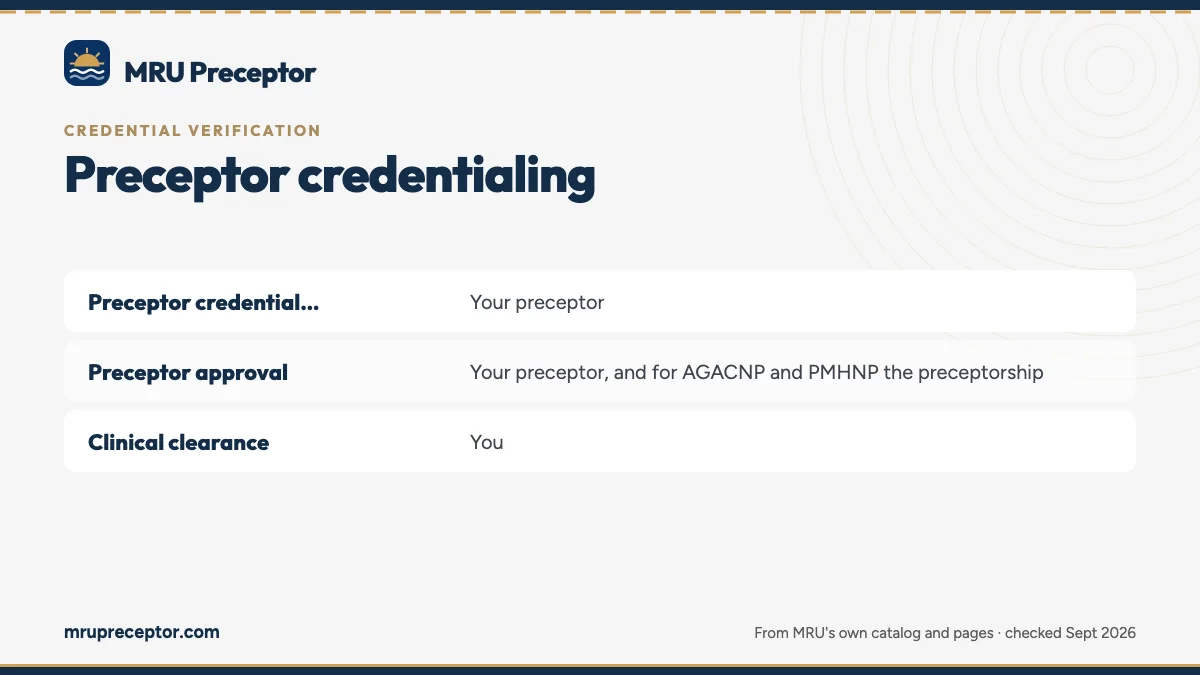
Credential verification is one of three separate reviews that come before your first clinical shift. Knowing which is which tells you who to chase when something stalls.
| Check | Who is checked | What MRU publishes |
|---|---|---|
| Preceptor credential verification | Your preceptor | A fee line; the document list is not public |
| Preceptor approval | Your preceptor, and for AGACNP and PMHNP the preceptorship | The approver for each program |
| Clinical clearance | You | American Data Bank, a Level II check with fingerprints, drug screens, immunizations and insurance |
Your first shift waits on all three. Nothing in the catalog makes your clearance wait for the preceptor checks, so run them in the same weeks rather than one after the other. Your own clearance is covered on the American Data Bank page, and approval, which follows verification, on the approval page.
What to collect from your preceptor
MRU's own list is in the handbook, and it takes priority. Until you have it, gather the items below; each ties to something MRU or Florida's preceptor rule treats as relevant.
A one-request checklist
- Full legal name, exactly as it appears on the license
- Profession and license type: APRN, MD, DO or other
- License number, issuing state and expiry date; for a Florida site, the Florida license
- For an APRN, national certification with its specialty and expiry date
- A current CV showing the practice setting and the patients seen
- The practice name and the address where your hours will take place
- A professional email address MRU can use to reach them
- For the leadership MSN, the preceptor's master's or higher degree and administration or management role
Send the list in one message, explain briefly that MRU verifies credentials before approving preceptors, and ask for everything together. Check each expiry date as the documents arrive.
Why the credentials have to fit the course
A preceptor can hold every required credential and still be the wrong fit. MRU defines its clinical courses by population and setting, and the preceptor's practice has to supply them.
For the MSN-FNP, MSN5700 covers adults and older adults in community, clinic or primary-care practice, MSN6050 women from menarche to the end of pregnancy, and MSN6150 infants to adolescents. PMHNP rotations are in a psychiatric-mental health specialty. The AGACNP courses MSN5040C, MSN5041C and MSN5042C are acute care with adults from young adulthood to the frail elderly.
Put the course population next to the CV before you submit. A family practice that sees few children may suit MSN5700 but struggle to fill MSN6150. The requirements page covers the Florida rule on who may precept.
Asking a busy clinician for documents
Preceptors agree to teach; paperwork is the part they did not sign up for. Keep your request short, specific and one-time.
Tell them what the documents are for, that MRU may contact them directly, and roughly when you expect to hear back. Offer to fill in whatever you can from their practice's public information and ask them only to confirm it. If they work for a hospital or large group practice, ask whether an office there handles student paperwork for clinicians, and send the request to that office as well.
When approval arrives, tell them and thank them. A preceptor who found the process easy is more likely to take you for a later course, or another MRU student after you. The page for preceptors explains the commitment from their side.
Open questions to settle in the handbook
No public MRU document answers these points. Look for them in the handbook, then ask your approver.
- the exact documents MRU verifies
- whether MRU wants the documents from you or directly from the preceptor
- whether verification is repeated when a license or certification renews mid-program
- whether a preceptor verified for one course is verified again for the next
- whether the Practicum Credentialing Fee applies on the appointment route
- how long verification usually takes
Ask in one email and keep the reply with your approval record.
An expired license or certification is exactly the kind of problem that stalls a file. Check every expiry date before you submit.
Questions MRU students ask
What is MRU's Practicum Credentialing Fee?
It is a fee MRU lists for verifying preceptor credentials. It appears in the cost tables for the MSN-FNP, the AGACNP and PMHNP certificates and the DNP, and in the July 2025 Bursar addendum. This site does not print the amount; check the current catalog and addenda on mru.edu.
Is the credentialing fee the same as the Practicum Affiliation Fee?
No. The affiliation fee is charged when MRU appoints your preceptor and is waived for students who secure an approved preceptor themselves. The credentialing fee covers verifying preceptor credentials, and MRU does not say the waiver extends to it. The affiliation fee page explains that fee.
Does my preceptor need national board certification?
MRU does not publish its own rule. For a clinical setting in Florida, rule 64B9-4.001(13) lists a certified practicing APRN, or a licensed MD, DO or dentist, all holding Florida licenses. So an APRN preceptor in Florida needs certification, while physicians qualify through licensure. Your handbook may add more.
Does the clinical site check credentials as well?
It may check yours. Hospitals and clinics run their own student onboarding, separate from MRU's check of your preceptor. Baptist Health South Florida, for example, takes student rotation requests only through Complio and lists its own background, drug screen, immunization and BLS requirements.
Who sends the preceptor's documents to MRU, me or my preceptor?
MRU does not say publicly. The handbook should explain whether you upload the preceptor's details, whether the preceptor submits them, or both. Until you know, gather everything yourself and let your preceptor know MRU may contact them directly. Keep copies of everything you send, in case a later course or a replacement approval needs the same documents.
Related pages
Last checked 2026-09-24
We check these pages against MRU's own catalog, addenda and program pages. The nursing student handbook on the MRU student portal and MRU's Office of Academic Affairs have the final word.
MRU says secure your own preceptor. We start the search now.
Tell us your MRU program, where you live and when your next clinical course starts. We look for preceptors who fit the course and help you gather what MRU checks before approving them.
- Preceptors matched to the course: adult primary care for
MSN5700, women's health, pediatrics, psychiatric or acute care - Credentials, license and site details collected before MRU's credential check
- Miami-Dade, Broward and Palm Beach, or wherever in a SARA state you live
Start your placement plan
Program, city and start date is all we need to begin.