Typhon at MRU: what it is and how to log well
Typhon is the system MRU's fee tables list as the "Clinical Evaluation Portfolio System" for the MSN-FNP, MSN Direct Entry and ASN. MRU does not publish how its Typhon setup works, so your syllabus and course faculty fill in the details. The catalog is clear on the deadline, though: logs and case lists are due by the course's last day, and anything missing fails the course.
Get your placement plan
Tell us your MRU program and where you live. A placement advisor replies with what an MRU-ready preceptor and site look like for you.
Which MRU programs use Typhon
MRU names Typhon in one place: the fee tables in the July 2025 Bursar addendum and on the program pages, where it appears as the Clinical Evaluation Portfolio System. The same fee line was in the 2023 catalog, so Typhon is not new at MRU.
What the fee tables show
- MSN: Family Nurse Practitioner: Typhon listed.
- MSN Direct Entry: Typhon listed.
- ASN: Typhon listed.
- FNP, PMHNP and AGACNP post-master's certificates: no tracking system named.
- DNP: practice hours go in myevaluation.com instead.
If you are in a certificate program, do not assume either way. Ask your course faculty which system your clinical course uses before your first shift, so none of your hours end up recorded in the wrong place. DNP students can go straight to the myevaluation.com guide.
What MRU expects you to record
The catalog lists what a clinical course must produce by its last day: practicum hours completed with a University-approved preceptor, logs, case lists, other documentation, and an end-of-course evaluation signed by the preceptor, the clinical instructor and you. Missing any one of them fails the course.
What MRU does not say publicly is which of those pieces live inside Typhon and which are handled another way. It also publishes no case-list template, no minimum patient numbers and no list of the fields each encounter needs. Those details belong to the syllabus and to the nursing student handbook on the student portal.
Read both before your first shift. The logs and case lists page sets out the documentation rule in full, and the end-of-course evaluation page covers the three signatures.
Before your first entry
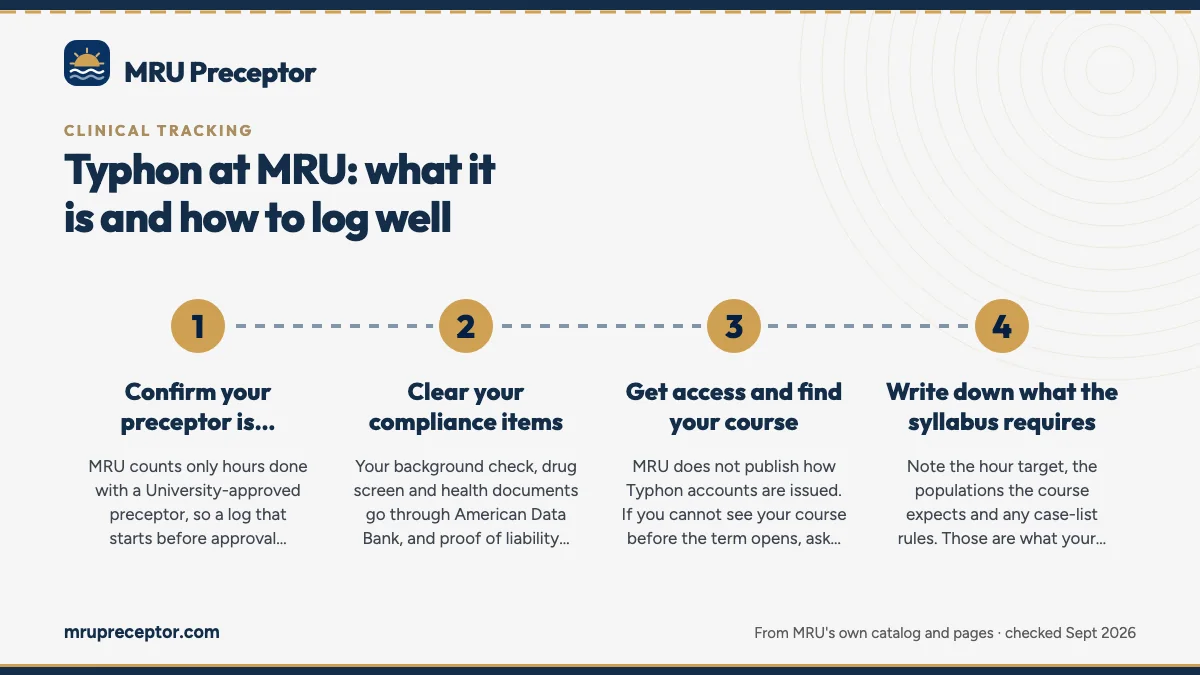
- Confirm your preceptor is approvedMRU counts only hours done with a University-approved preceptor, so a log that starts before approval records hours that may never count. The approval page shows who signs off for your program.
- Clear your compliance itemsYour background check, drug screen and health documents go through American Data Bank, and proof of liability insurance is due at least 15 days before the externship starts.
- Get access and find your courseMRU does not publish how Typhon accounts are issued. If you cannot see your course before the term opens, ask your course faculty rather than waiting for week one.
- Write down what the syllabus requiresNote the hour target, the populations the course expects and any case-list rules. Those are what your entries will be checked against at the end.
Logging habits that protect the grade
None of these are MRU rules. They are habits that keep a record accurate and complete when the last day of the course arrives.
- Log each shift the same day, while times and cases are fresh.
- Record only the hours you actually worked. The catalog treats falsified time logs, misrepresented hours and false encounter records as grounds for course failure and possible dismissal.
- Keep patient identifiers out of every entry. MRU requires you to follow HIPAA and each site's privacy policies, and violations can cost you the course.
- Keep your own short record of dates, hours and your preceptor's name, so you can reconcile anything that looks wrong later.
- Check your running total every week against the syllabus target, not only at midterm.
- Tell your clinical instructor early if your preceptor's schedule changes and your total starts to slip.
If you are an FNP student unsure what target to log against, the FNP clinical hours page explains why MRU prints no total and what the course credits imply.
Two FNP courses in one term
Full-time MSN-FNP students take MSN6050 and MSN6150 together in semester IV. That means two sets of entries running side by side: women's health from menarche to the end of pregnancy in one, infants to adolescents in the other. Keep each encounter attached to the course whose population it belongs to.
The capstone asks for something different. In MSN6400 you work in one clinical setting across the lifespan, so your case list should show patients of different ages rather than a single group. The syllabus sets the spread it expects; MRU's public documents do not.
If your women's health and pediatric hours happen at the same family practice, ask your course faculty how to split them before you log the first shift. Untangling a mixed log at the end of the term is much harder.
What Typhon does not answer
Some questions come up every term, and MRU's public documents answer none of them. Take them to your course faculty or clinical instructor.
- Whether late entries are accepted, and how long after a shift.
- Who reviews your entries during the term, and how often.
- Whether your preceptor confirms hours in Typhon or on a separate timesheet.
- What happens to your Typhon record between courses and after graduation.
- How the Typhon fee in your program's cost table is billed.
Ask once, in writing, and keep the answer with your course records. An answer for one course may not hold for the next, so ask again when a new clinical course begins. If a reply changes something you have already logged, fix the entry straight away and tell your clinical instructor what you changed and why.
Questions MRU students ask
Do FNP post-master's certificate students use Typhon at MRU?
MRU's public documents do not say. The Bursar addendum names Typhon for the MSN-FNP, MSN Direct Entry and ASN, but the FNP, PMHNP and AGACNP certificate fee tables list no tracking system at all. Certificate students take the same FNP clinical courses as MSN students, so ask your course faculty which system those sections use.
Is there a Typhon fee at MRU?
Yes. MRU's fee tables list a Clinical Evaluation Portfolio System fee, identified as Typhon, for the MSN-FNP, MSN Direct Entry and ASN. The amount is in the catalog's cost tables and the July 2025 Bursar addendum. It is separate from the Practicum Credentialing Fee and the Practicum Affiliation Fee, which both relate to preceptors.
Can I log hours before MRU approves my preceptor?
You can type anything into a log, but MRU only counts practicum hours completed with a University-approved preceptor. Hours worked before approval risk not counting at all, and the catalog's rule on misrepresented hours makes relabeling them later a bad idea. Wait for written approval, then start your shifts and your log together.
What if I forget to log a shift in Typhon?
Enter it as soon as you notice, with the real date and the hours you actually worked, and tell your clinical instructor if the course limits how late entries can be made. MRU publishes no late-entry rule. It does publish that falsified or misrepresented hours can mean course failure and possible dismissal, so never pad a catch-up entry.
Do MSN Direct Entry students use Typhon too?
Yes. The MSN Direct Entry fee table lists the same Typhon fee as the MSN-FNP, and so does the ASN's. Direct Entry is a pre-licensure program with 495 clinical hours across seven clinical courses in an onsite program, so the log covers externship shifts rather than an NP preceptorship. The MSN Direct Entry page covers the program.
Related pages
Last checked 2026-09-24
We check these pages against MRU's own catalog, addenda and program pages. The nursing student handbook on the MRU student portal and MRU's Office of Academic Affairs have the final word.
MRU says secure your own preceptor. We start the search now.
Tell us your MRU program, where you live and when your next clinical course starts. We look for preceptors who fit the course and help you gather what MRU checks before approving them.
- Preceptors matched to the course: adult primary care for
MSN5700, women's health, pediatrics, psychiatric or acute care - Credentials, license and site details collected before MRU's credential check
- Miami-Dade, Broward and Palm Beach, or wherever in a SARA state you live
Start your placement plan
Program, city and start date is all we need to begin.