MRU's MSN Family Nurse Practitioner program: the clinical side
MRU's MSN-FNP is a 50-credit master's taught onsite and online, with four clinical courses running from MSN5700 to MSN6400. The catalog tells FNP students to secure their own preceptor, and the Office of Academic Affairs must approve that person before the preceptorship starts. Below: the courses, the order you meet them and what each one asks of a preceptor.
Get your placement plan
Tell us your MRU program and where you live. A placement advisor replies with what an MRU-ready preceptor and site look like for you.
MSN5700 to MSN6400MSN6400, per its course description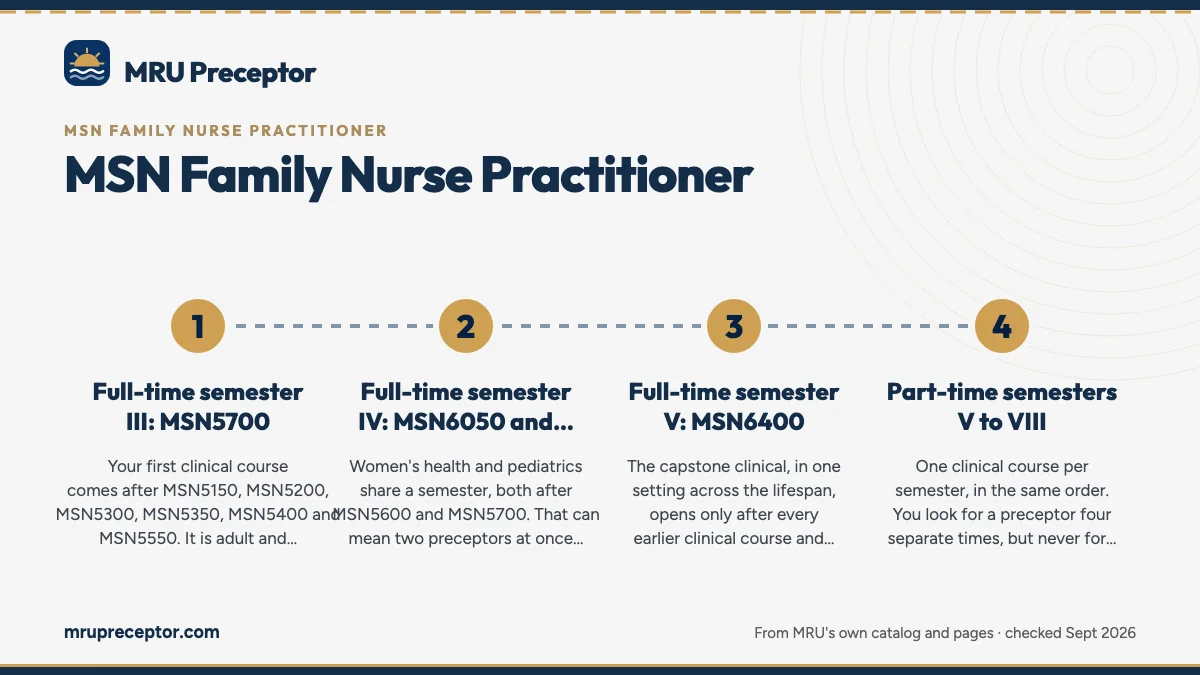
MSN-FNP at a glance
MRU awards a Master of Science in Nursing with a Family Nurse Practitioner focus after 50 semester credits. Full-time students finish in 20 months over five semesters, and part-time students take 32 months over eight. The catalog lists the program as face-to-face at the Miami Springs campus and online.
The degree plan prints 1,275 total clock hours, but that figure blends lecture, lab and clinical time together. It is not a clinical-hour count, which matters when a site, a board or a future employer asks how many patient-care hours you completed.
Key facts from MRU's catalog
- Credential: Master of Science in Nursing, Family Nurse Practitioner
- Credits: 50, with no more than 24 graduate transfer credits accepted
- Length: 20 months full-time (5 semesters) or 32 months part-time (8 semesters)
- Delivery: onsite in Miami Springs, and online
- Clinical tracking: Typhon, listed in the fee table as the Clinical Evaluation Portfolio System
The four clinical courses and their hours
Four courses carry clinical time. MRU prints each course's credits and total clock hours, but it does not print a clinical-hour figure for the FNP, either course by course or for the whole degree.
| Course | Patients and setting | Credits | Total clock hours (MRU) | Clinical hours (our calculation) |
|---|---|---|---|---|
MSN5700 Advanced Practice in Primary Care | Adults and older adults in a community, clinic or primary-care practice | 8 | 270 | 225 |
MSN6050 Advanced Practice in Primary Care: Women's Health | Women from menarche to the end of pregnancy | 5 | 165 | 135 |
MSN6150 Advanced Practice in Primary Care: Pediatrics | Infants to adolescents, with sports physicals depending on the site | 5 | 165 | 135 |
MSN6400 Role Development in Family Practice: Clinical Integration | One clinical setting, patients across the lifespan | 8 | 300 | 270 (description says at least 180) |
The last column is our arithmetic, not MRU's. MRU counts one credit as 15 lecture hours or 45 clinical hours, so a course's credits and printed clock hours can be split into a lecture share and a clinical share. Worked that way, the four courses come to about 765 clinical hours.
MSN6400 is the one course where MRU states a number: its description asks for "a minimum of 180 clinical hours", lower than the 270 the arithmetic produces. Your syllabus settles which figure your instructor holds you to. The FNP clinical hours page walks through the calculation line by line.
The order you take them in
Full-time and part-time students meet the same four courses, just spaced differently. Each clinical course lists prerequisites, so the order is fixed.
- Full-time semester III:
MSN5700Your first clinical course comes afterMSN5150,MSN5200,MSN5300,MSN5350,MSN5400andMSN5550. It is adult and geriatric primary care; the MSN5700 guide covers the preceptor profile. - Full-time semester IV:
MSN6050andMSN6150togetherWomen's health and pediatrics share a semester, both afterMSN5600andMSN5700. That can mean two preceptors at once, or one family practice that sees both groups. - Full-time semester V:
MSN6400The capstone clinical, in one setting across the lifespan, opens only after every earlier clinical course andMSN5270. - Part-time semesters V to VIIIOne clinical course per semester, in the same order. You look for a preceptor four separate times, but never for two courses at once.
From Fall 2026 MRU runs 16-week semesters split into two 8-week modules. A preceptor approved in week three leaves noticeably less room to finish hours before the course's last day than one approved before the semester opens.
Who finds your preceptor and who signs off
You do. The FNP section of the catalog states: "Students are required to secure their own preceptor." The same paragraph says the Office of Academic Affairs approves the preceptor before the preceptorship begins, and it refers you to the nursing student handbook for the rest.
If you arrive without one, MRU says you "will be appointed one by the University for an additional fee". The FNP fee table calls this the Practicum Affiliation Fee, a one-time charge on entering the practicum, and notes that it is waived only for students who secure an approved preceptor. A separate Practicum Credentialing Fee covers verifying preceptor credentials. The Practicum Affiliation Fee page sets out both choices.
One detail catches people out: the public MSN-FNP web page does not repeat the own-preceptor sentence. It only asks applicants to be eligible for externship and preceptorship requirements and says practicum hours are done with a University-approved preceptor. The full rule sits in the catalog and in MRU's October 2025 international FNP program sheet.
MRU does not publish how long approval takes, which forms are involved or a deadline for naming your preceptor; those live in the handbook on the student portal. The preceptor approval page gathers what is known.
What kind of preceptor and site fits each course
Match the preceptor to the patients the course describes. MSN5700 needs adult and older-adult primary care. MSN6050 needs someone who sees women from first period through pregnancy, and MSN6150 needs infants, children and teenagers. MSN6400 asks for one setting where you see every age group, which in practice points toward family practice.
MRU's own qualification list for FNP preceptors is not public. For a Florida site, Board of Nursing rule 64B9-4.001(13) defines a qualified preceptor as a certified practicing APRN or a licensed MD or DO (dentists also qualify), and requires a Florida license whenever the clinical setting is in Florida. Nothing in it requires a set number of years in practice. Outside Florida your own state's rules apply; the preceptor requirements page explains the difference.
MRU caps indirect clinical supervision in the FNP and post-master's programs at eight students per supervisor. South Florida health systems that publish student policies ask for an affiliation agreement with the school first, so check that before you build a plan around a hospital-owned clinic.
Clearance, logs and the course's last day
Approving your preceptor is only half the gate; MRU also clears you. American Data Bank handles the background check, drug screening, medical document manager and clinical document clearance, and the FNP fee table adds a Level II background check with fingerprints. Immunization proof has to come from a Florida-licensed provider, with a flu shot every year.
Proof of individual liability insurance is due at least 15 days before the externship starts, or the course can be dropped from your schedule. You can apply through MRU's clinical department or carry your own policy.
During each course you record hours, case lists and documentation in Typhon. By the last day MRU expects every practicum hour done and an end-of-course evaluation signed by three people: your preceptor, your clinical instructor and you. A missing piece fails the course, and falsified logs mean failure and possible dismissal. The Typhon guide has logging habits that help.
Failing the preceptorship alone fails the whole course: MRU records an F when any component (lecture, lab, simulation or preceptorship) is failed.
Admission rules that shape where you can train
You must live in Florida or a SARA member state for the whole program. California is not a SARA member and is missing from MRU's licensure table, so California residents fall outside the rule. Because it runs for the duration of the program, talk to your program chair before any move; the SARA residency page has the detail.
Admission also asks for an active RN license (the catalog names no state), a bachelor's degree in a health-related field, graduation from a programmatically accredited RN program, three letters of recommendation, a CV and MRU's Ethics, Information Literacy and Professional Writing Seminar. MRU's catalog says it does not promise that licensure requirements are met anywhere other than Florida, so out-of-state students should check with their own board early.
Accreditation: ACEN, not CCNE, accredits MRU's master's and post-master's certificate programs, and ACEN's record lists the generic MSN FNP track as approved. SACSCOC accredits the university itself.
Why FNP students choose us
We are an independent placement service built around MRU's FNP sequence. For each course we look for a preceptor and site that suit the course's patients and sit near where you live, and we help you gather the license, certification and site details MRU's credential check will want. MRU makes the approval decision, and we make sure the request it receives is complete and fits the course from the first submission.
If a preceptor drops out partway through a course, we stay on call to search again. Tell us which of the four courses is next and where you live, using the form below, and a placement advisor will say plainly whether the timing looks workable.
Questions MRU students ask
Does MRU find FNP preceptors for students?
Only if you let it and accept the fee. The catalog's default is that FNP students bring their own preceptor. A student who does not is appointed one by the University, and the fee table lists the one-time Practicum Affiliation Fee for that. The waiver applies only when you secure an approved preceptor yourself. MRU does not publish how it chooses the preceptor it assigns or how far from home that site might be.
Can I do MRU FNP clinical hours where I work?
MRU's public documents do not address it, so ask the Office of Academic Affairs before you plan around your employer. Some South Florida systems set their own limits: Baptist Health's student page says employees cannot rotate at the facility where they work, and Nicklaus Children's says employees cannot rotate in their own department or during scheduled work hours.
Is MRU's FNP program online?
Both formats exist: the catalog lists the MSN-FNP as face-to-face in Miami Springs and online. Online coursework does not change the clinical side. Your hours in MSN5700, MSN6050, MSN6150 and MSN6400 are still completed at a clinical site with a University-approved preceptor, wherever in Florida or a SARA state you live.
What if my FNP preceptor quits in the middle of a course?
Tell your clinical instructor at once, because every hour still has to be finished with an approved preceptor by the course's last day. MRU offers no leave of absence. An Incomplete needs at least 80% of the course done plus faculty and Dean approval; going past 14 days after the course ends needs the Office of Academic Affairs, and 15 weeks is the ceiling.
Which certification exam do MRU FNP graduates take?
MRU does not name it. The catalog says graduates practice as FNPs after passing board certification exams, and MRU's February 2026 student achievement report gives FNP certification pass rates, but neither names the certifying body. Ask your program chair if the exam choice affects your planning.
Related pages
Last checked 2026-09-24
We check these pages against MRU's own catalog, addenda and program pages. The nursing student handbook on the MRU student portal and MRU's Office of Academic Affairs have the final word.
MRU says secure your own preceptor. We start the search now.
Tell us your MRU program, where you live and when your next clinical course starts. We look for preceptors who fit the course and help you gather what MRU checks before approving them.
- Preceptors matched to the course: adult primary care for
MSN5700, women's health, pediatrics, psychiatric or acute care - Credentials, license and site details collected before MRU's credential check
- Miami-Dade, Broward and Palm Beach, or wherever in a SARA state you live
Start your placement plan
Program, city and start date is all we need to begin.