Clinical hours in every MRU nursing program
MRU prints a clinical or practice hour total for eight of its ten nursing programs. The two exceptions are the MSN-FNP and the FNP post-master's certificate, where the catalog lists the clinical courses but no total. Pick your program in the planner, then use the table to see where the hours sit and which figures still need checking against your syllabus.
Get your placement plan
Tell us your MRU program and where you live. A placement advisor replies with what an MRU-ready preceptor and site look like for you.
Pick your MRU program
Your clinical courses and hours, who can precept you, where, and when to start looking. From MRU's own catalog and program pages.
- Who precepts
- A preceptor MRU approves before you start; at a Florida site, a Florida-licensed APRN, MD or DO
- Where
- Adult and geriatric primary care, women's health, pediatrics, then one setting across the lifespan
- Start looking
- Before MSN5700 (semester III full-time); insurance proof at least 15 days before the externship
- Who precepts
- The same approved-preceptor rule as the MSN-FNP
- Where
- The same four FNP settings; a gap analysis may shorten it for certified NPs
- Start looking
- Settle the gap analysis first, then look for the first clinical course's preceptor
- Who precepts
- A psychiatric preceptor approved before the rotation starts
- Where
- Adults and families, then children and adolescents, then lifespan care incl. substance use
- Start looking
- Two clinical courses run together in semester III, so line up both early
- Who precepts
- An acute-care preceptor approved by the Office of Academic Affairs
- Where
- Acutely ill adults: hospital units, ICUs, hospitalist and acute specialty services
- Start looking
- Two clinical courses run together in semester II, right after the on-campus skills weekend
- Who precepts
- A DNP Project team mentor assigned by the program director; a practice site that will host your project
- Where
- A healthcare organization where your leadership project can be carried out
- Start looking
- Pick the site before DNP8200, where you plan the change and seek external IRB approval
- Who precepts
- A nurse with a master's degree or higher working in administration and management
- Where
- A nursing leadership office: nurse manager, director or CNO level
- Start looking
- Semester III full-time (semester V part-time); the preceptor must be approved first
- Who precepts
- A preceptor in each setting (indirect supervision in a preceptorship model)
- Where
- Care of older adults, vulnerable and underserved populations, community and public health
- Start looking
- Ask how your course arranges the preceptor before the term starts
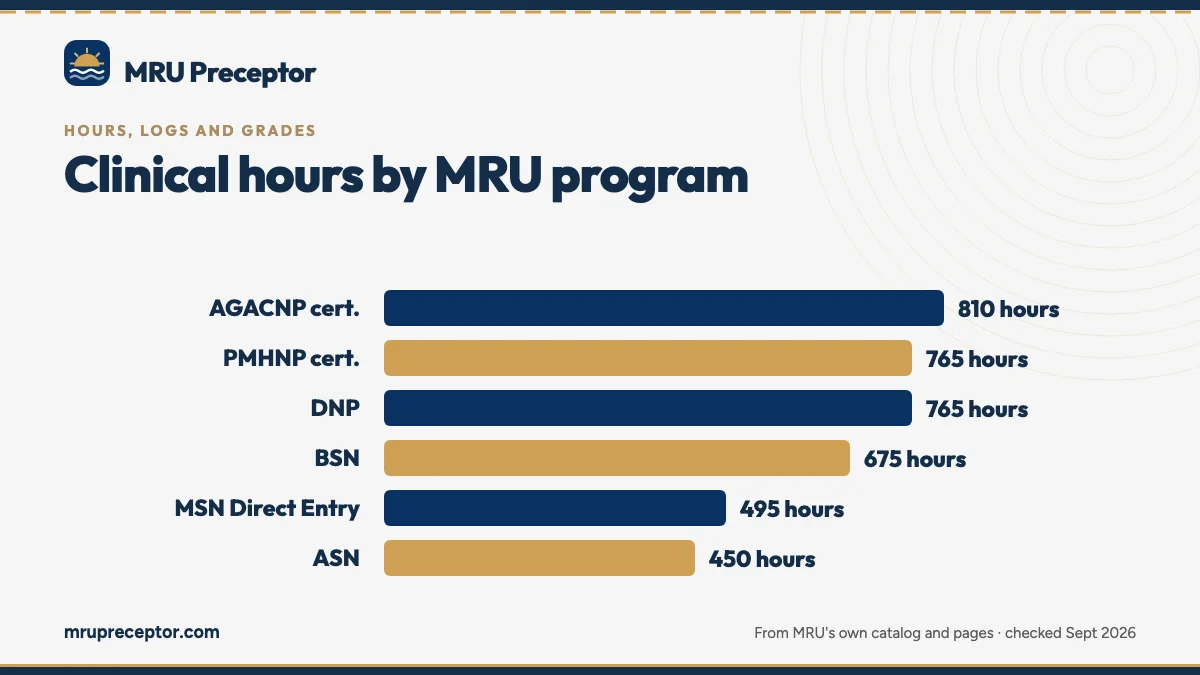
Clinical hours by program, from MRU's own documents
Every figure below comes from the 2025 catalog or from the addendum that later replaced that part of it. Where MRU prints a total, it appears as printed. Where MRU prints none, the cell says so, and any number beside it is our arithmetic, marked as ours.
| Program | Hours MRU prints | Courses that carry them | Worth knowing |
|---|---|---|---|
| MSN: Family Nurse Practitioner | No total printed | MSN5700, MSN6050, MSN6150, MSN6400 | About 765 by our calculation; MSN6400 says at least 180 |
| FNP Post-Master's Certificate | No total printed | The same four FNP courses | Certified NPs may need fewer credits after a gap analysis |
| PMHNP Post-Master's Certificate | 765 | MSN5056C 180, MSN6057C 180, MSN6065C 405 | Must include 115 child and adolescent, 150 psychotherapy and 500 lifespan hours |
| AGACNP Post-Master's Certificate | 810 | MSN5040C 225, MSN5041C 225, MSN5042C 360 | Plus a three-day on-campus skills and simulation weekend in semester I |
| DNP (39 credits) | 765 indirect practice hours | Every course except DNP1010; project work in DNP8200, DNP7700, DNP8440, DNP8500 | Leadership DNP; hours tracked in myevaluation.com |
| MSN: Healthcare Systems Leadership | 180 practicum hours | MSN5855 | Preceptor is a nurse leader with a master's degree or higher |
| RN-to-BSN | 135 | NUR4269, NUR4679, NUR4689, 45 each | Indirect supervision in a preceptorship model |
| MSN Direct Entry | 495 | Seven clinical courses, onsite program | Externships at contracted agencies |
| BSN (pre-licensure) | 675 | Eleven clinical courses, onsite program | Externships at contracted agencies |
| ASN | 450 | Seven clinical courses, onsite program | Lab hours are counted separately |
The PMHNP, AGACNP, DNP and leadership MSN totals come from the catalog and its 2026 addenda. The three pre-licensure figures come from MRU's 2026 prelicensure addendum, the same document that renumbered those courses.
How MRU turns credits into clinical hours
MRU's catalog uses one conversion for every program: a semester credit equals 15 lecture hours, 30 lab hours or 45 externship, clinical or simulation hours. Clinical credit is the heavy kind. MSN5040C, a five-credit acute care course, carries 225 hours at a site.
The degree plans also carry an HOURS column, and that is where students go wrong. The column is total clock hours, with lecture, lab and clinical added together. The MSN-FNP plan shows 1,275 hours for the whole degree, the PMHNP certificate 1,035 and the AGACNP certificate 1,020. Only 765 and 810 of the last two are clinical.
MRU's own numbers do not always agree with each other. MSN5042C is a seven-credit course, which the conversion would make 315 hours, yet the catalog lists 360, and the 810 total is built on 360. When the arithmetic and a printed figure disagree, follow the syllabus for your section and ask your course faculty which number they will hold you to.
The 1,275 hours in the MSN-FNP degree plan are not clinical hours. They count every lecture, lab and clinical hour in the program.
Which hours you have to arrange yourself
For the graduate NP programs and the new leadership MSN, the catalog is direct: "Students are required to secure their own preceptor." That covers the MSN-FNP, the FNP, PMHNP and AGACNP certificates and the MSN in Healthcare Systems Leadership. The own-preceptor rule explains where each version of that sentence is printed.
If you do not bring a preceptor, MRU appoints one for an additional fee. That is the one-time Practicum Affiliation Fee, waived only for students who secure an approved preceptor themselves.
The other programs work differently. For the ASN, BSN and MSN Direct Entry, the catalog describes externships at contracted agencies, with the Office of the Registrar coordinating the schedule. DNP students are assigned a DNP Project team mentor by the program director. For the RN-to-BSN, MRU does not say who finds the preceptor, so ask your program before the term begins.
No hour counts until the preceptor is approved
MRU's FNP rules say all practicum hours must be completed with a University-approved preceptor before the last day of the course. Approval comes before the first shift. Depending on your program and the document, the approver is the Office of Academic Affairs, the Program Coordinator, a graduate clinical coordinator or program faculty, and the preceptor approval page sorts out which one applies to you.
Once hours start, they have to be recorded somewhere MRU can see them. The fee tables name Typhon as the Clinical Evaluation Portfolio System for the MSN-FNP, MSN Direct Entry and ASN, and the DNP addendum puts practice hours in myevaluation.com. The FNP, PMHNP and AGACNP certificate fee tables name no tracking system, so certificate students should ask their course faculty where hours are logged.
Logs, case lists, other documentation and the signed end-of-course evaluation are all due by the course's last day. Anything missing on that date fails the course.
What the hours look like on a 16-week calendar
MRU's calendar changed in Fall 2026: each term is now a 16-week semester containing two 8-week modules. Fall 2026 runs August 31 to December 20, Spring 2027 January 4 to April 25, and Summer 2027 May 3 to August 22. Your syllabus says whether a clinical course uses the full semester or one module, and that changes the weekly load a great deal.
Some semesters stack two clinical courses. The weekly figures below are our arithmetic, assuming the hours spread evenly over all 16 weeks. A course squeezed into one module would roughly double them.
- AGACNP, semester II:
MSN5040CandMSN5041Ctogether are 450 hours, about 28 a week. - PMHNP, semester III:
MSN5056CandMSN6057Ctogether are 360 hours, about 22 a week. - MSN-FNP full-time, semester IV:
MSN6050andMSN6150together come to about 270 hours by our calculation, roughly 17 a week.
MRU does not set externship times, and shifts can fall on nights, weekends or holidays. Agree your preceptor's schedule before the term opens; the academic calendar page lists add/drop and withdrawal dates for each module.
Where MRU's numbers are unclear
A few hour questions have no clean answer in MRU's public documents. These are the ones worth raising early rather than in the last month of a course.
- MSN-FNP and FNP certificate: no clinical-hour total in the catalog or on the program pages. Our course-by-course working is on the FNP clinical hours page.
- FNP certificate for certified NPs: the catalog says 10 to 16 credits after a gap analysis, but the table printed under it lists all four clinical courses.
- DNP: the retired 60-credit plan required 1,000 practicum hours. The 39-credit addendum does not mention that figure or say how earlier MSN hours count.
- Leadership MSN: the program web page prints the practicum course as both
MSN5855andMSN5850. - PMHNP: the web page gives semester IV as 465 hours, while the catalog gives 450, which matches the 1,035 total.
For any of these, start with the nursing student handbook on the MRU student portal and your course syllabus. If they do not settle it, write to your program chair or the Office of Academic Affairs and keep the reply with your records.
Questions MRU students ask
Do simulation hours count toward MRU clinical hours?
MRU's credit conversion treats externship, clinical and simulation hours alike, at 45 per credit, so simulation can sit inside a clinical course. The catalog does not say how much of any NP course may be simulated. The AGACNP skills and simulation weekend is a separate on-campus requirement in semester I, and missing or failing it means failing the course. Ask your course faculty what counts before you plan around simulation.
Can I do MRU clinical hours at the hospital where I work?
MRU publishes no rule on this. Health systems that post student policies set their own limits: Baptist Health South Florida says employees cannot rotate at the facility where they work, and Nicklaus Children's says employees cannot rotate in their own department or during scheduled work hours. Whatever a site allows, MRU still has to approve the preceptor before any of those hours count.
Are MRU's DNP practice hours the same as NP clinical hours?
No. MRU's DNP is a leadership degree that does not prepare graduates for APRN licensure, and its addendum calls the 765 hours "indirect practice hours". They are spread across nearly every course and built around your DNP Project rather than a patient caseload. Your DNP Project team mentor and the course syllabus are the places to confirm what each hour should contain.
What happens if I reach the end of a clinical course short on hours?
Missing hours fail the whole course at MRU, even when every other component is passed. Where make-up hours are allowed, the catalog lists a fee per hour. An Incomplete needs at least 80% of the course done plus approval from your course faculty and program Dean. Raise a shortfall with your clinical instructor as soon as you see it, not in the final week.
Do I have to find my own preceptor in MRU's on-campus programs?
MRU publishes no own-preceptor rule for the ASN, BSN or MSN Direct Entry. Their catalog sections describe externships at contracted agencies and warn that an agency can change sites, after which MRU may adjust your schedule without notice. Shifts may be days, evenings, overnights, weekends or holidays, and can differ from the shift you enrolled in.
Related pages
Last checked 2026-09-24
We check these pages against MRU's own catalog, addenda and program pages. The nursing student handbook on the MRU student portal and MRU's Office of Academic Affairs have the final word.
MRU says secure your own preceptor. We start the search now.
Tell us your MRU program, where you live and when your next clinical course starts. We look for preceptors who fit the course and help you gather what MRU checks before approving them.
- Preceptors matched to the course: adult primary care for
MSN5700, women's health, pediatrics, psychiatric or acute care - Credentials, license and site details collected before MRU's credential check
- Miami-Dade, Broward and Palm Beach, or wherever in a SARA state you live
Start your placement plan
Program, city and start date is all we need to begin.