MRU's AGACNP clinical courses: MSN5040C, MSN5041C and MSN5042C
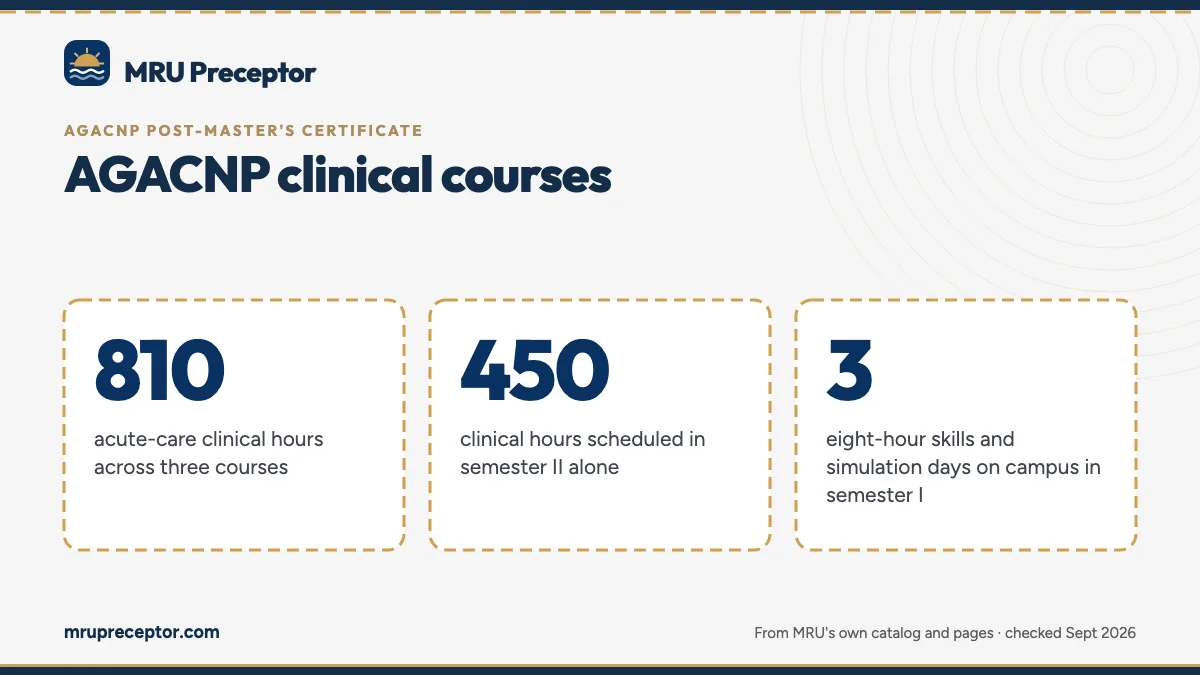
MRU's AGACNP Post-Master's Certificate puts 810 clinical hours into three acute-care courses: MSN5040C and MSN5041C at 225 hours each in semester II, then MSN5042C at 360 hours in semester III. Before any of that, semester I includes three required days of skills and simulation on the Miami Springs campus.
Get your placement plan
Tell us your MRU program and where you live. A placement advisor replies with what an MRU-ready preceptor and site look like for you.
Three courses, 810 hours
The certificate is 30 credits and 1,020 clock hours over 12 months and 3 semesters. Coursework is online, the catalog requires courses to be taken in program order, and each clinical course runs alongside the course that shares its number without the C.
| Course | Credits | Clinical hours | Focus | Semester |
|---|---|---|---|---|
MSN5040C Acute Care Clinical I | 5 | 225 | Acutely ill adults from young adult to frail elderly, for example musculoskeletal and reproductive problems | II, with MSN5040 |
MSN5041C Acute Care Clinical II | 5 | 225 | Cardiovascular, pulmonary and neurological problems | II, with MSN5041 |
MSN5042C Acute Care Clinical III | 7 | 360 | Endocrine, gastrointestinal and multisystem problems; transitions of care | III, with MSN5042 |
One number in MRU's own table does not reconcile. Seven credits at MRU's rate of 45 clinical hours per credit would be 315, yet MSN5042C lists 360, and the 810 total is built on 360. Build your schedule around 360 until the syllabus tells you a different figure.
The on-campus skills and simulation days
The AGACNP catalog entry adds a compulsory on-campus component: three 8-hour days of skills demonstration and simulation in semester I, tied to MSN5031 and its lab. The catalog is blunt about it. You must pass it to progress, and missing or failing it means failing the course.
The campus is a single building in Miami Springs, in Miami-Dade County, served by county public transport. If you live in another SARA state, budget for travel and time away from work in semester I, before any clinical preceptor is involved.
We found no dates for it in MRU's public documents. Look for them in your semester I course materials, and ask your faculty early if you have a work or family conflict, since the catalog sets out no make-up route.
Semester II: two acute-care preceptorships at once
Semester II is the heaviest clinical term in the certificate, with MSN5040C and MSN5041C running together for 450 hours. Spread evenly over a 16-week semester that is about 28 hours a week, by our arithmetic, on top of MSN5040 and MSN5041. MRU does not publish whether either course runs inside one 8-week module, so check your schedule in the portal.
The two courses cover different body systems. A hospitalist or general acute-care service may see all of them; a cardiology or neurology service leans toward MSN5041C. MRU publishes no rule on whether one preceptor may cover both courses in the same term, so ask the Office of Academic Affairs before building your plan on it.
Semester III then carries MSN5042C alone. Its endocrine, gastrointestinal and multisystem focus, plus transitions of care, suits services that manage complex inpatients through discharge.
Who can precept acute care in Florida
For a Florida site, rule 64B9-4.001(13) requires a certified practicing APRN or a licensed MD or DO with a Florida license. An acute care NP, a hospitalist, an intensivist or a specialist physician on an inpatient service can all meet that definition. The rule sets no years-of-practice minimum.
Florida's autonomous-practice statute covers only primary care, so an acute care APRN in Florida practices under a physician protocol. That does not affect their eligibility to precept; the rule asks for a certified, practicing APRN, not an autonomous one. Florida APRN protocol rules explain the background.
MRU's own AGACNP web page states the rule plainly: students secure their own preceptor, and the Office of Academic Affairs approves that preceptor before the preceptorship starts. MRU's preceptor qualification details are in the nursing student handbook on the portal, not on mru.edu. See preceptor approval.
Hospitals, affiliation agreements and your own employer
Acute-care hours usually mean a hospital, and hospitals add their own gate. Every South Florida system that publishes a student policy requires a school affiliation agreement. Baptist Health South Florida wants a Master Agreement and a Program Letter of Agreement, accepts requests only through Complio, needs student profiles at least 10 business days before the start date, and caps a rotation at 4 months. An HCA Florida hospital in Central Florida asks for requests at least a month ahead and tells students not to contact the hospital directly.
Which of these systems holds an agreement with MRU is for the Office of Academic Affairs to confirm, so ask there before you secure a physician's yes, because a willing preceptor cannot override a missing school contract.
Working at a hospital does not make it an easy site. Baptist says employees cannot rotate at the facility where they work. South Florida NP preceptors sets out each system's published rules.
Admission and clearance items that carry into clinicals
- Current ACLS and BLS at admission; Baptist, for one, also lists BLS among its student requirements.
- Individual liability insurance before clinicals, with proof at least 15 days before the externship starts.
- American Data Bank clinical clearance: background check, medical document manager, drug screening and clinical document clearance.
- A Level II background check with fingerprints, and written disclosure of any change to the Office of Academic Affairs within 24 hours.
- A programmatic orientation and an interview with the Dean at admission.
- Immunization proof from a Florida-licensed provider and an annual flu shot.
If you live near Miami Springs, MRU Health, the on-campus clinic on the third floor, can check immunizations, titers, CPR and a physical in one place. Acute-care experience is listed as preferred, not required. The AGACNP certificate page covers admission in full; the clinical hours hub compares the AGACNP with MRU's other programs.
Questions MRU students ask
Can I miss MRU's AGACNP on-campus days and make them up later?
MRU's catalog treats the three skills and simulation days in semester I as compulsory: you must pass them to progress, and missing or failing them fails the course. No make-up rule is published. If you have a conflict, raise it with your faculty before the term starts rather than after the dates pass.
Can I do AGACNP clinicals at the hospital where I work?
MRU publishes no rule on this, but hospitals do. Baptist Health South Florida says employees cannot rotate at the facility where they work, and Nicklaus Children's bars rotations in your own department or during your scheduled hours. Read the hospital's student policy and ask the Office of Academic Affairs before counting on your own unit.
Can an intensivist or hospitalist precept MSN5041C?
Under Florida's rule, a licensed MD or DO holding a Florida license qualifies as a preceptor, as does a certified practicing APRN. An intensivist, hospitalist or cardiologist can therefore meet the state rule for a Florida site. MRU publishes no specialty-match rule, and the Office of Academic Affairs approves each preceptor before hours start.
Is the AGACNP certificate fully online?
Almost. The coursework is online, with one required on-campus component: the three eight-hour skills and simulation days in semester I. The 810 clinical hours happen in person at approved acute-care sites near you, and you must live in Florida or a SARA member state for the whole program.
Which system tracks AGACNP clinical hours?
MRU's AGACNP fee table does not name one. Typhon appears in the tables for the MSN-FNP, MSN Direct Entry and ASN, and the DNP uses myevaluation.com, but nothing public says what AGACNP students log in. Ask your course faculty in semester I, before the first clinical course starts.
Related pages
Last checked 2026-09-24
We check these pages against MRU's own catalog, addenda and program pages. The nursing student handbook on the MRU student portal and MRU's Office of Academic Affairs have the final word.
MRU says secure your own preceptor. We start the search now.
Tell us your MRU program, where you live and when your next clinical course starts. We look for preceptors who fit the course and help you gather what MRU checks before approving them.
- Preceptors matched to the course: adult primary care for
MSN5700, women's health, pediatrics, psychiatric or acute care - Credentials, license and site details collected before MRU's credential check
- Miami-Dade, Broward and Palm Beach, or wherever in a SARA state you live
Start your placement plan
Program, city and start date is all we need to begin.