Florida APRN protocols, autonomous practice and who can precept you
In Florida, an APRN works either under a written protocol with a supervising physician or, in primary care only, as a registered autonomous APRN. Either kind can be a qualified preceptor under the Board of Nursing's rule, and so can a Florida-licensed MD or DO. Knowing which kind you are asking tells you who else at the practice may need to agree.
Get your placement plan
Tell us your MRU program and where you live. A placement advisor replies with what an MRU-ready preceptor and site look like for you.
Protocol practice: Florida's default
Under section 464.012(3) of the Florida Statutes, an APRN performs advanced-practice functions within the framework of an established protocol. The protocol is kept at the practice site, and the Board of Nursing's licensing steps end with filing it at the APRN's practice location.
The protocol comes with a supervisory relationship. The APRN works with a physician (in a group practice, one physician), and a physician or dentist keeps supervision over the specific course of medical treatment. Registered autonomous APRNs are the exception to all of this.
One prescribing rule shows up in daily practice: Florida APRNs may prescribe Schedule II controlled substances only up to a 7-day supply, with an exemption for psychiatric medications prescribed by psychiatric nurses. That exemption is worth understanding before a PMHNP rotation.
Autonomous practice: primary care only
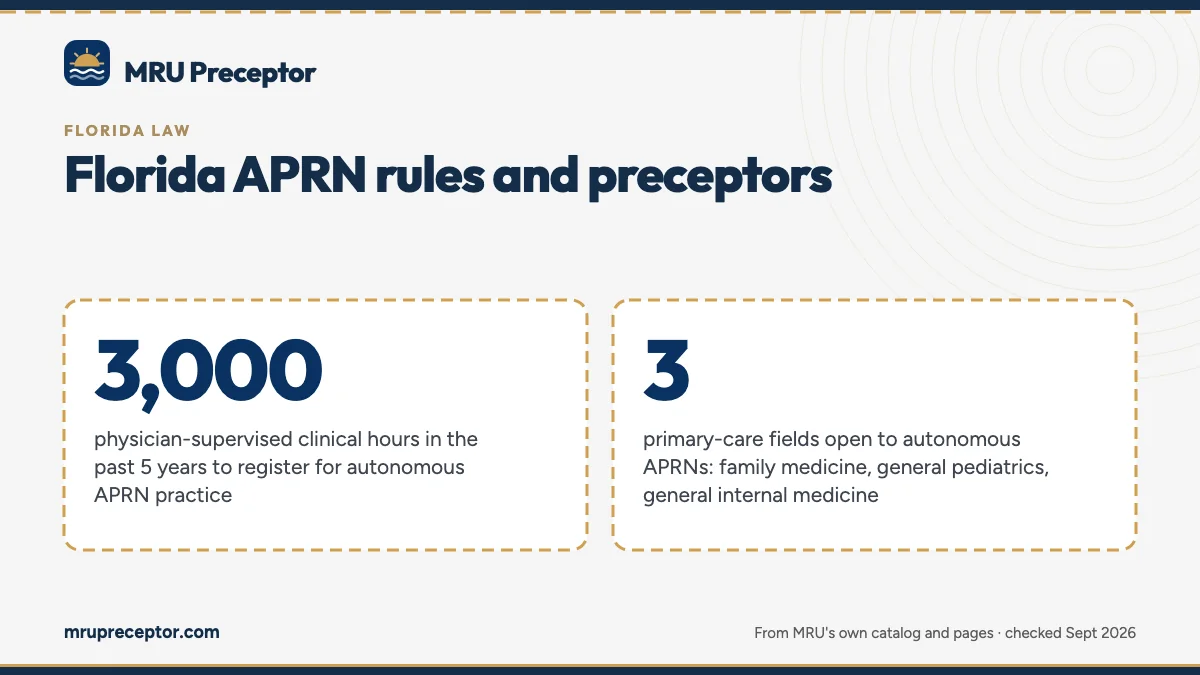
Section 464.0123 opens autonomous registration to APRNs in primary care alone, meaning family medicine, general pediatrics and general internal medicine as the Board defines them. The Board's rule describes primary care broadly, including diagnosis and treatment of acute and chronic illness and of behavioral and mental health conditions.
To register, the Board of Nursing requires
- A clear, active Florida APRN license
- At least 3,000 clinical hours under MD or DO supervision within the past 5 years (clinical teaching as faculty can count)
- Three graduate semester hours in differential diagnosis and three in pharmacology, completed within 5 years
- No discipline under sections 456.072 or 464.018 in the past 5 years
Once registered, an autonomous APRN may admit, manage and discharge hospital patients and sign certifications that would otherwise need a physician, but may not perform surgery beyond subcutaneous procedures. The statute also requires professional liability coverage and extra continuing education at renewal. Specialty practice outside the three primary-care fields, such as acute care, is not named, which reads as leaving it under protocol.
Who can precept an NP student in Florida
Under rule 64B9-4.001(13), the people who may supervise, teach and evaluate an NP student are certified practicing APRNs, plus physicians (MD or DO) and dentists who hold a license. When the clinical setting is in Florida, that license has to be a Florida one.
Three details matter. The rule does not distinguish between protocol and autonomous APRNs; both qualify if they are certified and practicing. It sets no minimum years of experience. And physician assistants are not on the list.
The rule also looks at you: it expects the student to hold an RN license issued under chapter 464. Whether a multistate Compact license issued under section 464.0095 satisfies that is not spelled out in the rule text, so a student relying on a Compact license should confirm with MRU. MRU's own preceptor qualifications, which may go further than the state rule, are in the nursing student handbook; the MRU requirements page covers what is public.
How practice type changes the ask
| Preceptor | How they practice | What to ask |
|---|---|---|
| APRN under protocol | Written protocol with a supervising physician, kept at the practice | Whether the practice owner or supervising physician must agree to host a student, and who provides the site details MRU asks for |
| Autonomous APRN | Registered under s. 464.0123; primary care only; no supervising physician | Whether they can decide alone about hosting you; a fit for primary-care courses, not acute care |
| MD or DO | Florida license under chapter 458 or 459 | Qualifies under the state rule; confirm that MRU accepts a physician preceptor for your course |
Whichever type you find, collect the license type and number and the certification details for MRU's credential check. A protocol APRN who is keen to teach but whose practice has not agreed is not yet a preceptor, so settle that question in the first conversation.
Matching the law to your MRU course
For FNP students, the primary-care courses line up with the fields open to autonomous APRNs. MSN5700 (adults and older adults), MSN6150 (pediatrics) and MSN6400 (Role Development in Family Practice, one setting across the lifespan) can each be precepted by an autonomous APRN in the right field, a protocol APRN, or a physician MRU approves. A dedicated women's health practice for MSN6050 sits outside the three named fields, so its APRNs are likely to work under protocol.
The AGACNP certificate's 810 hours are acute care, outside autonomous practice, so APRN preceptors there work under protocol, often inside hospitals with their own student rules; see the AGACNP courses page. A psychiatric practice is not one of the named fields either, although the Board's primary-care definition includes mental health conditions, so ask a PMHNP preceptor how their practice is set up; the PMHNP courses page has the hour mix.
Healthcare Systems Leadership and the DNP sit outside all of this: MSN5855 needs a master's-prepared nurse leader, and MRU's DNP does not prepare graduates for APRN licensure.
Outside Florida, and checking before you submit
Florida's preceptor rule covers clinical settings in Florida. If you are an online MRU student training in another SARA state, that state's rules govern your preceptor's license; start with clinicals outside Florida and your state guide.
Before you submit a Florida preceptor to MRU, confirm four things in one short conversation: that the license is a Florida license of a type the rule lists, the national certification, whether they practice under protocol or autonomously, and whether the practice as a whole has agreed to host you. Then ask whether they can carry the full hours to the course's last day and sign MRU's end-of-course evaluation alongside your clinical instructor. If the practice is in South Florida, the regional guide covers what local health systems require.
Questions MRU students ask
Can a physician assistant precept an MRU NP student in Florida?
Not under Florida's qualified-preceptor rule, which lists certified practicing APRNs, licensed MDs and DOs, and licensed dentists. Physician assistants are not on that list. MRU's handbook sets its own preceptor rules as well, so if a PA offers to help, ask your program's approver before you count on those hours.
Is there a minimum experience requirement for Florida preceptors?
Florida's rule does not set one. MRU may, but its preceptor qualifications are in the nursing student handbook on the student portal rather than on the public website. Check the handbook, or put the question to the Office of Academic Affairs, before approaching someone who is newly certified.
Can an autonomous APRN precept my acute-care or psychiatric hours?
Autonomous registration covers only family medicine, general pediatrics and general internal medicine, so an APRN working in acute care or another specialty is read as practicing under protocol. The preceptor rule itself does not care which kind of APRN you have. What matters is a certified practicing APRN in a setting that fits your course, approved by MRU.
Where can I read the Florida law myself?
The statutes are on the Florida Senate site: section 464.012 for protocol practice and section 464.0123 for autonomous practice. The preceptor rule is 64B9-4.001 on flrules.org. The Board of Nursing's APRN page at floridasnursing.gov lists licensing steps and autonomous-registration requirements. The sources list on this page links to each.
Does a protocol APRN's supervising physician have to sign anything for MRU?
MRU does not publish its preceptor or site forms, so there is no public answer. A protocol APRN works within a supervisory relationship with a physician, and the practice may want that physician or the owner to agree before a student arrives. Ask early, and follow what your MRU handbook asks for.
Related pages
Last checked 2026-09-24
We check these pages against MRU's own catalog, addenda and program pages. The nursing student handbook on the MRU student portal and MRU's Office of Academic Affairs have the final word.
MRU says secure your own preceptor. We start the search now.
Tell us your MRU program, where you live and when your next clinical course starts. We look for preceptors who fit the course and help you gather what MRU checks before approving them.
- Preceptors matched to the course: adult primary care for
MSN5700, women's health, pediatrics, psychiatric or acute care - Credentials, license and site details collected before MRU's credential check
- Miami-Dade, Broward and Palm Beach, or wherever in a SARA state you live
Start your placement plan
Program, city and start date is all we need to begin.