MRU's AGACNP certificate: acute-care clinicals and preceptors
MRU's Adult-Gerontology Acute Care NP certificate fits 810 clinical hours into 30 credits and 12 months. It is taught online, apart from a required three-day skills and simulation weekend on the Miami Springs campus in the first semester. You secure your own acute-care preceptor, and the Office of Academic Affairs approves both that person and the preceptorship before it begins.
Get your placement plan
Tell us your MRU program and where you live. A placement advisor replies with what an MRU-ready preceptor and site look like for you.
MSN5042C alone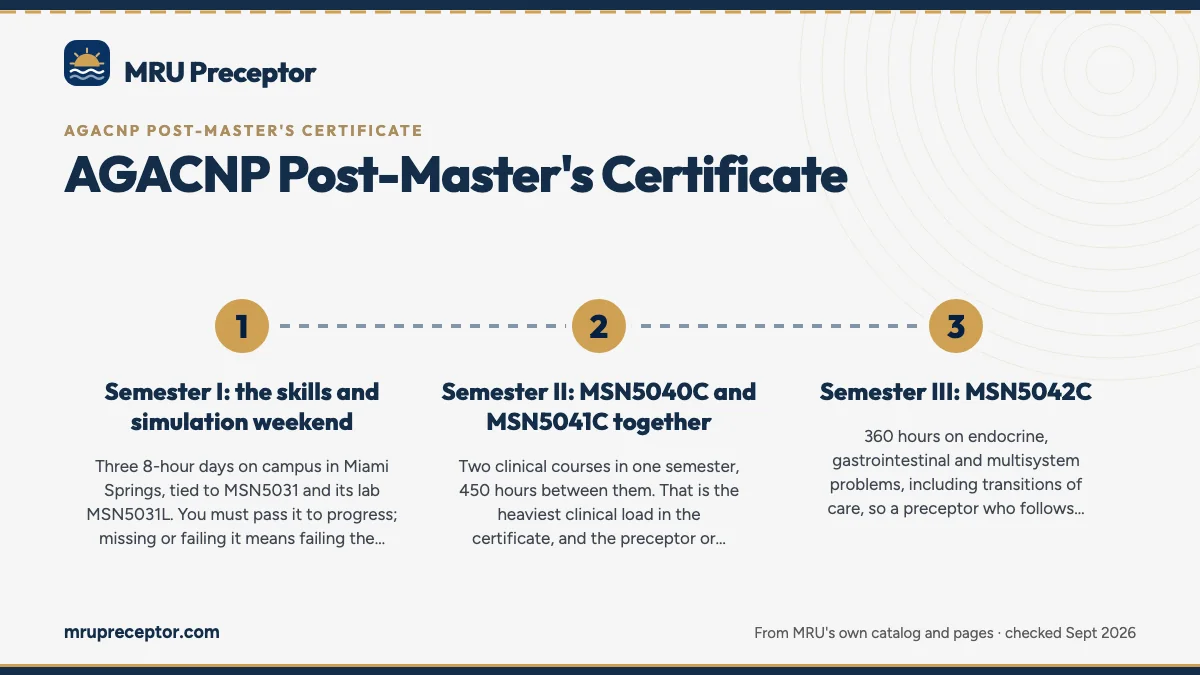
Certificate facts
This is a Post-Master's Certificate of 30 credits, finished in 12 months over three semesters. The catalog counts 1,020 clock hours, and 810 of those are clinical. Courses run in a fixed program order, and MRU states the curriculum meets NCSBN criteria for APRN certification-exam eligibility without naming the certifying body.
Admission items that matter for clinicals
- An MSN, with graduate advanced pathophysiology, pharmacology and health assessment
- Current ACLS and BLS certification
- Student liability insurance
- An active RN license
- Residence in Florida or a SARA member state for the full certificate
- A programmatic orientation and an admission interview
- Acute-care experience is preferred, not required
ACLS and BLS are admission requirements here, not something to sort out later. Keep both current for the whole year, because a lapse in the middle of a clinical course is harder to fix than one caught before the term.
The three acute care clinical courses
All 810 hours sit in three courses, each paired with a didactic course in the same semester.
| Course | Clinical focus | Credits | Clinical hours | Semester |
|---|---|---|---|---|
MSN5040C Acute Care Clinical I | Acutely ill adults from young adult to frail elderly, for example musculoskeletal and reproductive problems | 5 | 225 | II, with MSN5040 |
MSN5041C Acute Care Clinical II | Cardiovascular, pulmonary and neurological problems | 5 | 225 | II, with MSN5041 |
MSN5042C Acute Care Clinical III | Endocrine, gastrointestinal and multisystem problems; transitions of care | 7 | 360 | III, with MSN5042 |
One number does not reconcile. At MRU's rate of 45 clinical hours per credit, a 7-credit course would carry 315 hours, yet MSN5042C lists 360, and the 810 total is built on 360. Budget time for 360 hours unless your instructor sets a different figure. The AGACNP clinical courses page covers each course in more depth.
Sequence and the on-campus weekend
- Semester I: the skills and simulation weekendThree 8-hour days on campus in Miami Springs, tied to
MSN5031and its labMSN5031L. You must pass it to progress; missing or failing it means failing the course. Book travel early if you live outside South Florida. - Semester II:
MSN5040CandMSN5041CtogetherTwo clinical courses in one semester, 450 hours between them. That is the heaviest clinical load in the certificate, and the preceptor or preceptors need to cover both the general acute-care focus and cardiovascular, pulmonary and neurological cases. - Semester III:
MSN5042C360 hours on endocrine, gastrointestinal and multisystem problems, including transitions of care, so a preceptor who follows patients toward discharge fits well.
Since semester II is where clinical hours begin, your preceptor search belongs in semester I. From Fall 2026 each semester lasts 16 weeks, so there is little slack once a term opens.
Who finds your preceptor, and who approves
The AGACNP program page on mru.edu is the one MRU web page that prints the full rule: "Students are required to secure their own preceptor." The catalog repeats it. Both the preceptor and the preceptorship must be approved before it starts, and the Office of Academic Affairs is the approver named for this track.
A student with no preceptor is appointed one by the University for an additional fee. The AGACNP fee table lists this as the Practicum Affiliation Fee, which is waived only for students who secure an approved preceptor, plus a Practicum Credentialing Fee for verifying preceptor credentials. The Practicum Affiliation Fee page lays out that choice.
Approval paperwork, timelines and MRU's own preceptor qualifications are not public. The nursing student handbook on the student portal holds them, and the preceptor approval page summarizes what can be confirmed.
What an acute-care preceptor and site look like
The course descriptions point to hospital-level acuity: acutely ill adults, cardiopulmonary and neurological cases, multisystem problems and transitions of care. For a Florida site, rule 64B9-4.001(13) accepts a certified practicing APRN or a licensed MD or DO as preceptor, with a Florida license required for a Florida setting. Florida limits autonomous APRN practice to primary care, so an acute-care APRN precepting you in Florida will generally be practicing under a physician protocol; the Florida protocol page explains why that matters.
Hospitals add their own layer. Every South Florida system that publishes a student policy requires an affiliation agreement with the school. Baptist Health takes rotation requests only through Complio, and one HCA Florida hospital tells students not to contact it directly about placement. Check a hospital's rules before approaching its clinicians; our South Florida preceptors page goes system by system.
On MRU's side, a supervisor overseeing certificate students indirectly may have no more than eight at a time (a 1:8 ratio).
Clearance, records and residence
The AGACNP fee table names American Data Bank for clinical clearance (background check, drug screening, medical documents and clinical document clearance) and a Level II background check with fingerprints. Immunization proof must come from a Florida-licensed provider, the flu shot is yearly, and liability insurance proof is due at least 15 days before the externship; see the liability insurance page.
MRU does not name a tracking system for this certificate, so follow your syllabus. The catalog's end-of-course rules still apply: every hour completed with an approved preceptor, logs and case lists submitted, and an evaluation signed by the preceptor, clinical instructor and student by the course's last day. A failed component fails the whole course, as the failing a clinical course page explains.
You must live in Florida or a SARA member state for the whole certificate; California residents are outside that rule. ACEN accredits MRU's master's and post-master's certificate programs, and its record lists the AGACNP post-master's certificate as an approved option.
Why AGACNP students choose us
An acute-care placement has two sets of rules to satisfy: MRU's, and the hospital's. We look for acute-care preceptors and sites near you that match the course you are entering, check each hospital's student-placement rules before anyone is approached, and help you gather what MRU's credential check needs. MRU gives the final approval, and we make sure the acute-care preceptor it reviews is fully documented and suited to the course. Start with the form below, ideally during semester I.
Questions MRU students ask
Can I skip or reschedule the AGACNP on-campus weekend?
MRU's catalog treats it as required. The three-day skills and simulation weekend happens on campus in semester I, and missing or failing it means failing the course. MRU's public documents describe no make-up process for it, so if a date clashes with work or travel, raise it with your program as early as possible.
Do I need ICU experience for MRU's AGACNP certificate?
No specific unit is required. MRU lists acute-care experience as preferred, not required. What it does require at admission is current ACLS and BLS, an MSN with graduate pathophysiology, pharmacology and health assessment, an active RN license, liability insurance and residence in Florida or a SARA state.
Why does MSN5042C show 360 hours on 7 credits?
MRU does not explain it. Seven credits at 45 clinical hours each would be 315, but the catalog prints 360 for MSN5042C, and the certificate's 810-hour total depends on the 360 figure. Treat 360 as the target and confirm with your instructor at the start of semester III.
Can I simply contact a hospital unit and ask for an AGACNP rotation?
Often not. South Florida systems that publish policies require an agreement with the student's school first, Baptist Health accepts requests only through Complio, and an HCA Florida hospital asks students not to contact it directly. Read the hospital's student page first, then approach clinicians in the way it allows.
How many clinical hours fall in the second semester?
450. MSN5040C and MSN5041C each carry 225 clinical hours and run together in semester II, the first semester with clinical time. One acute-care preceptor may be able to cover both courses; if not, you need two, and MRU must approve each before hours begin.
Related pages
Last checked 2026-09-24
We check these pages against MRU's own catalog, addenda and program pages. The nursing student handbook on the MRU student portal and MRU's Office of Academic Affairs have the final word.
MRU says secure your own preceptor. We start the search now.
Tell us your MRU program, where you live and when your next clinical course starts. We look for preceptors who fit the course and help you gather what MRU checks before approving them.
- Preceptors matched to the course: adult primary care for
MSN5700, women's health, pediatrics, psychiatric or acute care - Credentials, license and site details collected before MRU's credential check
- Miami-Dade, Broward and Palm Beach, or wherever in a SARA state you live
Start your placement plan
Program, city and start date is all we need to begin.