Finding NP preceptors in Miami-Dade, Broward and Palm Beach
MRU's only campus is in Miami Springs, and many of its NP students search for preceptors across Miami-Dade, Broward and Palm Beach. The large health systems publish rules that run students through school affiliation agreements and their own platforms, so most self-found preceptorships come from private practices and community clinics. Wherever you land, a Florida site needs a Florida-licensed preceptor and MRU's approval.
Get your placement plan
Tell us your MRU program and where you live. A placement advisor replies with what an MRU-ready preceptor and site look like for you.
The license rule for every Florida site
Florida's Board of Nursing defines a qualified preceptor in rule 64B9-4.001(13). The preceptor has to be a certified practicing APRN, a physician (MD or DO) or a dentist, each licensed, and a clinical setting in Florida calls for a Florida license under the matching chapter of Florida law. Nothing in the rule requires a minimum number of years of experience.
MRU's own preceptor qualifications are published only to students, in the nursing student handbook behind the portal login, so read that too before you ask anyone. A preceptor who meets the state rule still needs MRU's approval before your first hour. For how Florida's protocol and autonomous practice types affect the ask, see the Florida APRN guide; for MRU's side, see preceptor requirements.
What the big systems say publicly
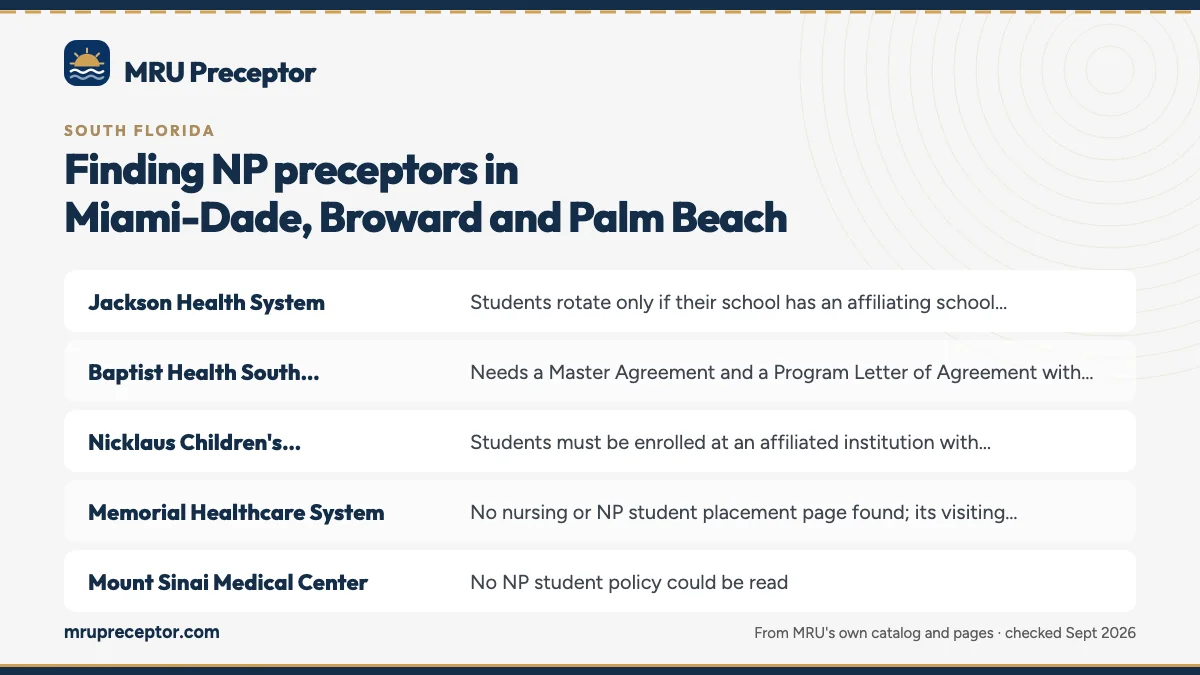
The table summarizes each system's own public statements about student rotations, as they could be read in September 2026. These pages change, so read the current version before you plan around one. Whether MRU holds an agreement with any system is a question for MRU, not something to assume from this table.
| System | What its public page says |
|---|---|
| Jackson Health System | Students rotate only if their school has an affiliating school agreement; the school list is updated every six months, and some agreements cover Jackson employees only |
| Baptist Health South Florida | Needs a Master Agreement and a Program Letter of Agreement with the school; takes requests only through Complio, with student profiles due at least 10 business days before the start; students may contact Baptist providers directly about precepting |
| Nicklaus Children's Hospital | Students must be enrolled at an affiliated institution with school approval; NP students must secure a preceptor before submitting requirements; nursing rotations go through CCPS |
| Memorial Healthcare System | No nursing or NP student placement page found; its visiting medical students onboard through Complio |
| Mount Sinai Medical Center | No NP student policy could be read |
| HCA Florida Healthcare | No South Florida student page found; one Central Florida HCA hospital requires an affiliation agreement and asks students not to contact it directly |
What that means for your search
Hospital preceptorships depend on paperwork between institutions, not only on a willing NP. Every system above that states a policy asks for a school agreement, and Baptist adds its own platform and lead time. A hospital-based NP who says yes is only the first step; the agreement between school and hospital has to exist as well, and MRU does not publish its site-agreement process.
So ask MRU early. If you have a contact at a particular hospital, ask the Office of Academic Affairs whether an agreement is in place or can be arranged before you spend weeks on it. For AGACNP students, whose 810 hours are acute care, this question comes first.
One overlap is worth knowing. Baptist takes requests only through Complio, which comes from American Data Bank, the vendor MRU names for clinical clearance. That is an observation about shared software, not evidence of any arrangement between MRU and Baptist.
Private practices and community clinics
As general guidance, most self-found FNP preceptorships come from private practices and community clinics rather than hospitals. A practice owner or lead clinician can often decide to host a student without a system-level agreement, although some will still ask MRU for paperwork. Match the practice to the course:
MSN5700: adult and older-adult primary care in a community, clinic or primary-care practiceMSN6050: women's health, from menarche to the end of pregnancyMSN6150: pediatrics from infancy through adolescence; some sites include sports physicalsMSN6400: one clinical setting across the lifespan for at least 180 hours, which suits a family practice- PMHNP courses: psychiatric practices and community mental health settings that can cover child and adolescent work, psychotherapy and lifespan care
Course detail is on the MSN5700 page and the PMHNP clinical courses page.
Local realities worth planning for
Competition. In academic year 2021-22 the Florida Center for Nursing's South region, which covers Broward, Miami-Dade and Monroe, had 23 graduate nursing pathways. Many programs ask the same practices, so a practice that says it is full this term may already be hosting another school's student.
Where you work. Two systems restrict staff: Baptist bars employees from rotating at their own facility, and Nicklaus bars them from their own department and from rotating during scheduled shifts. If you are on staff at a hospital, read its rule before planning clinicals there.
Language and shifts. MRU requires English during externship hours unless the agency authorizes another language in writing, and it warns that externship hours can fall on any shift. Raise both with a practice before you commit.
Distance. MRU publishes no distance limit for a preceptorship site. A Palm Beach student can look close to home rather than near Miami Springs, as long as MRU approves the preceptor.
How we search in South Florida
We search in person, near where you live, starting with practices and clinics whose patients fit your course and whose hours fit your schedule. Before we introduce you, we confirm the preceptor's Florida license and specialty and ask whether they can carry your hours to the course's last day. Then we help you put the credentials, license and site details together for MRU's credential check and approval.
Where a hospital's school agreement is the deciding factor, that step belongs to MRU, so we concentrate on practices and clinics where your placement can move straight ahead. If a hospital is the only realistic setting for your course, we tell you early and point you to MRU. How it works walks through the full process, and the Florida guide covers statewide context.
Questions MRU students ask
Can I do my MRU clinical hours at the hospital where I work?
It depends on the hospital and on MRU. Baptist Health will not place employees in student rotations where they work, and Nicklaus Children's excludes staff from their own department and from rotating during scheduled hours. Where a hospital does allow it, MRU must approve the preceptor, and the hospital may need a school agreement first.
Does a private practice need an affiliation agreement with MRU?
MRU does not publish its site-agreement process or say which sites need a signed agreement. Some practices ask for one; others host students on the strength of the school's paperwork. The nursing student handbook on the MRU PORTAL and the Office of Academic Affairs are where to confirm what MRU needs from a practice.
What is CCPS?
CCPS is the Centralized Clinical Placement System. Baptist Health routes ASN and BSN rotation requests through it, and Nicklaus Children's routes nursing rotations through it. MRU's public documents do not mention CCPS, so if a site asks about it, check with your program before assuming it applies to your NP course.
Can a physician be my preceptor in Miami?
Florida's qualified-preceptor rule includes licensed MDs and DOs alongside APRNs, and a Florida site needs a Florida-licensed preceptor. MRU does not publish which credentials it accepts for each course, so confirm in the handbook or with your approver before you ask a physician. The Healthcare Systems Leadership practicum is different: it calls for a master's-prepared nurse leader.
Is the Florida license rule different in Broward or Palm Beach?
No. Rule 64B9-4.001(13) applies statewide, so any Florida clinical setting needs a Florida-licensed preceptor, whether the practice is in Miami-Dade, Broward or Palm Beach. The county only changes which practices and health systems are near you and how far you drive to reach them.
Related pages
Last checked 2026-09-24
We check these pages against MRU's own catalog, addenda and program pages. The nursing student handbook on the MRU student portal and MRU's Office of Academic Affairs have the final word.
MRU says secure your own preceptor. We start the search now.
Tell us your MRU program, where you live and when your next clinical course starts. We look for preceptors who fit the course and help you gather what MRU checks before approving them.
- Preceptors matched to the course: adult primary care for
MSN5700, women's health, pediatrics, psychiatric or acute care - Credentials, license and site details collected before MRU's credential check
- Miami-Dade, Broward and Palm Beach, or wherever in a SARA state you live
Start your placement plan
Program, city and start date is all we need to begin.