MSN5700 Advanced Practice in Primary Care
MSN5700 is the first clinical course in MRU's MSN-FNP: 8 credits, 270 total clock hours in the catalog, with adult and geriatric patients in a community, clinic or primary-care practice. You bring the preceptor, and MRU's Office of Academic Affairs has to approve that person before the preceptorship starts.
Get your placement plan
Tell us your MRU program and where you live. A placement advisor replies with what an MRU-ready preceptor and site look like for you.
MSN5700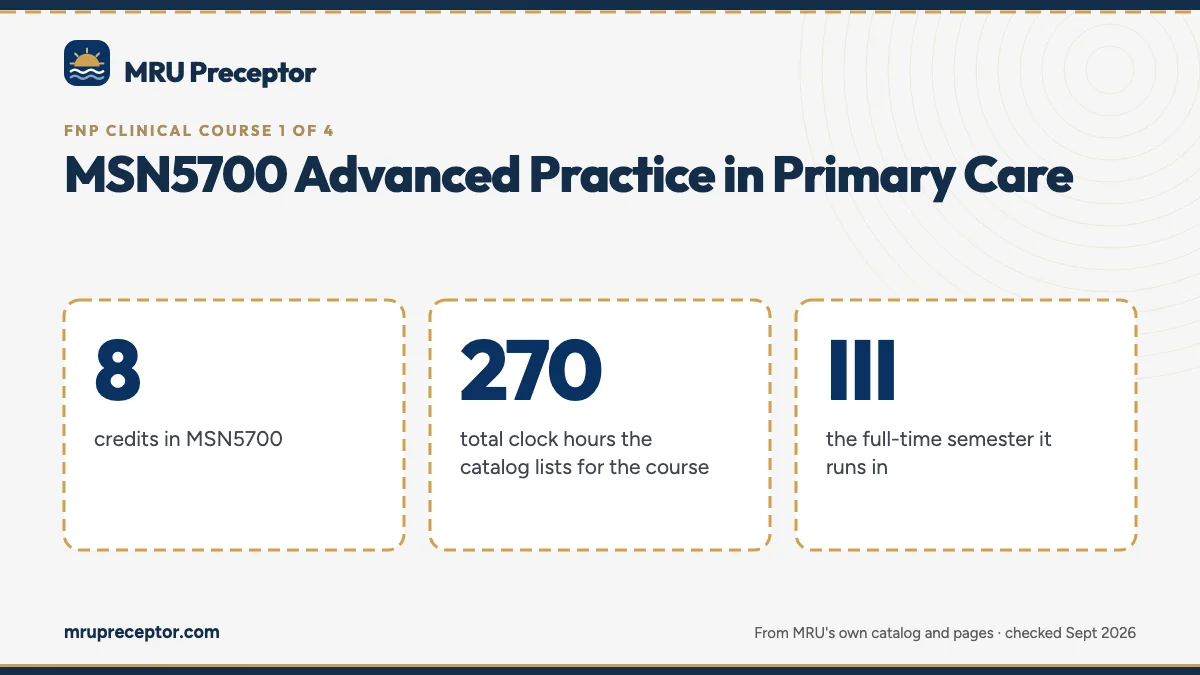
What MRU's catalog says about MSN5700
The 2025 catalog (Volume X) lists MSN5700 Advanced Practice in Primary Care as an 8-credit course that includes clinical. Its degree-plan hours column shows 270 clock hours, and that column adds lecture, lab and clinical time together rather than showing clinical time alone.
The patients are adults and older adults. The places the catalog names are a community setting, a clinic or a primary-care practice, and those are the words to hold a prospective site against. The same course appears in the FNP Post-Master's Certificate, which uses all four MSN-FNP clinical courses.
| Item | What MRU publishes |
|---|---|
| Full title | Advanced Practice in Primary Care (includes clinical) |
| Credits | 8 |
| Total clock hours | 270, lecture and clinical combined |
| Population | Adult and geriatric patients |
| Setting | Community, clinic or primary-care practice |
| Prerequisites | MSN5150, MSN5200, MSN5300, MSN5350, MSN5400, MSN5550 |
| Hour tracking | Typhon, named in the MSN-FNP fee table |
How many clinical hours is MSN5700?
MRU does not print a clinical-hour figure for MSN5700, or for any single FNP course. What it does publish is how time converts to credit: 15 hours of lecture, 30 of lab, or 45 of externship, clinical or simulation work make one semester credit.
Apply that rule to 8 credits and 270 total hours and only one split adds up: 3 lecture credits (45 hours) plus 5 clinical credits (225 hours). So 225 clinical hours is our calculation, not a number MRU states. If your syllabus gives a different target, the syllabus is what your faculty will grade against.
The same arithmetic across all four FNP clinical courses comes to about 765 hours. The FNP clinical hours page sets out each step, including the 180-hour minimum written into the final course's description.
Do not quote 270 hours to a preceptor. That figure includes classroom time; by MRU's own conversion the clinical share is closer to 225, and the syllabus sets the real target.
Prerequisites and where it falls in your plan
You reach MSN5700 after six courses: MSN5150, MSN5200, MSN5300, MSN5350, MSN5400 and MSN5550. The Office of Academic Affairs handles prerequisite overrides, so do not plan on taking it early without that office's say-so.
On the full-time plan (50 credits over 5 semesters and 20 months) it is the only clinical course in semester III. The part-time plan runs 8 semesters over 32 months and places one clinical course in each of semesters V to VIII. Because the other three clinical courses all list MSN5700 as a prerequisite, it has to come first in that run.
That makes it the gate for everything after it. Women's health and pediatrics both require it, along with MSN5600, so a late start here pushes each later placement back by a term.
Who can precept MSN5700
MRU's public documents do not list preceptor qualifications for the FNP. The catalog refers you to the nursing student handbook, which sits behind the login on the student portal, so read its preceptor section before you approach anyone.
If the site is in Florida, the Board of Nursing's rule 64B9-4.001(13) sets the floor. A qualified preceptor is a certified, practicing APRN or a licensed MD or DO, and the license has to be a Florida one. Nothing in it demands a set number of years in practice; whether MRU adds such a requirement is a question for the handbook or the Office of Academic Affairs.
For an adult and geriatric primary-care course, the natural match is a family or internal medicine practice where the preceptor sees adults and older adults most of the day. Florida lets some APRNs practice autonomously in family and general internal medicine, but an APRN working under a physician protocol meets the rule just as well; Florida's protocol rules explain the difference. More detail on who qualifies, including outside Florida, is on preceptor requirements.
Finding a site that fits the course description
Large South Florida systems that publish a student policy, including Jackson, Baptist and HCA, require a school affiliation agreement first. MRU does not publish which of them it holds one with, so ask the Office of Academic Affairs. With an independent practice the questions narrow to the preceptor, the license and the schedule. South Florida preceptors covers the local picture.
Questions to put to a prospective preceptor
- Are most of your patients adults and older adults, the group the course names?
- Is your license issued by the state the clinic is in (Florida, for a Florida site)?
- Can you offer enough clinic days to finish before the course's last day?
- Will you sign the end-of-course evaluation MRU requires from you, the clinical instructor and me?
- Does your practice need a school agreement or a compliance platform before a student can start?
MRU's catalog also says externship shifts can fall on evenings, nights, weekends or holidays, so a clinic with Saturday hours is not a problem in itself.
During the course and at the finish
Hours go into Typhon, which MRU's fee table calls the Clinical Evaluation Portfolio System for the MSN-FNP. By the course's last day you need every hour completed with the approved preceptor, plus logs, case lists, documentation and an end-of-course evaluation signed by your preceptor, your clinical instructor and you. The Typhon page covers logging habits.
Miss any of those items and the whole course fails. Failing any single component, lecture or preceptorship, does the same, and falsified logs or invented encounters mean failure and possible dismissal. MRU allows only one repeat of an MSN course.
If your preceptor leaves mid-semester, act that week: a replacement needs MRU approval before new hours count, and the preceptor dropped out page lists the first moves.
Questions MRU students ask
Can I do MSN5700 at an urgent care?
MRU's description names a community setting, clinic or primary-care practice with adult and geriatric patients, and it publishes no list of accepted site types. An urgent care that sees mostly adults may or may not suit, depending on how your faculty read that wording. Ask the Office of Academic Affairs before you commit, and keep the answer in your MRU email.
Can a physician assistant precept MSN5700 in Florida?
Florida's rule 64B9-4.001(13) defines a qualified preceptor as a certified practicing APRN or a licensed MD, DO or dentist, so a physician assistant is not on that list for a Florida site. MRU's public documents say nothing about PAs either way. Outside Florida, check your own state board's rules and MRU's handbook before asking a PA.
Does an FNP-PMC gap analysis remove MSN5700?
It might, but do not assume so. MRU says currently certified NPs may need only 10 to 16 credits after a gap analysis, yet the certified-NP table printed just below that statement still lists all four clinical courses. Get your gap analysis result in writing before you start searching for a primary-care preceptor.
When should I start looking for an MSN5700 preceptor?
MRU publishes no deadline for naming a preceptor and no approval timeline. Two dates are fixed: self-registration opens 20 days before the semester, and proof of liability insurance is due at least 15 days before the externship starts. Since approval must come before any hours, we suggest starting during the semester before semester III. The calendar page lists term dates.
Is MSN5700 offered online?
The MSN-FNP is offered onsite and online, but the clinical part happens in person with an approved preceptor at a real practice. Online students must live in Florida or a SARA member state for the whole program, and a preceptor outside Florida is licensed under that state's rules rather than Florida's.
Related pages
Last checked 2026-09-24
We check these pages against MRU's own catalog, addenda and program pages. The nursing student handbook on the MRU student portal and MRU's Office of Academic Affairs have the final word.
MRU says secure your own preceptor. We start the search now.
Tell us your MRU program, where you live and when your next clinical course starts. We look for preceptors who fit the course and help you gather what MRU checks before approving them.
- Preceptors matched to the course: adult primary care for
MSN5700, women's health, pediatrics, psychiatric or acute care - Credentials, license and site details collected before MRU's credential check
- Miami-Dade, Broward and Palm Beach, or wherever in a SARA state you live
Start your placement plan
Program, city and start date is all we need to begin.