MSN6050 Women's Health: MRU's FNP clinical, explained
MSN6050 Advanced Practice in Primary Care – Women's Health is a 5-credit course whose catalog hours total 165, and its patients are women from menarche to the end of pregnancy. Full-time students take it in semester IV alongside MSN6150 Pediatrics, so you are planning clinical time for two populations in the same term.
Get your placement plan
Tell us your MRU program and where you live. A placement advisor replies with what an MRU-ready preceptor and site look like for you.
MSN6050MSN6150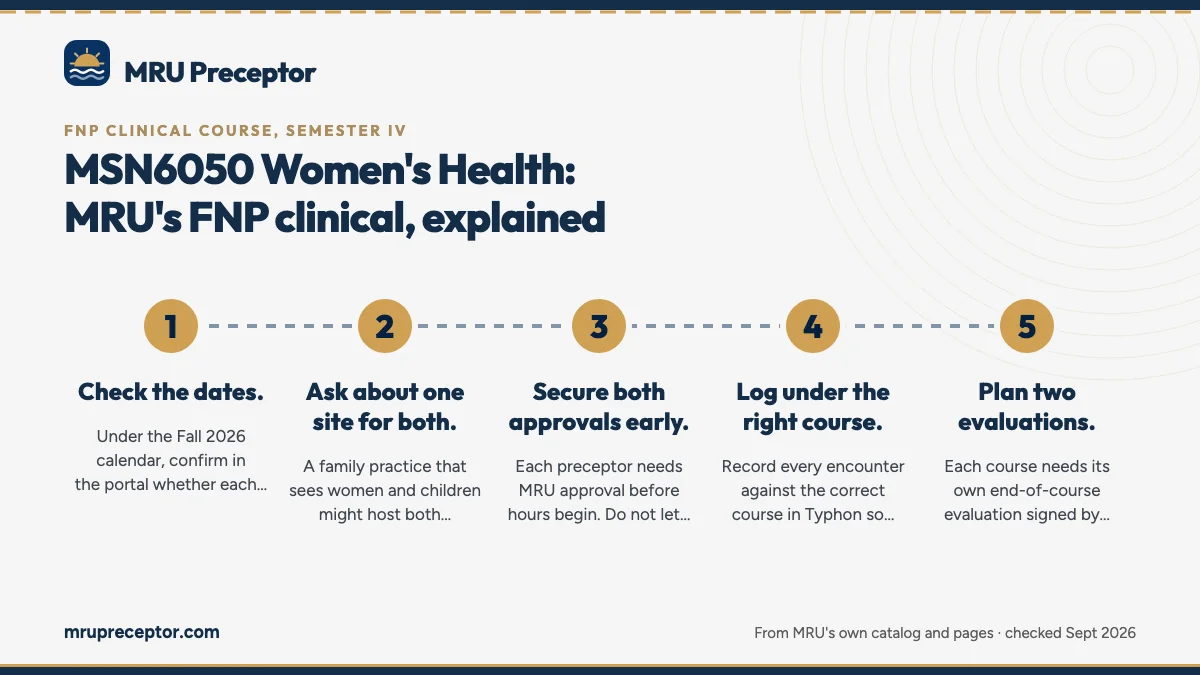
The course in the catalog's own terms
MRU's 2025 catalog gives MSN6050 5 credits and 165 clock hours, a figure that folds lecture and clinical time into one number. The population is narrow and named: women from menarche to the end of pregnancy.
The full title keeps the phrase "Advanced Practice in Primary Care", which places women's health inside MRU's primary-care sequence rather than as a separate specialty. It comes after MSN5700 and uses the same own-preceptor rule as every FNP clinical course.
| Item | Detail |
|---|---|
| Title | Advanced Practice in Primary Care – Women's Health |
| Credits | 5 |
| Total clock hours | 165 (lecture plus clinical) |
| Patients | Women from menarche to the end of pregnancy |
| Prerequisites | Everything required for MSN5700, plus MSN5600 and MSN5700 |
| Full-time placement | Semester IV, together with MSN6150 |
| Part-time placement | One of semesters VI or VII (your degree plan shows which) |
| Also required in | FNP Post-Master's Certificate |
Clinical hours: MRU's figure and ours
No clinical-hour number is printed for MSN6050. MRU's credit rule fills the gap: each semester credit is worth 15 lecture hours or 45 clinical hours. For 5 credits totaling 165 hours, the split that works is 2 lecture credits (30 hours) and 3 clinical credits (135 hours).
Treat 135 as our calculation from MRU's 45-hours-per-credit rule, not as MRU's statement. If the syllabus names another figure, give your preceptor that number instead.
Full-time, you carry MSN6150 in the same semester, and the same arithmetic puts it at 135 as well, so roughly 270 clinical hours across two populations in one term. MRU does not publish whether each course fills the full 16 weeks or one 8-week module; check your schedule in the portal. The FNP hours page sets out the program-wide numbers.
Which patients count, and where to find them
Read literally, the printed range covers girls and women from their first period through their reproductive years and pregnancy. The catalog lists no visit types, so look in the syllabus for any required mix before you pick a site.
The range also stops at the end of pregnancy and says nothing about menopause. If most of a practice's patients are older women, ask your course faculty whether those visits count toward MSN6050 before you commit to it.
Site types that can match the description
- An OB/GYN office with outpatient prenatal and gynecology visits
- A women's health or family planning clinic
- A community health center with a women's health service
- A family practice with a steady share of women's visits, if your faculty agree it fits
MRU approves the preceptor, not a site type, so any of these still depends on the person you would work with.
Who can supervise MSN6050
At a Florida clinic, your preceptor must meet rule 64B9-4.001(13): a certified practicing APRN, or a licensed MD or DO, holding a Florida license. A women's health or family NP and an OB/GYN physician can all fall inside that definition, and so can a certified nurse midwife licensed as a Florida APRN.
Which of those MRU will accept for this course is MRU's decision. It publishes no specialty rules, years of experience or board-certification requirements for FNP preceptors; if it sets any, they are in the nursing student handbook on the portal. The Office of Academic Affairs approves each FNP preceptor before the preceptorship starts, and MRU charges a Practicum Credentialing Fee for verifying preceptor credentials. See preceptor approval and preceptor credentialing.
Running MSN6050 and MSN6150 in one semester
The full-time plan stacks both 5-credit primary-care courses in semester IV. It is the one term where two sets of clinic days have to fit around each other and around lectures.
- Check the dates. Under the Fall 2026 calendar, confirm in the portal whether each course runs across the 16-week semester or inside one 8-week module.
- Ask about one site for both. A family practice that sees women and children might host both courses. MRU does not publish whether one preceptor may cover two courses in a term, so ask the Office of Academic Affairs.
- Secure both approvals early. Each preceptor needs MRU approval before hours begin. Do not let the second approval trail the first.
- Log under the right course. Record every encounter against the correct course in Typhon so neither looks short near the end.
- Plan two evaluations. Each course needs its own end-of-course evaluation signed by preceptor, clinical instructor and you by that course's last day.
If the placement wobbles mid-term
Missing hours by the last day fails MSN6050, and so does failing its preceptorship component. MRU offers no leave of absence, so stepping away means a withdrawal. A W is recorded only before the course's 50% point; after that it becomes a WF, which counts as a failure.
Failures add up quickly at graduate level. A second failure of the same MSN course means dismissal, and so does failing any two MSN concentration courses, which is why a shaky placement is worth fixing in week three rather than week twelve.
An Incomplete is possible only with at least 80% of the course done, a written request and approval from faculty and the program Dean; the incomplete grade page has the time limits. If you are running short of hours, behind on clinical hours sets out what to do while there is still time.
Questions MRU students ask
Does MSN6050 include labor and delivery?
The catalog describes the population as women from menarche to the end of pregnancy and does not mention labor and delivery or inpatient obstetrics. The course sits in MRU's primary-care sequence. If you want birth experience or wonder whether a hospital shift would count, ask your course faculty first rather than assuming either way.
Can a certified nurse midwife precept MSN6050?
In Florida, certified nurse midwives are licensed as APRNs, and the state's preceptor rule covers certified practicing APRNs with a Florida license. MRU, though, publishes no specialty rule for FNP preceptors, so whether it approves a midwife for this course is its call. Ask the Office of Academic Affairs before asking the midwife to commit.
Can I take MSN6050 in a different term from MSN6150?
Full-time students take them together in semester IV. The part-time plan puts one clinical course in each semester from V to VIII, so part-time students take women's health and pediatrics in separate terms; your degree plan shows which comes first. Both courses require MSN5600 and MSN5700 beforehand.
Do FNP certificate students take MSN6050?
Yes. The FNP Post-Master's Certificate uses the same four clinical courses as the MSN-FNP. Currently certified NPs receive a gap analysis, and MRU says they may need only 10 to 16 credits, so check your own result before you assume women's health is waived.
How many hours a week is MSN6050?
MRU does not publish weekly hours. If the clinical share is 135 hours, which is our calculation from the 45-hours-per-credit rule, spreading it over 16 weeks comes to about 8 or 9 hours a week, and fitting it into an 8-week module means about 17. Your schedule and syllabus decide which applies.
Related pages
Last checked 2026-09-24
We check these pages against MRU's own catalog, addenda and program pages. The nursing student handbook on the MRU student portal and MRU's Office of Academic Affairs have the final word.
MRU says secure your own preceptor. We start the search now.
Tell us your MRU program, where you live and when your next clinical course starts. We look for preceptors who fit the course and help you gather what MRU checks before approving them.
- Preceptors matched to the course: adult primary care for
MSN5700, women's health, pediatrics, psychiatric or acute care - Credentials, license and site details collected before MRU's credential check
- Miami-Dade, Broward and Palm Beach, or wherever in a SARA state you live
Start your placement plan
Program, city and start date is all we need to begin.