How many clinical hours is MRU's FNP program?
MRU does not print a clinical-hour total for its MSN-FNP. Applying the catalog's rule of 45 clinical hours per credit to each clinical course gives about 765 hours, but that is our calculation, not MRU's figure, and MSN6400's own description asks for a minimum of 180. Confirm the number for your cohort in the nursing student handbook and your syllabus.
Get your placement plan
Tell us your MRU program and where you live. A placement advisor replies with what an MRU-ready preceptor and site look like for you.
What MRU prints, and what it leaves out
The catalog's MSN-FNP section gives the degree as 50 semester credits and 1,275 total hours. It names four clinical courses: MSN5700, MSN6050, MSN6150 and MSN6400. The program web page adds that every practicum hour must be done with a University-approved preceptor before the last day of the course.
Neither source gives a single clinical-hour figure. The 1,275 is a sum of lecture, lab and clinical hours across all 50 credits, so it overstates the time you will spend with a preceptor. The only clinical number MRU writes into an FNP course description is the minimum of 180 for MSN6400.
That gap matters when a preceptor asks how many hours you need, or when you compare MRU with a school that prints its total. Until MRU gives you a figure in writing, treat any single number, ours included, as an estimate. The clinical hours hub shows how the FNP compares with MRU's other programs.
The 45-per-credit rule and how we applied it
Page 69 of the catalog sets MRU's conversion: one semester credit equals 15 lecture hours, 30 lab hours or 45 externship, clinical or simulation hours. The degree plan lists each FNP course's credits and its total clock hours, which is enough to work out the clinical share.
Take MSN5700, at 8 credits and 270 clock hours. If the non-clinical part is lecture, the only split that fits is 3 lecture credits (45 hours) and 5 clinical credits (225 hours). The same method gives 135 clinical hours for each five-credit specialty course and 270 for MSN6400.
One assumption carries the whole calculation: that none of the non-clinical credits in these four courses are lab. The degree plan marks MSN5700 as including clinical, while MSN5600, the course before it, is the one marked as including lab, which is why we read it this way. If a course did carry lab credit, its clinical share would be smaller than shown.
The FNP clinical courses, course by course
| Course | Credits | Clock hours (MRU) | Clinical hours (our calculation) | Population |
|---|---|---|---|---|
MSN5700 Advanced Practice in Primary Care | 8 | 270 | 225 | Adult and geriatric, in a community, clinic or primary-care practice |
MSN6050 Women's Health | 5 | 165 | 135 | Women from menarche to the end of pregnancy |
MSN6150 Pediatrics | 5 | 165 | 135 | Infant to adolescent, with sports physicals depending on site |
MSN6400 Clinical Integration | 8 | 300 | 270 (description: at least 180) | Across the lifespan in one clinical setting |
| Total | 26 | 900 | About 765 | Four clinical courses |
The credits and clock hours are printed in the catalog. The 765 is not. It is 225 + 135 + 135 + 270, worked out by us from MRU's own conversion, and MRU has never published it as the program's clinical total.
Notice the gap between the two totals in the table. The four courses hold 900 clock hours between them. By our working, about 135 of those are lecture hours spread across the four courses, which is what separates the 900 from the 765.
The MSN6400 question: 270 or at least 180
MSN6400, Role Development in Family Practice: Clinical Integration, is the capstone. Its catalog description places you in one clinical setting under a clinical preceptor and asks for "a minimum of 180" clinical hours. Converting its 8 credits and 300 clock hours gives 270.
The two figures do not strictly contradict each other, since 180 is written as a floor. But MRU does not explain the difference. The remaining time could be simulation, which the conversion counts at the same rate, or the course could simply expect more than its minimum. Nothing public settles it.
For planning, it is safer to ask your preceptor for enough time to cover 270 hours and release the extra if your syllabus sets 180. Falling short in the capstone is the costlier mistake, because missing hours fail the whole course. The MSN6400 page covers the site and preceptor profile for the capstone.
How the hours fall across your semesters
Full-time students take MSN5700 in semester III, MSN6050 and MSN6150 together in semester IV, and MSN6400 in semester V. Part-time students take one clinical course a semester, from semester V to semester VIII. For full-time students, semester IV is the crunch: two populations, possibly two sites, and about 270 hours by our calculation in a single term.
- Semester III,
MSN5700: about 225 hours, roughly 14 a week over 16 weeks. - Semester IV,
MSN6050andMSN6150: about 270 hours, roughly 17 a week. - Semester V,
MSN6400: 180 to 270 hours, roughly 11 to 17 a week.
Those weekly figures are our arithmetic and assume the hours spread evenly across a 16-week semester. If your syllabus runs a course inside one 8-week module, double them. Each course page covers its own setting: adult primary care, women's health and pediatrics.
FNP certificate students: fewer courses may apply
The FNP Post-Master's Certificate uses the same four clinical courses. Its full plan is 41 credits and 1,140 hours, and like the MSN it prints no clinical-hour total. The same 45-per-credit working applies, so the full clinical load also comes to about 765 by our arithmetic.
Currently certified NPs are the exception. After a gap analysis, the catalog says they may only need 10 to 16 credits, and it names AG-ACNP, AG-PCNP, PNP-PC, ACNP and adult NP certifications. The table printed right below that statement, though, shows all four clinical courses at 26 credits and 900 hours.
Your gap analysis, not the table, decides which clinical courses you take, so get the result in writing before you look for a preceptor. The FNP certificate page has the rest of the program detail.
Where to confirm your number
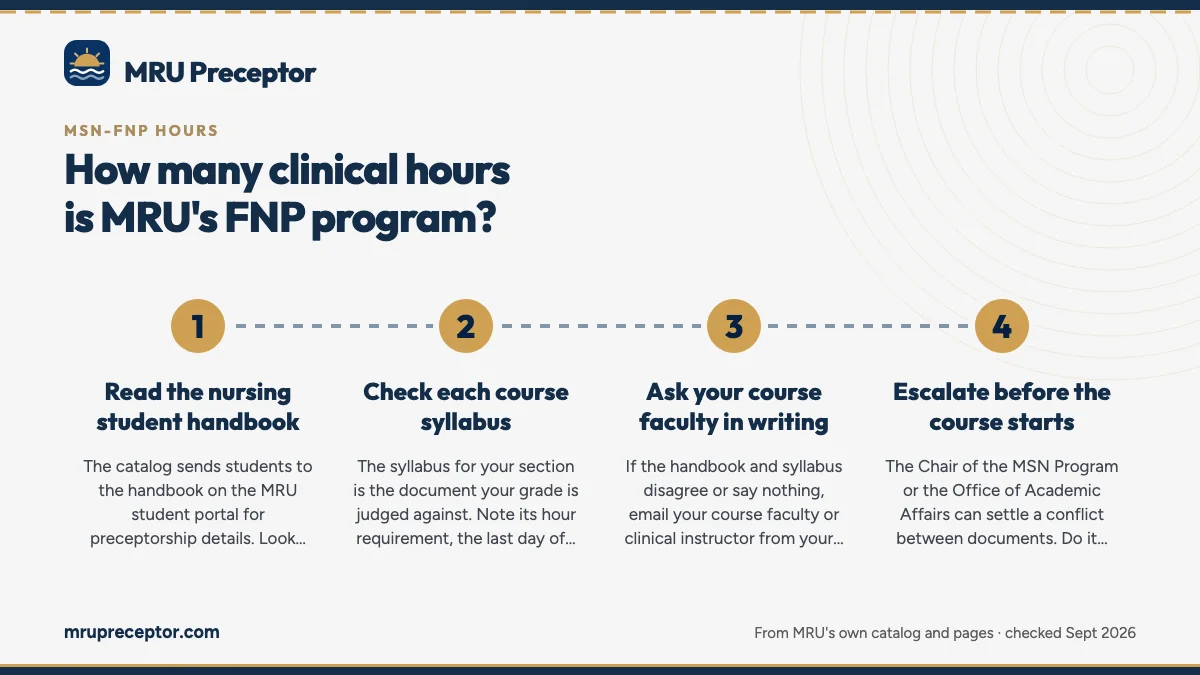
- Read the nursing student handbookThe catalog sends students to the handbook on the MRU student portal for preceptorship details. Look for an hour requirement per course and any rule on simulation. Our handbook guide lists what else to look up while you are there.
- Check each course syllabusThe syllabus for your section is the document your grade is judged against. Note its hour requirement, the last day of the course and what has to be logged.
- Ask your course faculty in writingIf the handbook and syllabus disagree or say nothing, email your course faculty or clinical instructor from your MRU account and keep the reply.
- Escalate before the course startsThe Chair of the MSN Program or the Office of Academic Affairs can settle a conflict between documents. Do it while there is still time to adjust your preceptor's schedule.
Questions MRU students ask
Is 765 the official clinical-hour total for MRU's FNP?
No. MRU has not published a clinical-hour total for the MSN-FNP or the FNP certificate. The 765 is our own sum of 225, 135, 135 and 270, reached by applying the catalog's 45-hours-per-credit conversion to each clinical course. Treat it as an estimate, and use the figure in your handbook and syllabus whenever they give one.
Why do some sources say MRU's FNP has 1,275 hours?
Because 1,275 is the total printed in MRU's MSN-FNP degree plan. It adds lecture, lab and clinical clock hours across all 50 credits, so it does not describe time at a clinical site. The four clinical courses alone hold 900 clock hours, and only part of those are clinical.
Do MRU FNP hours have to be logged in Typhon?
MRU's MSN-FNP fee table lists Typhon as the Clinical Evaluation Portfolio System, so MSN-FNP students should expect to record hours there. The FNP certificate fee table names no tracking system, so certificate students should ask. Either way, logs, case lists and the signed end-of-course evaluation are due by the course's last day. The Typhon guide covers logging habits.
Can extra hours in one FNP course count toward the next?
MRU publishes no carry-over rule, and its practicum rule is written course by course: each course's hours must be completed with an approved preceptor before that course's last day. Nothing public says extra hours in MSN5700 reduce what MSN6050 or MSN6150 require, so do not plan on it without written confirmation from your course faculty.
Who can precept MRU FNP hours at a Florida site?
MRU does not publish its preceptor qualifications; they sit in the student handbook. Florida's Board of Nursing rule 64B9-4.001(13) defines a qualified preceptor as a certified practicing APRN, a licensed MD or DO, or a licensed dentist, and requires a Florida license when the clinical setting is in Florida. MRU must still approve the preceptor before your hours begin.
Related pages
Last checked 2026-09-24
We check these pages against MRU's own catalog, addenda and program pages. The nursing student handbook on the MRU student portal and MRU's Office of Academic Affairs have the final word.
MRU says secure your own preceptor. We start the search now.
Tell us your MRU program, where you live and when your next clinical course starts. We look for preceptors who fit the course and help you gather what MRU checks before approving them.
- Preceptors matched to the course: adult primary care for
MSN5700, women's health, pediatrics, psychiatric or acute care - Credentials, license and site details collected before MRU's credential check
- Miami-Dade, Broward and Palm Beach, or wherever in a SARA state you live
Start your placement plan
Program, city and start date is all we need to begin.