The MRU nursing student handbook: where it is and what to look up
MRU's catalog sets the clinical rules, then refers you to the student handbook for preceptor details, and the current handbook sits only on the student portal. No public copy exists on mru.edu. Read its clinical sections before your first clinical course, because the catalog sends you there for exactly the parts it leaves out.
Planning your first clinical course?
Tell us your MRU program and start term. A placement advisor can help you line up a preceptor MRU can review.
Why the catalog keeps sending you there
Every NP program section of the 2025 catalog ends its preceptor paragraph the same way: for the details, see the student handbook. That pointer appears for the MSN-FNP on page 122, the FNP certificate on page 126, PMHNP on page 136 and AGACNP on page 140.
Page 77 of the catalog says the latest version of the handbook is on the student portal. A search of MRU's public media library, roughly 160 PDFs, turned up no student, clinical or preceptor handbook. So the forms, deadlines and preceptor qualifications the catalog leaves out sit in a document only enrolled students can open.
That makes the handbook the most useful thing to read before a clinical course starts. Reading it early turns guesses about deadlines into dates.
Where to find it
Log in to MRU PORTAL, the self-service student portal linked in the header of mru.edu. It runs on CampusNexus and has separate logins for students, faculty and applicants. The same portal handles add/drop, forms, policies and procedures, re-entry requests and the Complaint and Grievance Form.
MRU's June 2026 Student Rights and Responsibilities document also mentions a "Student Hub" alongside the catalog and handbook, and says grievance procedures are published there. The platform behind the Student Hub is not public, so if the handbook is not where you expect, look there too.
If you cannot log in, the IT Help Desk takes requests at helpdesk@mru.edu. The portal, Moodle and email guide explains where other clinical items live.
What to look up before your first clinical course
Read with a specific list. These are the gaps the public catalog leaves, and the handbook is the first place to close them.
- preceptor qualifications for your program: credential, license state, certification, experience
- the names of the preceptor and site forms, and who signs each one
- the deadline for submitting your preceptor, measured from the term start
- who approves your preceptor, and how you will hear the decision
- any expected approval time
- whether a site needs an agreement with MRU, and who arranges it
- how clinical faculty evaluate you, and whether anyone visits the site
- logging rules: what counts as an hour, and how soon entries must be made
- what to do if your preceptor withdraws mid-course
- the chain of command for academic issues, which MRU's grievance procedure says the handbook sets
Note the page or section for each answer so you can cite it later. The placement process page shows where each answer fits in the sequence.
How the handbook fits with the catalog, addenda and syllabus
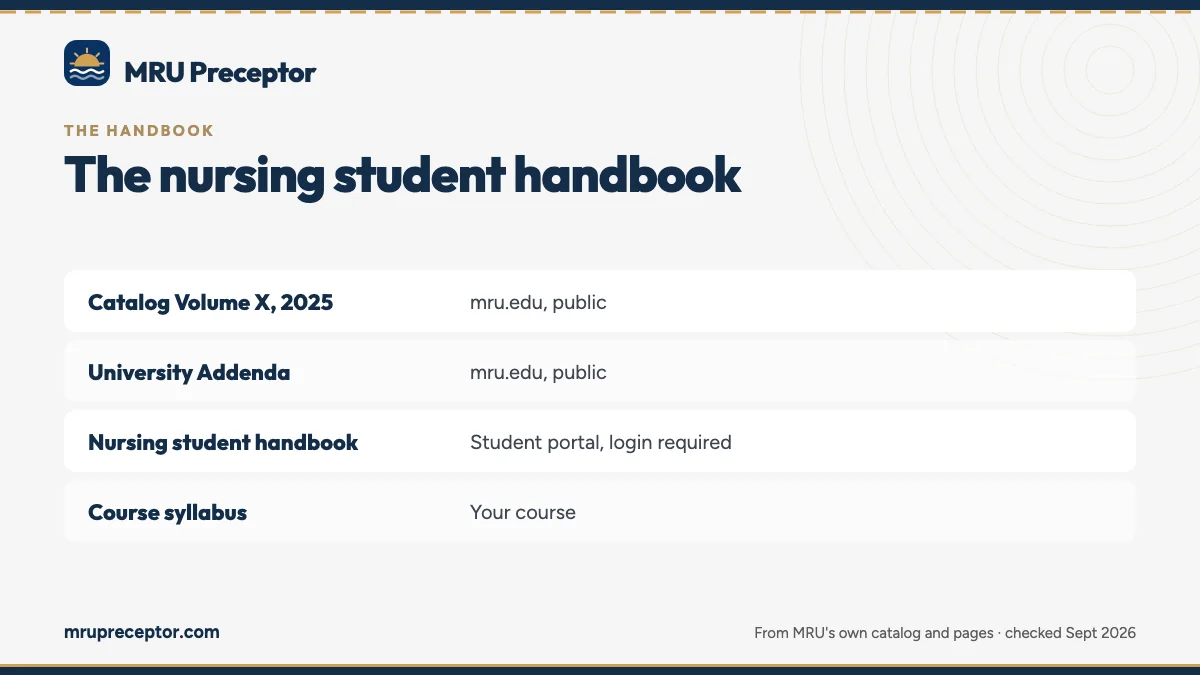
Four documents shape a clinical course, and each settles different things.
| Document | Where it is | What it settles |
|---|---|---|
| Catalog Volume X, 2025 | mru.edu, public | Program rules, grading, admission and the cost tables |
| University Addenda | mru.edu, public | Updates to the catalog, including the Fall 2026 calendar, fees, the DNP and the leadership MSN |
| Nursing student handbook | Student portal, login required | The clinical and preceptor details the catalog refers onward |
| Course syllabus | Your course | Course-specific hours, assignments and due dates |
The Registrar tells students to check the addenda for catalog updates, so an addendum wins where the two differ. MRU does not publish a rule for when the handbook and the catalog disagree. If you find a conflict, ask the Office of Academic Affairs in writing which one applies to you.
Keep a dated copy of what you rely on
The catalog calls the portal copy the latest version, which means it can change. Save the clinical sections in force when your course begins, with the date you saved them.
Do the same with anything in writing that interprets the handbook for you: a preceptor approval, an answer about a deadline, a confirmation of which approver handles your program. Keep those messages in your MRU mailbox; MRU warns that forwarding university email to a personal account means missing its messages.
If a rule changes mid-program, those saved copies show what you were told and when. They are also what you will want in front of you if a question about hours comes up in the last week of a course.
When the handbook doesn't answer your question
Ask in order, and in writing. Start with your syllabus and course faculty, then your clinical instructor, then the chair of your program. For preceptor approval, background or health disclosures, late incompletes and withdrawals, the catalog names the Office of Academic Affairs.
Use your university email for every question. It is MRU's official channel: open it daily and reply to official messages inside 24 hours. Put your program, course code and semester in the subject line so the message reaches the right person without a round of follow-up questions.
The who does what guide maps each MRU office to its clinical role, and the Office of Academic Affairs page covers that office in detail.
Questions MRU students ask
Is the MRU nursing student handbook available online?
Only to enrolled students. The catalog says the latest version is on the student portal, and no public copy was found on mru.edu or in MRU's public document library. If you are not yet enrolled, ask your admissions contact or the program chair what the clinical sections cover.
Does the handbook override the catalog?
MRU does not say publicly. Its Registrar page tells students that the University Addenda update the catalog, but no public document ranks the handbook against either. When they seem to conflict, ask the Office of Academic Affairs in writing which applies, and keep the reply.
Does the handbook list approved clinical sites?
No one outside MRU can say, because the handbook is not public. MRU publishes no list of clinical sites, partner hospitals or affiliation agreements anywhere on mru.edu. Check the handbook's clinical section, and if it is silent, ask your program chair whether any such list exists.
What if my syllabus and the handbook give different dates?
Work to the earlier date while you ask. Email your course faculty, quote both documents with page or section numbers, and ask which governs. Missing a deadline because two documents disagreed is hard to undo, while meeting the earlier one loses you nothing.
Is the handbook the same for every nursing program?
The catalog refers to one student handbook in each NP program section, but because the handbook is not public, whether it has program-specific clinical sections cannot be confirmed. Look for your program by name, and check that any rule you rely on applies to your track, not only to another one.
Related pages
Last checked 2026-09-24
We check these pages against MRU's own catalog, addenda and program pages. The nursing student handbook on the MRU student portal and MRU's Office of Academic Affairs have the final word.
MRU says secure your own preceptor. We start the search now.
Tell us your MRU program, where you live and when your next clinical course starts. We look for preceptors who fit the course and help you gather what MRU checks before approving them.
- Preceptors matched to the course: adult primary care for
MSN5700, women's health, pediatrics, psychiatric or acute care - Credentials, license and site details collected before MRU's credential check
- Miami-Dade, Broward and Palm Beach, or wherever in a SARA state you live
Start your placement plan
Program, city and start date is all we need to begin.