Who does what at MRU when you take a clinical course
A clinical course at MRU passes through several offices, and only a few of them deal with preceptors. Depending on your program, the Office of Academic Affairs, a Program Coordinator, a graduate clinical coordinator or program faculty approve your preceptor. MRU Health, the clinical department and the Registrar handle compliance, insurance and scheduling, while the Center for Student Achievement and WellConnect do other work entirely.
Need help with the preceptor part?
Tell us your MRU program and where you live. We search for a preceptor that fits your course; MRU approves.
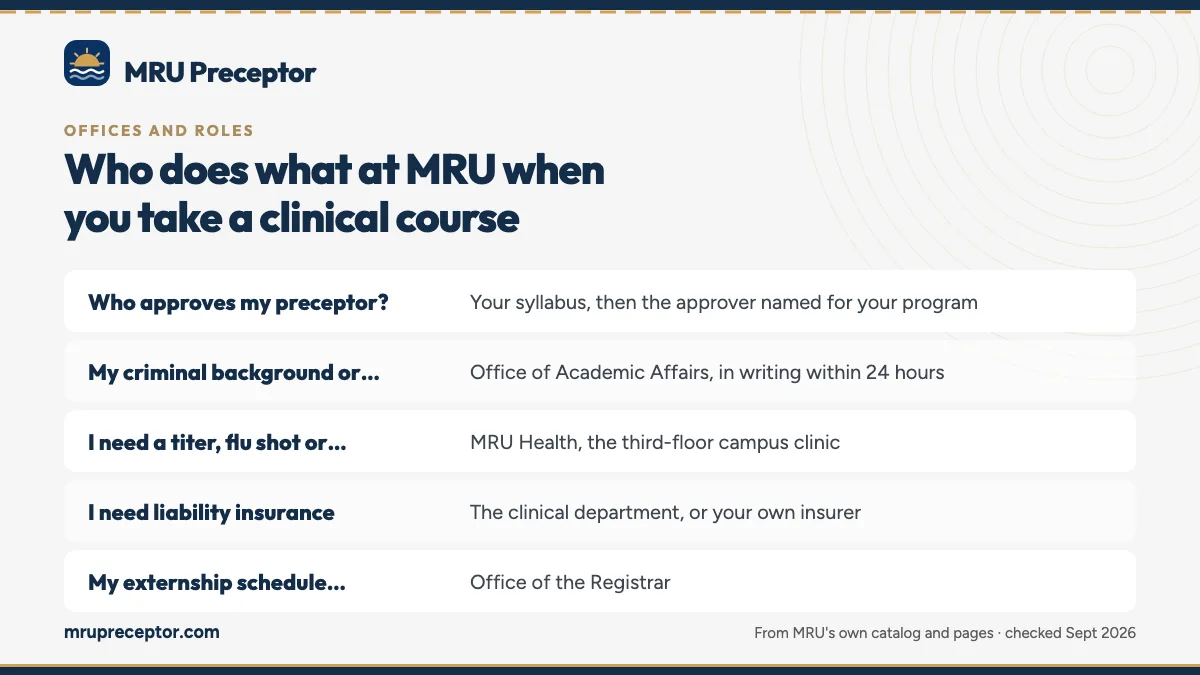
Quick reference: who to ask
Use this table to find your first stop. The sections below explain each office and role.
| Your question | Start with |
|---|---|
| Who approves my preceptor? | Your syllabus, then the approver named for your program |
| My criminal background or health has changed | Office of Academic Affairs, in writing within 24 hours |
| I need a titer, flu shot or physical | MRU Health, the third-floor campus clinic |
| I need liability insurance | The clinical department, or your own insurer |
| My externship schedule changed | Office of the Registrar |
| I need more time to finish my hours | Course faculty and program Dean; Office of Academic Affairs past 14 days |
| I need personal support | WellConnect, or the Office of Academic Advisement and Student Success |
| I want to make a formal complaint | Office of Human Resources, on the University Complaint and Grievance Form |
| I can't log in to the portal | IT Help Desk |
School of Nursing leadership
Two deans lead the School of Nursing's programs. The Dean of Graduate Studies is the nurse administrator for the master's, post-master's certificate and DNP programs, and the Dean of Pre-Licensure Programs leads the ASN and BSN.
Below them sit the program chairs MRU lists: the Chair of the MSN Program, the Chair of MSN Direct Entry, the Chair of ASN and the Chair of BSN. For a clinical question the handbook and syllabus do not answer, your program chair is usually the right person to ask before you go to a university-wide office.
The program Dean also has a formal role in grades: together with course faculty, the Dean approves an Incomplete Grade Request. AGACNP applicants may meet the Dean at admission, since the AGACNP admission steps include an interview with the Program Coordinator or the Dean.
The roles that approve preceptors
Four offices or roles approve preceptors, and which one you deal with depends on your program. The Office of Academic Affairs approves them for the MSN-FNP, FNP certificate and AGACNP, and MRU's October 2025 PMHNP sheet names it for PMHNP too.
The Program Coordinator approves PMHNP preceptors according to the 2025 catalog and interviews PMHNP and AGACNP applicants. A clinical coordinator from the graduate nursing programs approves preceptors for the MSN in Healthcare Systems Leadership.
For the DNP, the program director matches each student with a DNP Project team mentor, and the 2025 catalog gives approval of practicum hours, projects, preceptors and mentors to program faculty. The approval page sets these out by program.
Compliance, insurance and health
MRU Health is the on-campus clinic on the third floor of the MRU building, set up to help students meet school and clinical-site requirements. It checks TB, influenza, hepatitis B, MMR, varicella, Tdap, CPR, physicals, drug screens and titers, Its services include immunizations, lab work, imaging and physicals, paid by card or cash.
The clinical department helps students obtain the individual liability insurance every nursing student needs before an externship, billed through MRU, though you may bring your own policy instead. MRU's directory lists a Clinical Operations department, but that directory dates from 2021.
Clearance itself runs through American Data Bank, an outside vendor MRU names for background checks, drug screening and clinical documents; PMHNP students may see CastleBranch named instead. See immunizations and health records for the health side in detail.
Scheduling and records: the Office of the Registrar
The Registrar coordinates scheduling of externship sections with program representatives. When an externship agency adds, removes or swaps sites, MRU can change your timetable without warning, and the final published version is the one you work to. Externship times and dates are not set by MRU, so shifts can fall on days, evenings, overnights, weekends or holidays, even when that differs from your enrolled shift.
The same office runs registration: you can sign yourself up from 20 days before a semester until that semester's add/drop deadline. If you fail a course, the Registrar drops all your courses and reschedules the failed one, provided you are eligible to retake it.
The Registrar also keeps academic records, handles transcripts and posts the catalog and University Addenda, which it tells students to check for catalog updates.
Inside the course: faculty, clinical instructor and preceptor
Within a clinical course, three people matter most. Your course faculty set the syllabus and grade the course. Your clinical instructor co-signs the end-of-course evaluation. Your preceptor supervises your hours and signs the same evaluation.
All three signatures, yours included, must be on that evaluation by the course's last day, along with your logs, case lists and documentation. MSN-FNP students track hours in Typhon and DNP students in myevaluation.com. If your preceptor or clinical instructor becomes hard to reach near the end of the course, raise it with your course faculty at once rather than on the last day.
MRU does not publish whether faculty visit clinical sites or on what schedule. If your syllabus is silent, ask your course faculty early how they will evaluate your clinical performance. The end-of-course evaluation page covers the signatures.
Offices that are not placement offices
Several MRU offices sound as if they might help with placement. None of them is described that way.
- Center for Student Achievement (CSA): part of the School of Nursing, focused on NCLEX-RN preparation and academic coaching. ASN, BSN and MSN Direct Entry students need CSA clearance to graduate.
- Office of Academic Advisement and Student Success: academic advising, tutoring, SAP appeals and help preparing for licensure and certification. Appointments are booked through the office's Moodle page or by email.
- WellConnect: a 24/7 support program powered by New Directions, offering short-term counseling, resource referrals and legal and financial consultations.
- Office of Career Services: its clearance is needed to graduate, but it has no role in clinical placement.
Help finding a preceptor comes from your own search, MRU's appointment route or an independent service; how it works explains ours.
Questions MRU students ask
Does MRU have a clinical placement office?
MRU publishes no description of one. The catalog mentions a clinical department that helps with liability insurance, and a 2021 staff directory lists Clinical Operations. The only placement route MRU describes publicly is appointment of a preceptor for a fee, for students who do not bring their own.
Is WellConnect the same as academic advising at MRU?
No. The nursing page links to WellConnect under an academic advising label, but the page it opens holds two separate services. Advising is the Office of Academic Advisement and Student Success; WellConnect is a 24/7 counseling and support program run with New Directions.
Who should I contact first if my preceptor cancels?
MRU does not publish a route. Tell your course faculty and clinical instructor straight away, then your program chair, and remember that any replacement preceptor needs approval before hours with them count. The preceptor dropped out guide covers the next steps.
Does the Center for Student Achievement help NP students with clinicals?
Not as far as MRU's public pages show. The CSA focuses on NCLEX-RN preparation, bootcamps and academic coaching for students and alumni, and no NP-certification or clinical-placement role was found. NP students with clinical questions should go to their program chair or their program's approver.
Who handles complaints about a clinical course?
Start informally with the person or department involved, following the chain of command the student handbook sets for academic issues. A formal complaint goes to the Office of Human Resources on the University Complaint and Grievance Form, which you must sign yourself. Grade appeals follow the separate academic appeals procedure.
Related pages
Last checked 2026-09-24
We check these pages against MRU's own catalog, addenda and program pages. The nursing student handbook on the MRU student portal and MRU's Office of Academic Affairs have the final word.
MRU says secure your own preceptor. We start the search now.
Tell us your MRU program, where you live and when your next clinical course starts. We look for preceptors who fit the course and help you gather what MRU checks before approving them.
- Preceptors matched to the course: adult primary care for
MSN5700, women's health, pediatrics, psychiatric or acute care - Credentials, license and site details collected before MRU's credential check
- Miami-Dade, Broward and Palm Beach, or wherever in a SARA state you live
Start your placement plan
Program, city and start date is all we need to begin.