MSN6400 Clinical Integration: MRU's final FNP clinical
MSN6400 Role Development in Family Practice: Clinical Integration is the last clinical course in MRU's FNP: 8 credits, 300 total clock hours, one setting and patients across the lifespan. Its description asks for "a minimum of 180 clinical hours", while MRU's own credit rule would put the clinical share at 270, so get the working target from your syllabus.
Get your placement plan
Tell us your MRU program and where you live. A placement advisor replies with what an MRU-ready preceptor and site look like for you.
MSN6400 descriptionMSN6400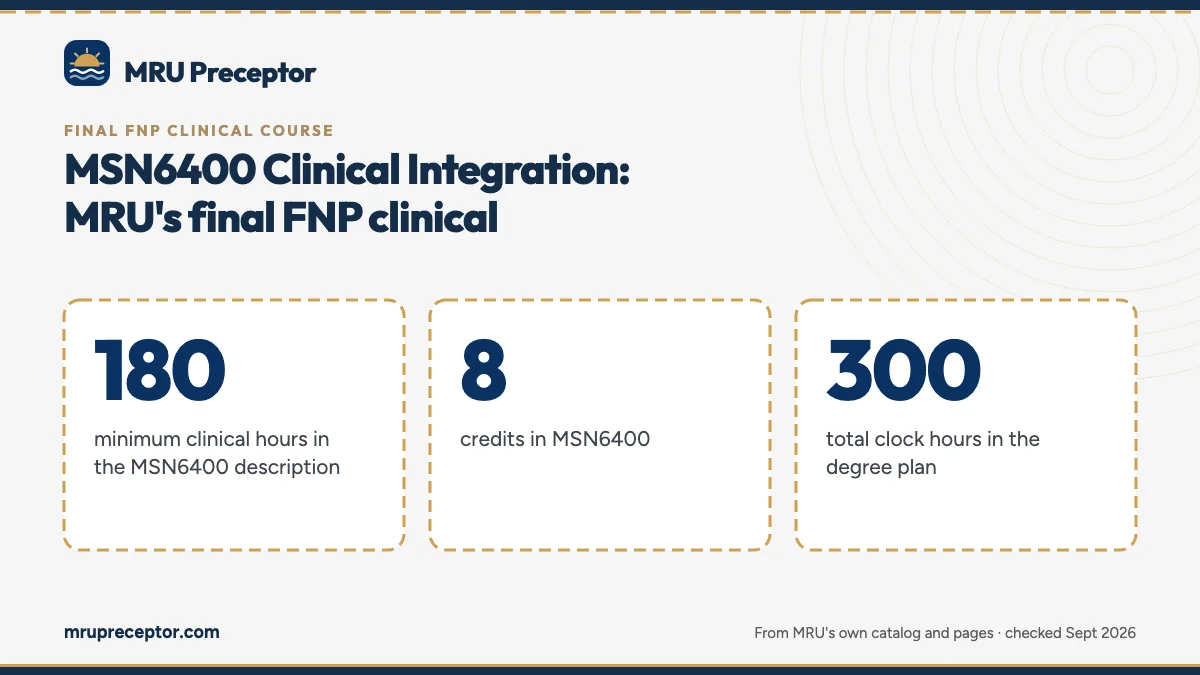
What the catalog says about MSN6400
The capstone of the FNP clinical run is done, in the catalog's words, "in one clinical setting under the guidance of a clinical preceptor". The patients span the lifespan, so this is the course where women, children, adults and older adults come together in one practice.
It carries 8 credits and 300 clock hours in the degree plan, and its description sets a floor of 180 clinical hours. Prerequisites are all the earlier clinical courses plus MSN5270, so it cannot overlap with MSN5700, MSN6050 or MSN6150.
| Item | Detail |
|---|---|
| Title | Role Development in Family Practice: Clinical Integration |
| Credits | 8 |
| Total clock hours | 300 (lecture and clinical together) |
| Clinical hours in the description | A minimum of 180 |
| Setting | One clinical setting, one clinical preceptor, patients across the lifespan |
| Prerequisites | All prior clinical courses and MSN5270 |
| Full-time / part-time semester | V (last) / VIII (last) |
180 or 270: the hours conflict
MRU's credit rule counts 45 clinical hours or 15 lecture hours per credit. Eight credits and 300 total hours only balance as 2 lecture credits (30 hours) plus 6 clinical credits (270 hours). That 270 is our calculation from MRU's rule; the only clinical figure MRU itself prints for this course is the 180 minimum in the description.
The two numbers do not have to contradict each other, since 270 sits above a 180 floor, but MRU does not say which one your faculty will hold you to. The syllabus, or a written answer from your course faculty, settles it. The FNP hours page shows how the same gap affects the program total of about 765 by our count.
Do not plan around 180 just because it is the smaller number. Get the target in writing before your preceptor builds a schedule, because running short on the last day fails the course.
One setting across the lifespan: choosing the site
The first three FNP clinicals each have a population. This one asks for breadth inside a single practice, which narrows the field: the site needs a schedule that genuinely includes children, adults and older adults, and ideally women's visits too.
A family practice is the obvious fit, and a community health center with a mixed panel can be another. Whatever the label on the door, the test is the patient list: if a clinic cannot show you children and older adults in the same weeks, keep looking.
Checks before you commit to an MSN6400 site
- Ask the preceptor roughly what share of visits are pediatric, adult and geriatric.
- Confirm they can host you for the whole course, since the description names one setting.
- Check the license: Florida-issued for a Florida site.
- Ask whether the practice has its own onboarding steps that must be done before your first day.
- Agree how the end-of-course evaluation will be signed before the last week.
Who can precept the capstone
Florida's rule 64B9-4.001(13) applies to any Florida site: the preceptor must be a certified practicing APRN or a licensed MD or DO, licensed in Florida. For a lifespan course the natural candidates are a family nurse practitioner or a family medicine physician. Florida's autonomous-practice pathway includes family medicine, but an APRN practicing under protocol qualifies as a preceptor just the same.
MRU publishes no preceptor qualifications of its own on mru.edu. The catalog points to the nursing student handbook, which is on the student portal. The Office of Academic Affairs approves the preceptor before the preceptorship starts, and MRU's fee tables list a charge for checking preceptor credentials. If you study from another state, the preceptor's licensing follows that state's rules; clinicals outside Florida explains the residency and licensing side.
Timing: the last semester before graduation
MSN6400 sits in semester V on the full-time plan and semester VIII on the part-time plan, the final semester either way. Anything that delays it delays your graduation, and MRU has no leave of absence to pause the clock.
FNP Post-Master's Certificate students take the same course, and because it requires the other clinical courses, it comes last for them too. MRU sets no public deadline for naming the preceptor. Proof of liability insurance is due at least 15 days before the externship begins, and self-registration opens 20 days before the semester.
If the capstone preceptor is uncertain close to the term, read delayed graduation for what a one-term slip involves, and use the form below to talk to a placement advisor about a search.
Finishing: logs, the evaluation and the last day
The finish line is strict. By the course's last day, MRU needs all hours completed with the approved preceptor, your logs, case lists and documentation in Typhon, and an end-of-course evaluation signed by three people: preceptor, clinical instructor and student. Missing any of these fails the course, and falsified time logs or encounters mean failure and possible dismissal.
A failed capstone has to be retaken in a later term, and MRU permits only one repeat of any MSN course. Keep your Typhon entries current each clinic day so the final week is about signatures, not reconstruction.
Book the evaluation signing early in the final two weeks rather than on the last clinic day, in case your preceptor is away. The end-of-course evaluation page covers how to avoid a missing signature.
Questions MRU students ask
Can I split MSN6400 across two clinics?
The catalog describes MSN6400 as taking place in one clinical setting under a clinical preceptor, so splitting it runs against the printed description. If your site closes or your preceptor leaves mid-course, contact your course faculty and the Office of Academic Affairs straight away; any replacement needs MRU approval before new hours count.
Can I go back to a preceptor from an earlier FNP course?
MRU publishes no rule against it. What matters for this course is breadth: the practice has to let you see patients across the lifespan in one place. A family practice that hosted your adult rotation may fit if it also sees children and women. Ask the Office of Academic Affairs whether an earlier approval carries over or must be renewed.
What if I have not finished MSN6400 hours by the last day?
Unfinished hours, logs, case lists or evaluation mean the course fails. An Incomplete is possible only if at least 80% of the course is done, you request it in writing, and faculty and the program Dean approve; going beyond 14 days needs the Office of Academic Affairs, and 15 weeks is the outer limit.
Which certification exam do MRU FNP graduates sit?
MRU's catalog says NP graduates practice after passing board certification exams, but it does not name the certifying body, and neither does its student achievement report. Ask your program chair which exams the curriculum is aligned with before you register, and plan your application for after MSN6400 is graded.
Can MSN6400 be at a specialty clinic?
The description calls for patients across the lifespan in one setting. A specialty clinic such as cardiology or dermatology may see a narrower age range, which is harder to reconcile with that wording. MRU publishes no list of approved setting types, so put the specific site to the Office of Academic Affairs before you accept an offer.
Related pages
Last checked 2026-09-24
We check these pages against MRU's own catalog, addenda and program pages. The nursing student handbook on the MRU student portal and MRU's Office of Academic Affairs have the final word.
MRU says secure your own preceptor. We start the search now.
Tell us your MRU program, where you live and when your next clinical course starts. We look for preceptors who fit the course and help you gather what MRU checks before approving them.
- Preceptors matched to the course: adult primary care for
MSN5700, women's health, pediatrics, psychiatric or acute care - Credentials, license and site details collected before MRU's credential check
- Miami-Dade, Broward and Palm Beach, or wherever in a SARA state you live
Start your placement plan
Program, city and start date is all we need to begin.