MRU's PMHNP clinical courses: MSN5056C, MSN6057C and MSN6065C
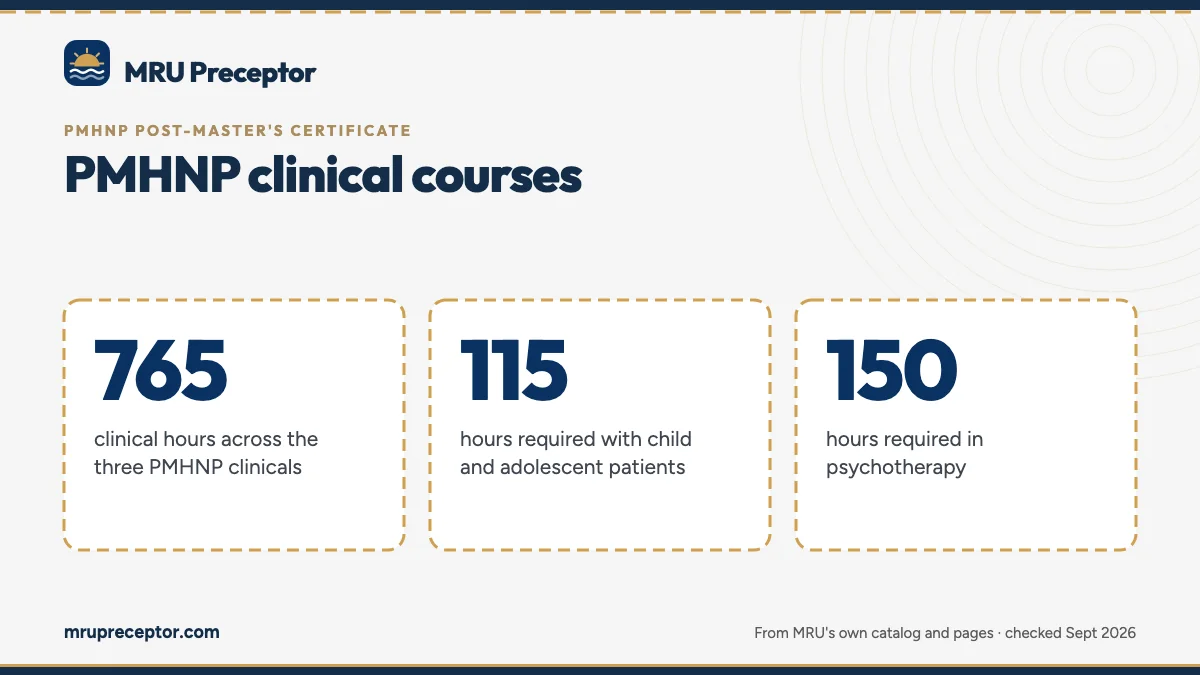
MRU's PMHNP Post-Master's Certificate has three clinical courses worth 765 hours: MSN5056C (180), MSN6057C (180) and MSN6065C (405). The catalog also requires those hours to include 115 with children and adolescents, 150 of psychotherapy and 500 across the lifespan, so your preceptors need to cover more than adult medication visits.
Get your placement plan
Tell us your MRU program and where you live. A placement advisor replies with what an MRU-ready preceptor and site look like for you.
The three courses at a glance
Unlike the FNP, the PMHNP certificate prints clinical hours course by course, so there is no arithmetic to do. The certificate is 35 credits and 1,035 clock hours over 16 months and 4 semesters, delivered online, and the catalog says courses must be taken in program order.
| Course | Credits | Clinical hours | Patients and focus | Semester |
|---|---|---|---|---|
MSN5056C Psychiatric Mental Health Clinical I | 4 | 180 | Adults and families; psychiatric specialty rotation with a preceptor | III, with MSN5056 |
MSN6057C Psychiatric Mental Health Clinical II | 4 | 180 | Children, adolescents and adults with families | III, with MSN6057 |
MSN6065C Psychiatric Mental Health Clinical III | 9 | 405 | Lifespan, co-occurring diagnoses, substance abuse | IV, with MSN6065 and MSN5027 |
Each clinical course runs in the same semester as the course that shares its number without the C, and the catalog's descriptions describe each rotation as work in a psychiatric-mental health specialty area with a preceptor who guides the student.
The 115 / 150 / 500 mix
The requirement sits in the catalog description of MSN6065C, which splits the total three ways: child and adolescent patients account for 115 hours, psychotherapy for 150, and lifespan clinical work for the remaining 500. Added together they make the 765.
The catalog does not assign each part to a particular course. What it does say is that MSN6057C includes children and adolescents in its population, and MSN6065C spans the lifespan with co-occurring diagnoses and substance abuse. Psychotherapy hours are not tied to any one course in the text, so ask your faculty whether therapy hours from all three clinicals count toward the 150.
MRU's fee tables name no tracking system for the PMHNP certificate, although Typhon is named for the MSN-FNP. Ask your faculty where to log hours and how each encounter should be tagged before your first clinical day.
Record the category of every encounter (child or adolescent, psychotherapy, lifespan) from week one. Rebuilding the split at the end of MSN6065C is where the arithmetic goes wrong.
Semester III and IV: how the load falls
Clinical work starts in semester III, when both 180-hour courses run together: 360 clinical hours in one term alongside MSN5056 and MSN6057. Semester IV carries the 405-hour MSN6065C plus two other courses.
One of those, MSN5027 Psychiatric Mental Health Practicum, sounds like a clinical course but is not. It is 2 credits and 30 hours, and the catalog describes a research project on community psychiatric issues with no clinical hours listed. The other, MSN6065, is a certification-exam review course.
A note on MRU's own numbers: the PMHNP web page shows semester IV as 465 hours, while the catalog shows 450, which is the figure that adds up to the 1,035 total. Treat the web page's number as a typo, and check your degree plan if the difference matters to your schedule.
Who can precept, and who approves
At a Florida site, Florida rule 64B9-4.001(13) requires a certified practicing APRN or a licensed MD or DO with a Florida license. MRU publishes no specialty rule, but the course descriptions put each rotation in a psychiatric-mental health specialty area, which points to a psychiatric APRN or a psychiatrist. Florida also treats that specialty differently on one point: its 7-day limit on APRN Schedule II prescribing does not apply to psychiatric medications prescribed by psychiatric nurses.
Approval is where MRU's documents differ. The 2025 catalog says the PMHNP Program Coordinator approves the preceptor before the preceptorship starts; MRU's October 2025 PMHNP sheet for international applicants names the Office of Academic Affairs. Ask which applies to your cohort, and see preceptor approval and preceptor requirements for the wider picture.
Settings that match each course
Because the certificate is online, your clinical sites are wherever you live in Florida or a SARA member state. The job is to cover three populations and one modality with as few preceptors as you can manage.
Settings that can supply each part of the mix
- Adults and families (
MSN5056C): outpatient psychiatry practices, community mental health centers. - Children and adolescents (
MSN6057C, and the 115 hours): child and adolescent psychiatry practices, pediatric behavioral health clinics. - Psychotherapy (the 150 hours): a preceptor who provides therapy as well as medication management.
- Lifespan, co-occurring and substance use (
MSN6065C): substance use treatment programs, integrated behavioral health, community mental health.
MRU's public documents say nothing about telehealth hours for this certificate. Ask the approver in writing before counting on a telepsychiatry-only practice. Whatever the setting, each preceptor still needs MRU's approval before any hours with them count.
Clearance and insurance for the PMHNP
PMHNP applicants attend a programmatic orientation and interview with the Program Coordinator, and they must show proof of student liability insurance before the first clinical. MRU's general rule applies on top: proof of individual coverage is due at least 15 days before the externship starts. Immunization proof must come from a healthcare provider licensed in Florida, and every nursing student needs a flu shot each year.
The PMHNP fee table names American Data Bank or CastleBranch for clinical clearance, and a Level II background check with fingerprints applies as well. Any change in your record, including a pending charge, must be disclosed in writing to the Office of Academic Affairs within 24 hours. The American Data Bank page covers keeping documents current, and the PMHNP certificate page covers admission and the program as a whole.
Questions MRU students ask
Can a psychologist or therapist supervise my psychotherapy hours?
Florida's preceptor rule lists certified practicing APRNs and licensed MDs, DOs and dentists; psychologists and licensed clinical social workers are not on it. MRU publishes nothing on who may supervise the 150 psychotherapy hours. Ask your approver before you arrange therapy hours with anyone other than a psychiatric APRN or physician.
Do telehealth hours count for MRU's PMHNP clinicals?
Nothing MRU has published covers this. The course descriptions speak of a rotation with a preceptor in a psychiatric-mental health specialty area and say nothing either way about video visits. Put the question to the Program Coordinator or the Office of Academic Affairs in writing, from your MRU email, before you rely on telepsychiatry for any hours.
Do I need mental health experience before the PMHNP clinicals?
No. It is listed as preferred rather than required. Admission does require an MSN, graduate courses in advanced pathophysiology, pharmacology and health assessment, an active RN license, residence in Florida or a SARA member state, and liability insurance before the first clinical.
Can one preceptor cover all 765 PMHNP hours?
MRU does not say either way. The practical test is the patient mix: one preceptor would need to see children and adolescents, provide psychotherapy and treat adults across the lifespan, including co-occurring and substance use disorders. If a single practice cannot offer all of that, line up a second site early and get it approved before MSN6065C begins.
Are the PMHNP clinical courses offered in a set order?
Yes. The catalog says PMHNP courses must be taken in program order. MSN5056C and MSN6057C run together in semester III, and MSN6065C follows in semester IV, so a preceptor gap in semester III delays the final clinical and your completion date.
Related pages
Last checked 2026-09-24
We check these pages against MRU's own catalog, addenda and program pages. The nursing student handbook on the MRU student portal and MRU's Office of Academic Affairs have the final word.
MRU says secure your own preceptor. We start the search now.
Tell us your MRU program, where you live and when your next clinical course starts. We look for preceptors who fit the course and help you gather what MRU checks before approving them.
- Preceptors matched to the course: adult primary care for
MSN5700, women's health, pediatrics, psychiatric or acute care - Credentials, license and site details collected before MRU's credential check
- Miami-Dade, Broward and Palm Beach, or wherever in a SARA state you live
Start your placement plan
Program, city and start date is all we need to begin.