MRU's MSN Direct Entry: how clinicals work
MSN Direct Entry is MRU's pre-licensure master's for people whose bachelor's degree is in another field. Its 495 clinical hours run through seven onsite courses at contracted externship agencies, so most students never search for a preceptor. The real work is meeting MRU's clinical rules, staying cleared and adjusting when an agency changes the schedule.
Get your placement plan
Tell us your MRU program and where you live. A placement advisor replies with what an MRU-ready preceptor and site look like for you.
Program facts
MSN Direct Entry leads to a Master of Science in Nursing and prepares graduates to sit the NCLEX-RN. It is taught face-to-face in Miami Springs. The full-time plan takes 20 months over five semesters; the part-time plan takes eight semesters, which the catalog and 2026 curriculum put at 32 months and the web page at 28.
The program is 67 credits. The catalog's timeframe table printed 64, and MRU's February 2026 Program Timeframe Addendum corrected it to 67. Of 1,380 total hours, 795 are didactic, 90 are lab and 495 are clinical.
Admission, in brief
- A bachelor's degree, plus prerequisites in anatomy and physiology I and II, microbiology, English, humanities, growth and development, and math
- The Nursing Core Qualifying Exam (NCQE)
- No more than 9 graduate transfer credits
The seven clinical courses
MRU renumbered the MSN-DE courses in 2026. The table gives both codes, because older paperwork still uses the catalog numbers; the 2026 course codes page explains the change. Old-to-new matching is by title, since MRU does not publish a mapping.
| 2026 code | Old code | Course | Credits | Clinical hours | Setting |
|---|---|---|---|---|---|
NGR5108 | MSN5320 | Foundations of Nursing Care Across the Lifespan | 8 | 90 (+60 lab) | Basic care across the lifespan |
NGR5203 | MSN5410A | Medical-Surgical Nursing I | 6 | 90 | Adults with acute and chronic conditions |
NGR5204 | MSN5410B | Medical-Surgical Nursing II | 6 | 90 | Complex and multisystem care |
NGR6300 | MSN5430B | Pediatrics | 3 | 45 | Pediatric settings |
NGR6353 | MSN5430A | Obstetrics | 3 | 45 | Obstetric settings |
NGR6507 | MSN5420 | Mental Health Nursing | 4 | 45 | Mental health settings |
NGR6117 | MSN5950A | Role of the Nurse Leader and Leadership Quality Initiatives | 5 | 90 | On-site leadership immersion |
NGR5108 comes first, straight after admission. The med-surg pair follows, then pediatrics, obstetrics and mental health, and the leadership immersion in NGR6117 closes the sequence once those three are done.
Who arranges your clinicals
MRU does, through its scheduling process. No MRU source tells MSN-DE students to find their own preceptors. The catalog describes clinicals as taking place at a "contracted externship agency", and the Office of the Registrar coordinates scheduling of those sections with program representatives.
The fee table points the same way. It lists a Typhon fee and repeats the note about waiving the affiliation fee for students who secure an approved preceptor, but it has no Practicum Affiliation Fee line for this program. In practice that means you are not choosing between bringing a preceptor and paying for one; you are placed into scheduled sections.
Clinical hours are logged in Typhon, MRU's Clinical Evaluation Portfolio System; the Typhon guide covers how to keep entries clean.
When the schedule changes
It will, at some point. MRU's catalog says externship times and dates are not set by the University, and shifts can be days, evenings, overnights, weekends or holidays, even if they differ from the shift you enrolled in. An agency may also add, drop or change sites, and MRU then adjusts your schedule without notice. You are expected to accept the final published schedule.
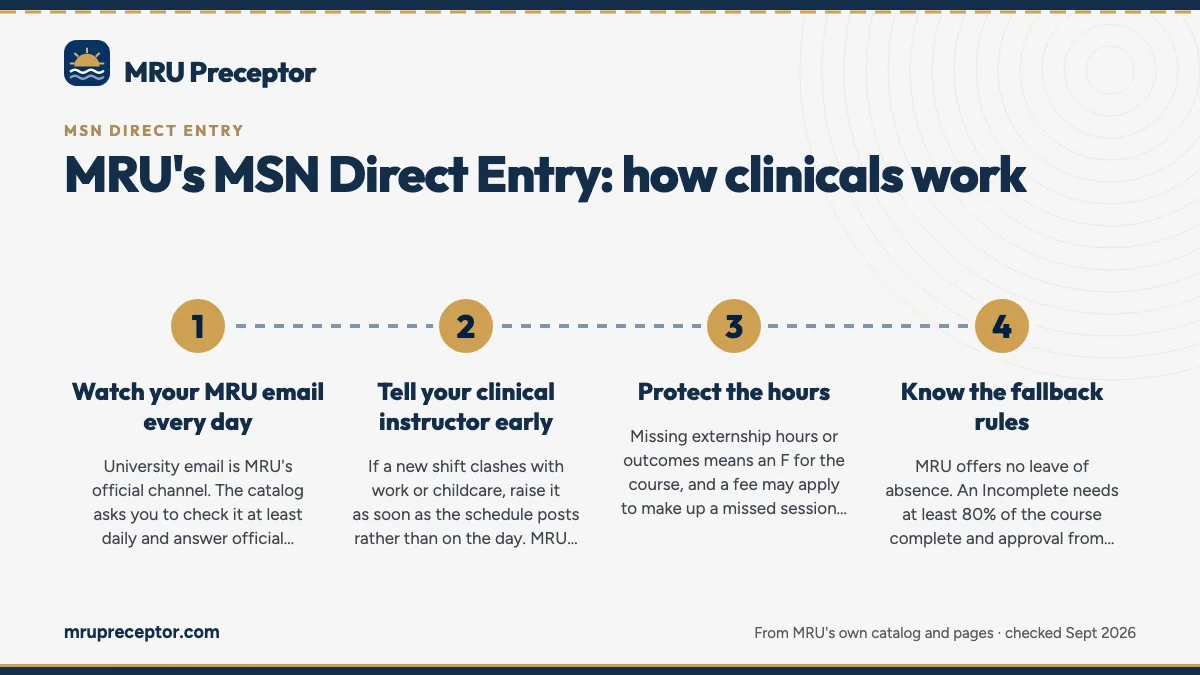
- Watch your MRU email every dayUniversity email is MRU's official channel. The catalog asks you to check it at least daily and answer official messages within 24 hours, and forwarding to a personal account means missing MRU mail. The portal, Moodle and email page explains the systems.
- Tell your clinical instructor earlyIf a new shift clashes with work or childcare, raise it as soon as the schedule posts rather than on the day. MRU does not promise an alternative, but early notice gives the most room.
- Protect the hoursMissing externship hours or outcomes means an F for the course, and a fee may apply to make up a missed session. Treat each shift as fixed once published.
- Know the fallback rulesMRU offers no leave of absence. An Incomplete needs at least 80% of the course complete and approval from faculty and the Dean. The failing a clinical course page covers the rest.
Clearance before your first rotation
The MSN-DE fee table names American Data Bank for clinical clearance, covering the background check, drug screening, medical document manager and clinical document clearances; the American Data Bank page walks through it. Screening is zero-tolerance, and MRU may test at the start of the program, again later and at random.
Health records need proof of immunization from a Florida-licensed provider and an annual flu shot. MRU Health, the on-campus clinic on the third floor, checks TB, influenza, hepatitis B, MMR, varicella, Tdap, CPR, a physical, a drug screen and titers, and offers immunizations and labs; the immunizations page lists what to bring.
Individual liability insurance is required before any externship, with proof at least 15 days before the start date. Any change to your background or health status goes to the Office of Academic Affairs in writing within 24 hours.
Rules at the agency
Direct clinical supervision in MRU's pre-licensure programs, including MSN-DE, runs at no more than 12 students per faculty member. During externship hours you speak English only unless the agency authorizes another language in writing, you keep your phone off the floor, and you do not use tobacco or e-cigarettes. HIPAA applies at every site, and a violation can mean course failure and dismissal. The clinical site rules page has the detail.
Before graduation, MSN-DE students also need clearance from the Center for Student Achievement, MRU's NCLEX support center. It is not a placement office.
Accreditation and the road to NP study
ACEN accredits MRU's master's programs, which include MSN Direct Entry, and MRU lists Florida Board of Nursing approval for its pre-licensure programs. SACSCOC accredits the university.
MRU schedules MSN-DE externships itself, so those placements are arranged for you. If you later move on to nurse practitioner study, the preceptor search becomes yours, and that is the search we specialize in; the MSN-FNP page shows how it works at MRU. Until then, the form below is open for questions.
Questions MRU students ask
Do MSN Direct Entry students find their own preceptors at MRU?
Not according to anything MRU publishes. The own-preceptor rule appears only for the NP tracks and the leadership MSN. MSN-DE clinicals are scheduled at contracted externship agencies, coordinated by the Registrar with program representatives, and the MSN-DE fee table has no Practicum Affiliation Fee line.
Can I choose my own clinical site or shift in MSN-DE?
Generally no. The catalog says externship dates and times are set by the agencies, not the University, and shifts may fall on nights, weekends or holidays. If an agency changes sites, MRU adjusts your schedule without notice, and you are expected to accept the final published schedule.
Is MRU's MSN Direct Entry 64 or 67 credits?
67. The 2025 catalog's program timeframe table printed 64 credits, and the February 2026 Program Timeframe Addendum corrected it to 67, which matches the 2026 curriculum. The part-time length also differs between sources: 32 months in the catalog and curriculum, 28 on the web page.
Does MSN Direct Entry make me a nurse practitioner?
No. It prepares you for the NCLEX-RN and entry into registered nursing. Becoming a nurse practitioner at MRU would mean later admission to the MSN-FNP or a post-master's certificate, each of which requires an active RN license and, under MRU's catalog, securing your own preceptor.
Which old code matches NGR6117?
By title, NGR6117 Role of the Nurse Leader and Leadership Quality Initiatives corresponds to the catalog's MSN5950A. MRU does not publish an official old-to-new map, so if a transcript, prerequisite list or requirement uses an old code, check with the Registrar.
Related pages
Last checked 2026-09-24
We check these pages against MRU's own catalog, addenda and program pages. The nursing student handbook on the MRU student portal and MRU's Office of Academic Affairs have the final word.
MRU says secure your own preceptor. We start the search now.
Tell us your MRU program, where you live and when your next clinical course starts. We look for preceptors who fit the course and help you gather what MRU checks before approving them.
- Preceptors matched to the course: adult primary care for
MSN5700, women's health, pediatrics, psychiatric or acute care - Credentials, license and site details collected before MRU's credential check
- Miami-Dade, Broward and Palm Beach, or wherever in a SARA state you live
Start your placement plan
Program, city and start date is all we need to begin.