Conduct at the site: MRU's externship rules
MRU's word for clinical time is externship, and the catalog attaches rules to it that apply on every unit. Your shift can be any hour of the day or week. English is the only language allowed during externship hours unless the agency gives written permission for another. Cell phones may not be used on the floor, tobacco and e-cigarettes are banned, and a HIPAA breach can end in dismissal. For NP students, indirect supervision is capped at a ratio of 1:8.
Get your placement plan
Tell us your MRU program and where you live. A placement advisor replies with what an MRU-ready preceptor and site look like for you.
Shifts can fall at any hour
MRU does not set externship dates and times. The catalog says externships can be scheduled for any shift, including nights, weekends and holidays, and the shift may differ from the one you enrolled in. For NP students with their own preceptor, that usually means your hours follow the preceptor's clinic schedule rather than a class timetable.
On-campus programs run on a different track. ASN, BSN and MSN Direct Entry externships are scheduled by MRU, with the Registrar working alongside program staff. When an agency changes the sites it offers, MRU may move your placement with no advance warning, and the catalog asks you to take whatever final schedule is published.
Either way, build flexibility into work and family plans before the term starts. A preceptor who works Saturdays or evenings can be an advantage if your own week allows you to match those hours.
English during externship hours
The catalog requires students to speak English only during externship hours, unless the agency authorizes otherwise in writing. The rule is short, but its exception is the part worth knowing.
The permission belongs to the agency, not to you or your preceptor alone. If a site wants you to speak another language with patients, ask for that authorization in writing and keep a copy with your clinical documents. A spoken go-ahead from a staff member is not what the catalog describes.
When you do use another language under a written authorization, follow the site's own policies on interpreters and on how the conversation is documented. Keep conversations with classmates and staff in English during your hours, since the rule covers the whole externship period and not only patient care.
Phones, tobacco and agency policies
Catalog conduct rules for the clinical floor
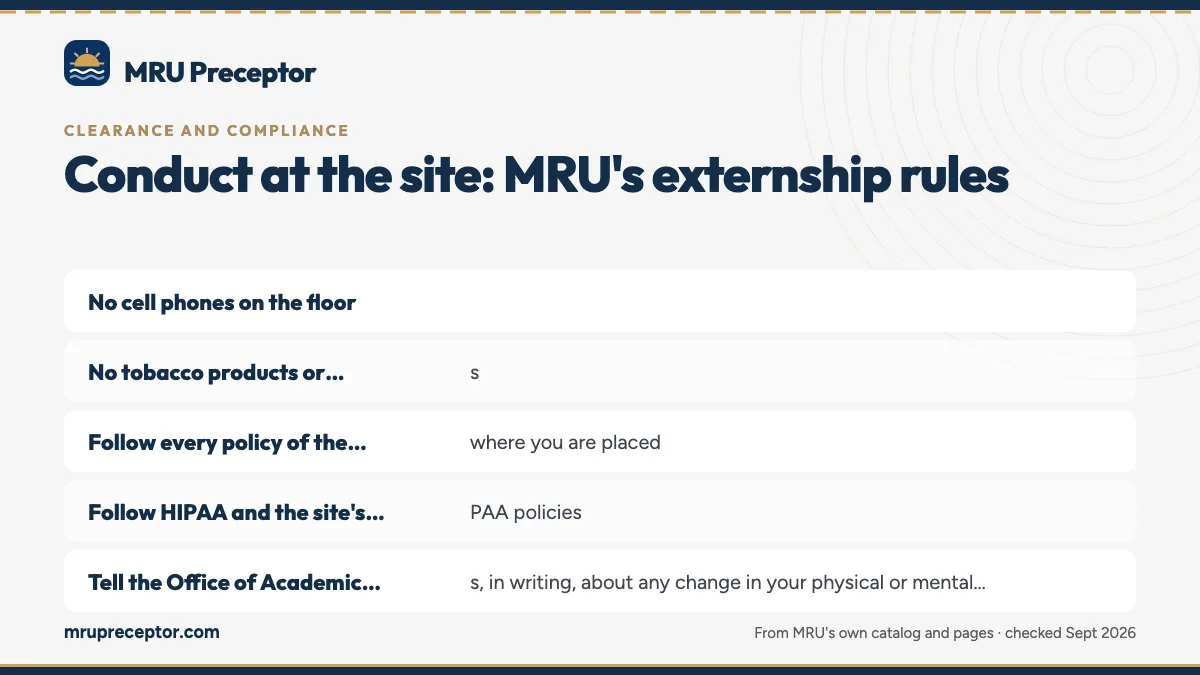
- No cell phones on the floor
- No tobacco products or e-cigarettes
- Follow every policy of the agency where you are placed
- Follow HIPAA and the site's own HIPAA policies
- Tell the Office of Academic Affairs, in writing, about any change in your physical or mental health, within 24 hours or before you next walk into an affiliate agency
The phone rule touches daily habits. If you rely on a phone for drug references or to log encounters, agree with your preceptor on where and when a device is acceptable, and do your Typhon or other log entries away from patient areas.
Agency policies can reach further than MRU's list: dress code, badge rules, parking, where students may chart. Ask for the site's student orientation material on your first day, or before it if you can.
HIPAA and honest documentation
MRU requires students to follow HIPAA and the HIPAA policies of each site. Violations can lead to course failure and dismissal. MRU does not name a HIPAA training vendor in its public documents, so expect training to come from your program or from the site's onboarding.
Your own paperwork is where slips tend to happen. Logs, case lists and write-ups should carry no patient names, dates of birth, record numbers or photos. Keep only what the course asks for, and never photograph a screen or chart.
Honest documentation is a separate rule with the same stakes. Falsified time logs, misrepresented hours or false client-encounter records mean course failure and possible dismissal. Our page on clinical logs and case lists covers what MRU expects you to submit by the course's last day.
Supervision: what the ratio caps mean
The catalog caps supervision ratios. In the MSN-FNP and the post-master's certificate programs, the maximum ratio for indirect clinical supervision is 1:8. In the ASN, BSN and MSN Direct Entry programs, the cap for direct supervision is 1:12. RN-to-BSN clinical courses are described as indirect supervision in a preceptorship model.
In nursing education, indirect supervision generally means faculty oversee your learning without being on the unit, while a preceptor works with you in person. MRU does not publish how often faculty contact you or whether they make site visits. What is public is that a clinical instructor co-signs your end-of-course evaluation along with your preceptor and you.
Your preceptor's role is shaped by the site and by state rules as well as by MRU. Florida's Board of Nursing rule on qualified preceptors, 64B9-4.001(13), casts the preceptor as the person who teaches you, oversees your care and judges your performance at the site. See who can precept an MRU student for the full picture.
If you already work at the site
MRU's NP programs require an active RN license, and training where you already work is tempting. Some South Florida systems limit it. Baptist Health South Florida's student rotation page rules out a rotation at the same facility that employs you. Nicklaus Children's Hospital lets staff rotate, but not in their home department and not during hours they are scheduled to work.
Where it is allowed, keep the two roles apart. Student hours should not overlap paid shifts, and your logs must show only time spent as a student with your approved preceptor. Blurring the two brings you close to the misrepresented-hours rule.
If your workplace is ruled out, the search moves elsewhere, and MRU still has to approve whoever you find. We can look for a preceptor near where you live; send us your course and location.
Questions MRU students ask
Can I choose my own clinical shift at MRU?
For NP tracks, your hours depend on your preceptor's schedule and the site. The catalog leaves externship dates and times to the agencies, and it warns that shifts may land on nights, weekends or holidays. On-campus programs get their schedules from MRU, which can revise them if an agency changes what it offers.
Can I speak Spanish with patients during my externship?
Only if the agency authorizes it in writing. MRU's catalog requires English during externship hours unless the agency gives written permission. If your site wants you to use Spanish or another language with patients, ask for that authorization on paper and keep a copy with your clinical records.
Can I use my phone at my clinical site?
MRU's catalog bars phones on the clinical floor. If you use an app for drug references or logging, agree with your preceptor on where a device may be used, away from patient areas, and follow the site's own device policy as well. When in doubt, leave the phone in your bag.
What happens if I break HIPAA at a clinical site?
MRU treats HIPAA violations seriously: the catalog says they can result in course failure and dismissal. If you think you made a mistake, tell your preceptor and your course faculty promptly, and follow the site's reporting process. Hiding an error usually makes the outcome worse, not better.
Does MRU send faculty to visit my clinical site?
MRU does not publish a site-visit policy, in person or virtual, or a faculty evaluation schedule. What is public is that a clinical instructor signs your end-of-course evaluation along with your preceptor and you. Ask your course faculty in the first week how they will check in with you and your preceptor.
Related pages
Last checked 2026-09-24
We check these pages against MRU's own catalog, addenda and program pages. The nursing student handbook on the MRU student portal and MRU's Office of Academic Affairs have the final word.
MRU says secure your own preceptor. We start the search now.
Tell us your MRU program, where you live and when your next clinical course starts. We look for preceptors who fit the course and help you gather what MRU checks before approving them.
- Preceptors matched to the course: adult primary care for
MSN5700, women's health, pediatrics, psychiatric or acute care - Credentials, license and site details collected before MRU's credential check
- Miami-Dade, Broward and Palm Beach, or wherever in a SARA state you live
Start your placement plan
Program, city and start date is all we need to begin.